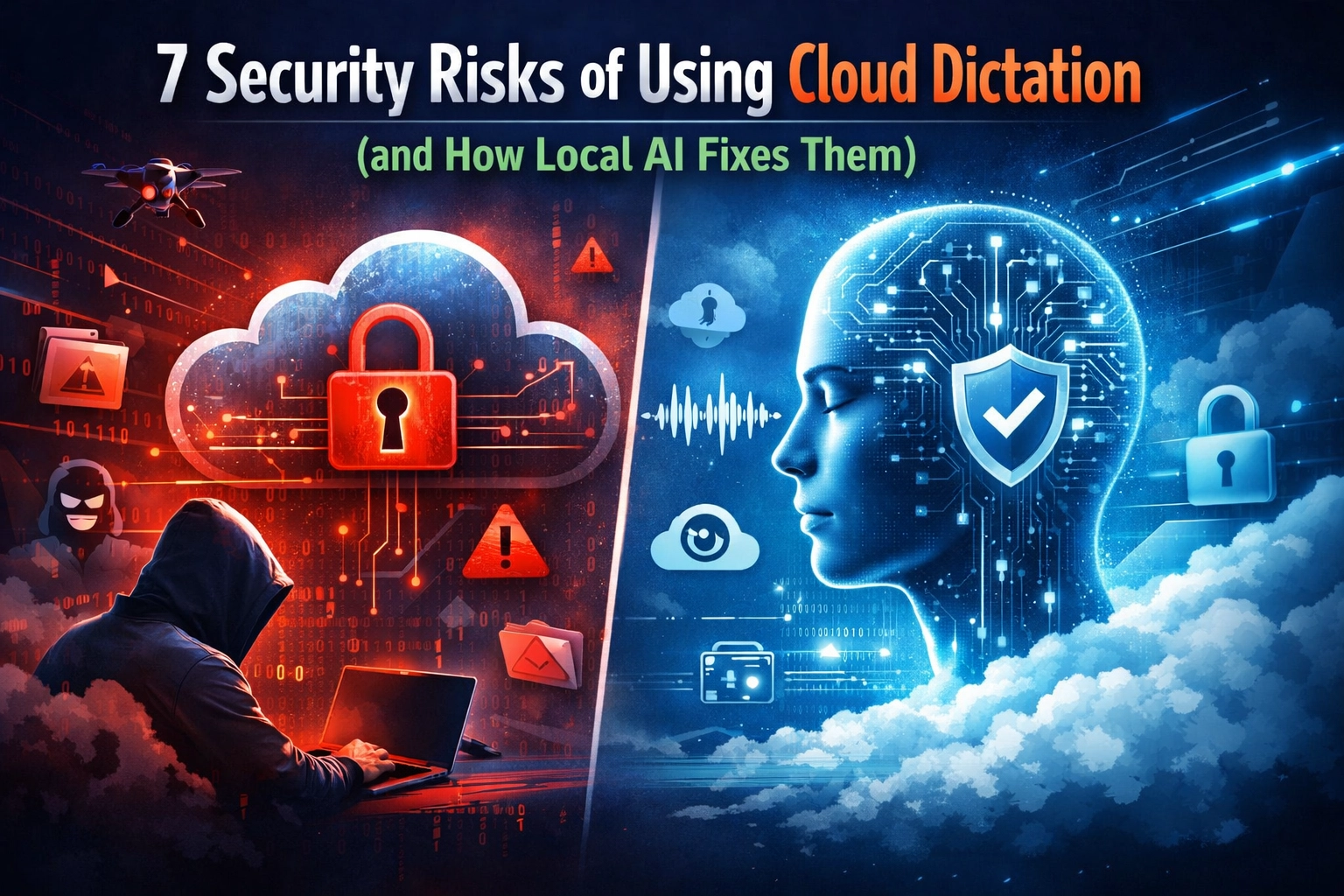
Stop uploading your trade secrets to someone else’s server.
Every time you hit "record" on a cloud-based dictation app, you create a security hole. You aren't just transcribing notes. You are exporting raw intelligence. You are handing over privileged information, proprietary strategies, and sensitive client data to a third party.
For IT and security professionals, this is a nightmare. You spend millions on firewalls, endpoint protection, and zero-trust architecture. Then, a user dictates a confidential memo into a cloud-connected microphone, and your perimeter vanishes.
The era of "rented" intelligence is over. You need local AI. You need air-gapped dictation. You need to own your data.
Here are the seven critical security risks of cloud dictation and the definitive local AI solution.
1. Data Interception: The Transit Trap
Cloud dictation relies on a handshake. Your device records audio. It compresses that audio. It sends it over the internet to a remote server. The server processes it. The text comes back.
Every step in that journey is a vulnerability. Even with TLS encryption, data in transit is data at risk. Unsecured Wi-Fi, man-in-the-middle attacks, and outdated security protocols on older devices create interception points. If the packets leave the building, they are no longer under your control.
The Local AI Fix: No Wire, No Fire.
Local AI dictation happens entirely on the device’s silicon. There is no transmission. No packets move across the network. No remote server is involved. If there is no data leaving the machine, there is nothing for a hacker to intercept. You kill the transit risk instantly.

2. Unintended Automatic Cloud Sync
Cloud tools are designed to be "helpful." They automatically sync files to personal accounts. They back up audio to the "cloud" without asking for permission. They create copies across multiple devices.
This creates unplanned storage of sensitive data. A voice note dictated on a work phone might end up in a personal cloud account because of a shared login or a default setting. You cannot secure what you cannot see.
The Local AI Fix: Ironclad Borders.
Local AI software like VoiceType doesn't have a "cloud" button. It stores data exactly where you tell it to: on the local machine. There is no background syncing to external servers. You maintain a hard border between your corporate data and the public internet.
3. The Third-Party Access Problem
When you use a cloud transcription service, you aren't just trusting one company. You are trusting their sub-processors, their infrastructure providers, and their API partners.
Research shows that over 40% of apps with voice recognition features harbor at least one high-risk security vulnerability. When you grant an app permission to access your microphone and upload audio, you are opening a door. You don't know who else has the key.
The Local AI Fix: Zero-Trust Execution.
Local AI operates within your existing security stack. It doesn't require external API calls. It doesn't need "permissions" to talk to third-party servers. It is a silent, powerful utility that runs behind your firewall. You trust your hardware; you trust your local software. That’s it.
4. Encryption Gaps and Storage Vulnerabilities
Cloud providers promise encryption at rest. But who holds the keys? If the provider holds the keys, the encryption is a suggestion, not a lock.
If a cloud server is misconfigured: a common occurrence in the enterprise world: your transcribed data becomes an open book. We have seen time and again how "secure" cloud buckets are left exposed to the public internet.
The Local AI Fix: Disk-Level Control.
With local AI, you manage the encryption. You use your enterprise-grade BitLocker or FileVault settings. You control the physical and logical access to the drive. There is no "server-side" to be misconfigured. Your security is as strong as your local policy, not as weak as a third-party’s mistake.

5. The Invisible Data Harvest
If the service is cheap (or even if it's expensive), your data is likely being used. Cloud providers often use customer voice data to "improve their models."
This is a form of data harvesting. Your unique voice patterns, your industry-specific jargon, and your confidential names are fed into a machine learning loop. You are effectively paying to train a model that your competitors might eventually use.
The Local AI Fix: Privacy by Design.
Local AI uses pre-trained models that reside on your hard drive. They don't learn from you to benefit others. They don't "call home" to share updates on what you've been saying. You own the input, the process, and the output. It is private, permanent, and personal.
6. Compliance and Legal Violations
For legal, medical, and financial sectors, cloud dictation is a regulatory minefield. HIPAA, GDPR, and attorney-client privilege requirements are strict. Uploading a patient’s record or a witness statement to a public cloud can constitute a breach.
Even if the provider claims compliance, the "shadow copy" problem: where versions of files remain on various servers: can make a full data deletion request impossible to fulfill.
The Local AI Fix: Automated Compliance.
Local AI simplifies the audit trail. Since the data never leaves the device, it remains within your compliant environment. You don't need a Business Associate Agreement (BAA) with a dozen different cloud vendors. You just need a secure laptop.

7. Shadow Copies and Version Sprawl
Cloud dictation creates a mess. You have the raw audio file on the device. You have the auto-transcript on the server. You have the edited version in your browser. You have the exported PDF in your downloads folder.
Every one of these is a potential leak. Unmanaged data versions are the "dark matter" of IT security: they are everywhere, and they are dangerous.
The Local AI Fix: Single Source of Truth.
Local AI streamlines the workflow. You dictate. The text appears. The audio is discarded or stored in one encrypted location. There are no ghost versions floating around in a data center in a different time zone. You keep your digital footprint small and manageable.
Reclaim Your Privacy with VoiceType
The old way of dictating is slow, risky, and annoying. It forces you to choose between productivity and security. It forces you to "rent" the ability to speak to your computer.
The new way is local.
VoiceType brings world-class AI dictation directly to your hardware. No cloud. No accounts. No subscriptions that harvest your data. It is an air-gapped solution for professionals who take security seriously.
Stop uploading.
Start dictating locally.
Reclaim your time and your privacy.
Why IT Professionals are Switching to Local AI:
- Zero Latency: No waiting for a server to respond. The text appears as fast as you speak.
- Total Reliability: Works in basements, on airplanes, and in high-security facilities without internet.
- Predictable Cost: One-time integration or controlled licensing. No fluctuating API costs.
- Absolute Security: The most secure way to process data is to never send it in the first place.

The Bottom Line
If you are an IT or security professional, your job is to reduce the attack surface. Cloud dictation expands it. Local AI shrinks it to a single point.
The choice is direct. You can continue to let your sensitive audio travel across the globe, or you can lock it down on the device where it belongs.
Invest in tools that respect your perimeter. Use VoiceType to turn your voice into a secure, productive asset without the cloud-based liability.
It’s your voice. It’s your data. Keep it that way.
Leave a Reply