Stop talking to strangers.
Every time you hit the microphone icon on a standard cloud-based app, you aren't just transcribing text. You are sending your raw voice, your private thoughts, and your proprietary data to a server you do not own. You are renting intelligence at the cost of your privacy.
Cloud dictation is a black box. You speak. The data travels. Somewhere, in a massive data center, an algorithm, or a human, processes your words. Then, the text comes back. It feels like magic. It is actually a liability.
The "old way" of dictation relies on the cloud. It is slow. It is risky. It is outdated.
The "new way" is local. It is private. It is VoiceType.
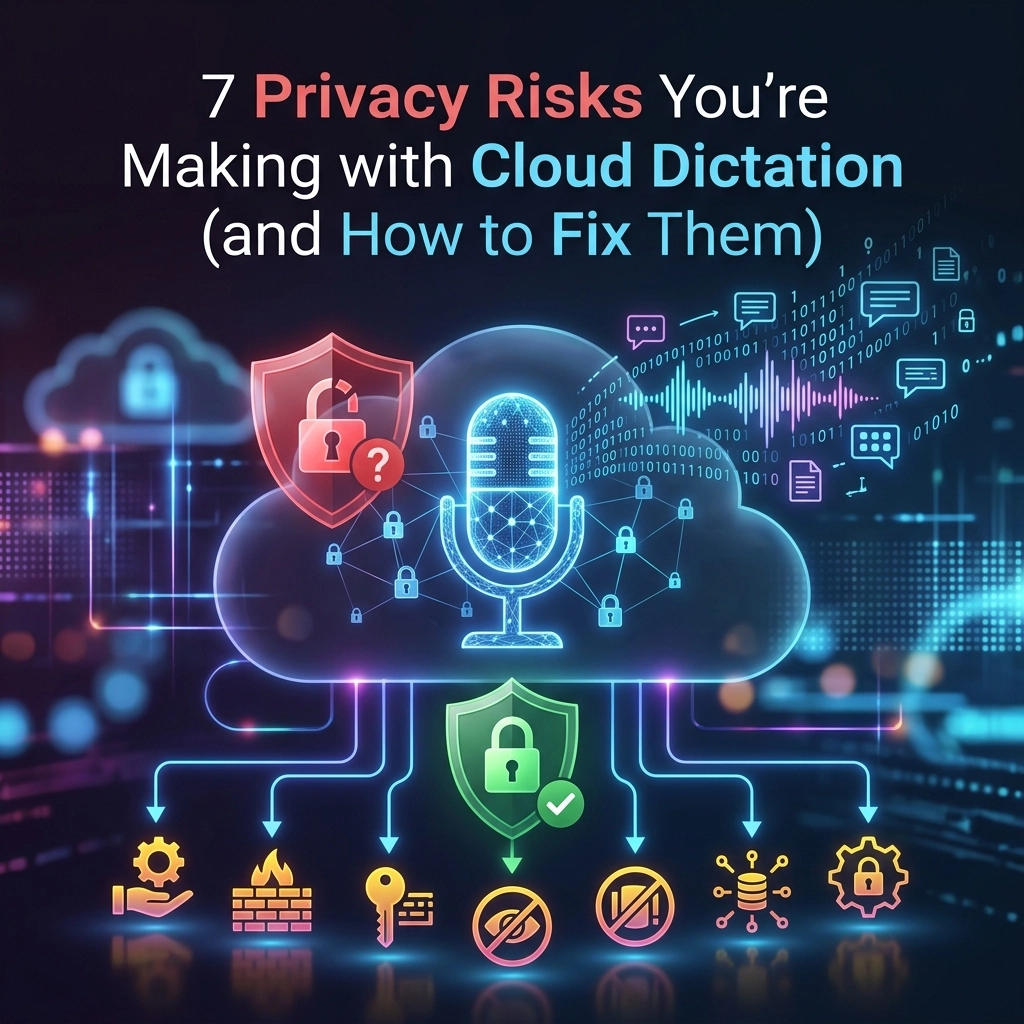
Here are the 7 privacy risks you are taking right now and how to fix them forever.
1. The Human "Quality Control" Trap
Cloud giants have a dirty secret. They use human contractors to "improve" their AI.
In 2019, the world learned that Amazon, Apple, and Facebook were paying thousands of people to listen to voice recordings. These weren't just accidental triggers. They were intentional transcriptions. Contractors heard everything: medical appointments, business deals, and private arguments.
If your voice data leaves your device, you lose control. You cannot know who is listening. You cannot revoke access once the audio is on their server.
The Fix: Go Local.
Use software that processes audio on your machine. VoiceType uses local AI. Your voice stays on your hardware. No humans. No contractors. No leaks.

2. Data Interception in Transit
Encryption is a band-aid, not a cure.
Even if a service claims "end-to-end encryption," your data is still moving. It travels from your device, through your router, across your ISP, and into the cloud provider's network. Every hop is a point of failure. Sophisticated actors can intercept data in transit.
More importantly, the data must be decrypted at the server to be processed by the AI. That is the moment of maximum vulnerability. If the server is compromised, your data is gone.
The Fix: Eliminate the Journey.
The safest way to send data is to not send it at all. Process your speech where it is spoken. VoiceType handles the entire heavy lifting of AI transcription locally on your CPU and GPU. If there is no transit, there is no interception.
3. The "Always Listening" Accidental Trigger
We have all seen it. Your phone lights up. It starts transcribing a conversation you didn't want recorded.
Cloud-based assistants are designed to be "passive listeners." They wait for a wake word. But they fail. They trigger on similar-sounding words. They record background noise. They capture sensitive legal testimony or confidential HR meetings without a single click.
Because these apps are cloud-tied, that accidental recording is immediately uploaded. It is now part of your permanent record in the cloud.
The Fix: Manual, Local Control.
Disable "Hey Siri" or "OK Google." Use a tool that requires intentional activation and stores nothing in a remote database. When you use VoiceType, you decide when the AI listens. If you don't click, it doesn't exist.
4. Metadata and Location Scraping
Dictation apps rarely just want your voice. They want your life.
Most cloud dictation tools request permissions for your location, your contacts, and your browsing history. They claim this helps the AI "get to know you." In reality, it builds a 360-degree profile of your behavior. They link your spoken words to your physical location and the people you know.
This isn't productivity. This is surveillance.
The Fix: Minimalist Permissions.
Audit your app permissions. Deny everything that isn't essential. Or better yet, use a utility that doesn't need to know where you are. VoiceType focuses on one thing: turning your speech into perfect text. It doesn't care about your GPS coordinates.

5. Search Provider Data Leaks
Think about where you dictate. Are you dictating into a search bar? A browser? A social media comment box?
When you use built-in cloud dictation in these fields, your transcribed text is often fed directly into the search provider’s database. Your private queries become part of your advertising ID. Your sensitive business research becomes a data point for a competitor's targeted ads.
You are effectively telling the world’s largest advertising engines exactly what is on your mind.
The Fix: Use an Independent Layer.
Dictate into a secure, local environment first. Then move the text. VoiceType acts as a silent, powerful utility that lives on your desktop. It works across all apps without feeding your data to the "Big Tech" ecosystem.
6. Voice Fingerprinting and Identity Risks
Your voice is a biometric identifier. It is as unique as your fingerprint.
Hackers are no longer just looking for passwords. They are looking for voice patterns. With enough samples of your voice, bad actors can create "Deepfake" audio to bypass voice-activated security at banks or impersonate you in phishing attacks.
By uploading hours of dictation to the cloud, you are handing over the ultimate key to your identity. If that cloud provider suffers a breach, your voice is out there forever. You can change a password. You cannot change your voice.
The Fix: Protect Your Biometrics.
Treat your voice like a master key. Keep it offline. VoiceType ensures your biometric signatures never leave your room. You get the efficiency of AI without the risk of identity theft.

7. The Compliance Nightmare
If you work in Law, Healthcare, or Finance, cloud dictation isn't just risky: it’s potentially illegal.
Regulations like GDPR, HIPAA, and CCPA demand strict control over how data is stored and processed. Most cloud-based dictation tools do not meet these standards by default. A single leaked recording of a patient's history or a client's strategy can result in millions of dollars in fines and the end of your career.
You are responsible for the tools you use. "The AI did it" is not a legal defense.
The Fix: Hardened Compliance through Localization.
The easiest way to comply with privacy laws is to ensure data never leaves your jurisdiction. For professionals, this means on-device processing. VoiceType provides the security professionals need. No data processing agreements. No third-party audits. Just local, secure, and compliant productivity.
The Verdict: Reclaim Your Voice
The old way of dictation is a compromise. You trade your privacy for a bit of convenience. You settle for laggy, server-dependent tools that stop working the moment your internet drops.
Stop settling.
Your thoughts are your most valuable asset. Stop renting them out to cloud providers who see you as a product.
VoiceType is the new standard.
We built VoiceType for the privacy-conscious professional. It is direct. It is fast. It is local. It gives you the power of modern AI without the strings of the cloud.
- No Servers: Everything stays on your machine.
- No Subscriptions to Privacy Loss: Own your tools, own your data.
- No Lag: Local processing is faster than the round-trip to a data center.
Fix your privacy risks today. Move your dictation to where it belongs: with you.
Experience the future of secure productivity.
Visit voicetype.in and take back control.
Leave a Reply