Stop uploading your brain to the cloud.
Every time you hit "record" on a standard dictation app, you are making a choice. You are choosing convenience over security. You are sending your private thoughts, client secrets, and sensitive data to a server you do not own. You are trusting a stranger with your professional reputation.
This is a gamble. The house usually wins.
Cloud-based tools are the industry standard, but they are built on a flawed foundation. They prioritize their data collection over your privacy. They want your audio to train their models. They want your files on their servers. They want control.
If you handle sensitive data: legal briefs, medical notes, corporate strategy: the cloud is a liability. It is a leak waiting to happen.
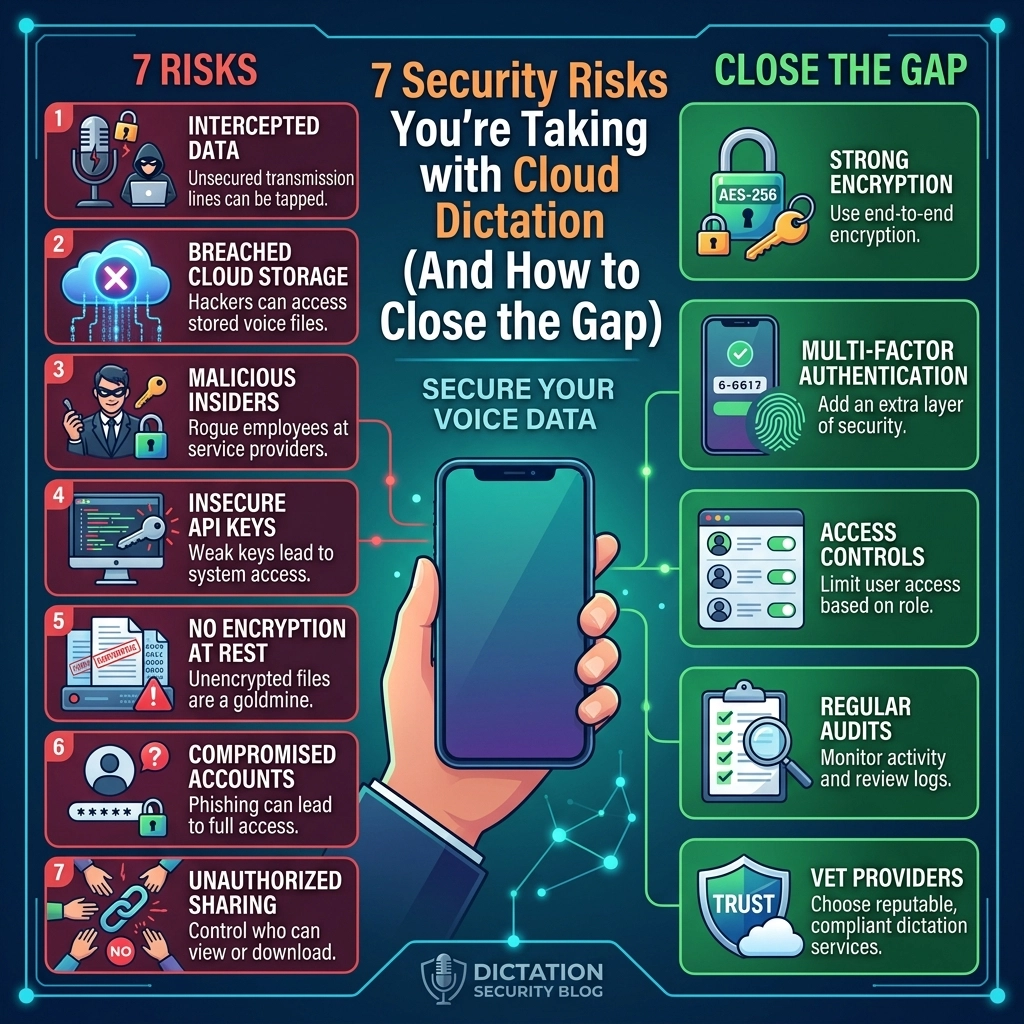
Here are the 7 security risks you are taking right now and the only way to close the gap for good.
1. The Shadow Sync Trap
Cloud dictation apps love to sync. They sync to your phone. They sync to your tablet. They sync to your personal cloud accounts without you ever clicking "Allow."
This creates uncontrolled data exposure. You dictate a sensitive memo in your office. Two minutes later, that audio file is sitting in a personal Dropbox or iCloud account. It is now outside your professional security perimeter. It is sitting on a device your IT department doesn't manage.
The Risk: Your data travels without a passport. It ends up in places you didn't authorize.
The Solution: Stop syncing. Use software that stays on your hard drive. If the data never leaves your computer, it can’t sync to your spouse’s iPad by mistake.

2. The Centralized Server Bullseye
Think of cloud providers as giant digital banks. They store the data of millions of users in one place. This makes them a massive target. Hackers don't want to break into your laptop; they want to break into the server that holds 10,000 laptops’ worth of data.
History is littered with "secure" vendors who suffered catastrophic breaches. In 2019, thousands of hours of medical transcriptions were exposed because of a single misconfigured cloud bucket. One mistake by one engineer at a third-party company can end your career.
The Risk: You are a passenger on a ship you aren't steering. If the ship hits an iceberg, you go down with it.
The Solution: Eliminate the server. If there is no central database of your audio, there is nothing for a hacker to target. Process everything locally. Keep your data invisible.
3. Training the Machine with Your Secrets
Most cloud AI tools are not free. Even if you pay a subscription, you are still the product. Your audio files are used to "improve the algorithm." This is tech-speak for "we are using your private data to train our software."
When you dictate a proprietary trade secret, the AI learns from it. That information is now part of a model owned by a multi-billion dollar corporation. You have effectively donated your intellectual property to a third party.
The Risk: Your "private" notes are being read by an AI to help it get smarter for the next user.
The Solution: Demand 100% offline processing. VoiceType doesn't need to "learn" from you. It works for you. Your data stays on your silicon. No training. No sharing. No exceptions.
4. The Third-Party Handshake
When you use a cloud tool, you aren't just trusting one company. You are trusting their hosting provider. You are trusting their transcription API. You are trusting their analytics partner.
Every time your data moves, it passes through a new set of hands. Every handshake is a point of failure. You have no way of knowing if the sub-contractor in another country has the same security standards as the company you signed up for.
The Risk: The "Security Chain" is only as strong as the weakest sub-processor.
The Solution: Cut the chain. Use a tool that performs the entire transcription process on your local CPU. No handshakes. No middle-men. Just you and your machine.

5. Public Wi-Fi and the Man-in-the-Middle
Cloud tools require an internet connection. This is their leash. If you are a professional on the move, you are often dictated by the availability of Wi-Fi.
Using a cloud-based dictation tool at a coffee shop or an airport is a disaster. It is trivial for a bad actor to intercept data packets moving from your laptop to the cloud. Even with encryption, the metadata alone can tell a story you don't want told.
The Risk: Your "secure" connection is only as safe as the router you're connected to.
The Solution: Go dark. The most secure connection is no connection at all. Work offline. Dictate in the middle of a forest or on a plane with zero bars. True productivity doesn't need a signal.
6. The Ghost Trail of Managed Copies
Cloud dictation creates a trail of digital breadcrumbs. There is the original audio. There is the temporary cache. There is the auto-generated transcript. There is the edited version.
These copies live in your "Downloads" folder, your "Temp" files, and your browser cache. Cloud tools often leave these fragments behind long after you’ve deleted the "main" file. This is a forensic nightmare.
The Risk: Deleting a file on the cloud doesn't mean it’s gone from the internet.
The Solution: Maintain absolute ownership. When you use local-first software, you control the file path. You know exactly where the audio lives and where the text goes. When you delete it, it is actually gone. No ghosts in the machine.
7. The Single Point of Failure: Your Login
Most cloud security boils down to a username and a password. If a bad actor gets your credentials, they have everything. They can download every note you’ve ever dictated. They can see your entire history.
Multi-factor authentication (MFA) helps, but it isn't a silver bullet. Session hijacking and phishing are more sophisticated than ever. The mere existence of a "Login" page means your data is accessible from anywhere in the world.
The Risk: One stolen password gives a stranger the keys to your entire professional life.
The Solution: Physical security. Offline software doesn't have a global login. To get your data, someone has to physically hold your encrypted laptop. This changes the threat model from "Global Hacker" to "Physical Theft," which is much easier to manage.

Closing the Gap: The Offline Revolution
The old way of dictation is broken. It is slow. It is risky. It is invasive. You are forced to "rent" access to your own voice. You are forced to ask permission from a server to turn your speech into text.
There is a better way.
The new way is local. The new way is private. The new way is VoiceType.
We built VoiceType for the professionals who can't afford a "glitch" or a "leak." We built it for the lawyers, the doctors, and the executives who value their autonomy.
Why VoiceType is the only logical choice:
- 100% Offline: We don't have servers for your data. We don't want them. Your audio stays on your device. Always.
- Zero Subscriptions: Stop renting your productivity. Own your tools. One-time ownership for a lifetime of privacy.
- Blazing Speed: Don't wait for "uploading…" or "processing…" bars. Your local hardware is faster than any cloud queue.
- Absolute Privacy: No AI training. No data mining. No third-party handshakes.
Reclaim Your Privacy
Security isn't something you can outsource. It is something you must own.
Stop gambling with your data. Stop trusting the cloud with your secrets. Close the gap between your voice and your screen by keeping the entire process under your roof.
Dictate with confidence. Work without limits.
Take control of your data today at voicetype.in.
Leave a Reply