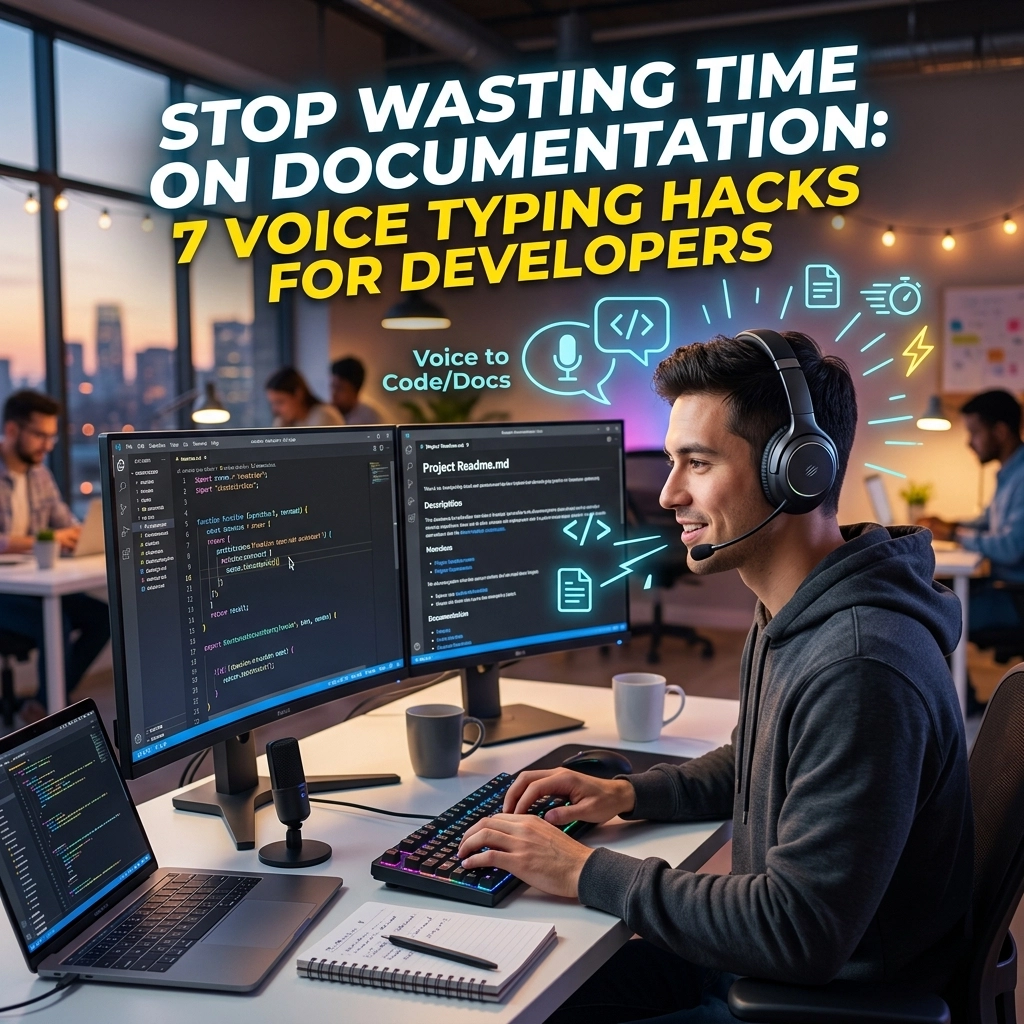
Documentation is the developer’s tax. It is the price you pay for writing code that actually works. It is also the ultimate flow-killer. You spend hours in a deep state of logic, building complex architectures, only to hit a wall when it’s time to explain what you just did.
Typing is the bottleneck. Your brain moves at the speed of light. Your fingers move at the speed of a tractor. By the time you’ve typed out a README or a technical spec, your creative energy is drained. You’re done.
Stop doing that.
Voice typing is no longer a gimmick. It is a precision tool. If you aren't using your voice to document your code, you are working harder than you need to. You are wasting time that could be spent building.
At VoiceType, we see the future of development as hands-free and high-speed. Here are 7 voice typing hacks to help you reclaim your flow and finish your documentation in record time.
1. Talk to Your AI Assistants, Don't Type
Prompt engineering is the new coding. But typing out a 500-word prompt to explain a complex bug or a new feature request is exhausting. Most developers write short, clipped prompts because they are tired of typing. Short prompts lead to bad AI outputs.
Change your approach. Speak to your AI.
When you speak, you naturally provide more context. You explain the "why" and not just the "what." Research shows that voice dictation produces longer, clearer prompts with significantly better first-pass results. Speech preserves your intent. It captures the nuance that gets lost when you’re trying to be brief at a keyboard.
Dump your thoughts into the mic. Let the AI clean up the grammar. You get a perfect technical spec in half the time.

2. Activate Local Processing for Instant Speed
Latency is the enemy of productivity. If you have to wait three seconds for your voice to turn into text, you’ll stop using it. Most default voice-to-text engines rely on the cloud. They are slow. They are unreliable.
Fix this immediately. If you are using a mobile interface or a tablet for quick documentation updates, go into your settings. On Gboard, navigate to "Voice typing" and toggle on "Faster voice typing." This downloads the speech-to-text engine directly to your device.
It works offline. It works instantly. It removes the friction between your thought and the screen. High-speed documentation requires zero lag. Demand it from your tools.
3. Reclaim Your Screen Real Estate
Developers love big monitors for a reason. You need to see your code, your terminal, and your documentation at the same time. On smaller devices or split-screen setups, the on-screen keyboard is a parasite. It eats 40% of your viewable space.
Kill the keyboard.
Use the "Ghost Keyboard" hack. Most modern voice typing interfaces allow you to hide the keyboard entirely while the microphone stays active. You regain that precious screen real estate. Now you can look at your IDE on the top half of the screen and watch your documentation write itself on the bottom half.
Focus on the content. Ignore the keys.

4. Use Voice Commands for Structural Formatting
Documentation without formatting is just a wall of text. No one reads a wall of text. But reaching for the Enter key or typing ### for headers every ten seconds breaks your concentration.
Learn the verbal shortcuts. Say "new line" to move down. Say "new paragraph" to create space. If you need a list, just say it.
- Old way: Type, backspace, shift+enter, type, reach for mouse.
- New way: "Point one. New line. Point two. New line."
It feels robotic at first. Then it feels like a superpower. You stay in the zone. Your hands stay off the peripheral. Your documentation looks professional without you ever touching a formatting bar.
5. Enable Continuous Dictation Mode
The biggest frustration with standard voice typing is the timeout. You pause for three seconds to think about a variable name, and the microphone shuts off. You have to click it again. It’s annoying. It’s a flow-breaker.
Force the mic to stay open. High-end productivity software and specific developer tools allow for continuous dictation. This means the microphone stays live until you tell it to stop.
This is essential for long-form technical writing or explaining complex logic. You can pace around the room. You can look at your notes. You can think. The tool waits for you. It doesn’t demand your constant attention. It becomes a silent partner in your workflow.

6. The "Voice-to-Send" Shortcut for Quick Updates
Not all documentation happens in a .md file. A huge portion of a developer’s "documentation" happens in Slack, Jira, or GitHub comments. These are the quick updates that keep the team moving.
Stop typing "Looks good to me" or "Fixed the header padding issue in the CSS file."
Use the "Send" command. Dictate your update and end with the word "Send." In many integrated environments, this will automatically fire off the message or comment. It’s a zero-click operation. You can update your project manager on your progress while you’re walking to get coffee.
Reclaim those five-minute windows. They add up to hours by the end of the week.
7. Use Verbal Annotations and Emojis
Technical documentation can be dry. Sometimes you need to highlight a warning or flag a section for review. Don't go hunting through an emoji picker.
Say it. "Warning sign emoji" or "Checkmark emoji."
Use these as visual anchors. If you’re dictating a code review, say "Thumbs up emoji" for a job well done. It adds personality and clarity to your communication without the manual overhead. It keeps the energy high. It keeps the focus on the result.

The Problem: Typing is Manual Labor
We treat typing as a core skill, but for a developer, it’s actually a distraction. Your value lies in your logic, your architecture, and your ability to solve problems. Every second you spend worrying about a typo in a README is a second you aren't solving a problem.
The "old way" of documenting is slow, tedious, and prone to procrastination. You tell yourself you’ll write the docs later. "Later" never comes. Or when it does, you’ve forgotten the details.
The Solution: VoiceType
The "new way" is immediate. It is effortless. It is VoiceType.
By moving your documentation to your voice, you remove the physical barrier to entry. You record your thoughts while they are fresh. You preserve your flow state. You get back to the code faster.
We built VoiceType to be a silent, powerful utility. It works behind the scenes. It doesn't need constant attention. It just works.
Reclaim Your Productivity
You didn't become a developer to spend four hours a day in a markdown editor. You became a developer to build things that matter.
Documentation is necessary, but it shouldn't be painful. These seven hacks aren't just about saving a few minutes. They are about changing your relationship with your work. They are about reclaiming your time and your mental energy.
Stop typing. Start speaking. Get more done.

Hard Truths About Developer Documentation
- Documentation is never "finished." It’s a living entity. If you make it hard to update, it will die. Voice typing makes it easy to keep things current.
- Your team doesn't want your prose. They want your information. Speech-to-text forces you to be direct and clear.
- Privacy matters. Use tools that offer local processing to ensure your proprietary code explanations stay on your machine.
- The bottleneck is you. Your tools are fast. Your internet is fast. Your typing is slow. Remove the bottleneck.
The shift to voice is happening. You can either be at the forefront of the productivity curve or you can keep grinding away at a QWERTY keyboard like it's 1995. The choice is yours.
Try it for one hour today. Dictate one pull request description. Use one voice-formatted list. You won't go back.
Your flow state is waiting. Claim it at voicetype.in.
Leave a Reply