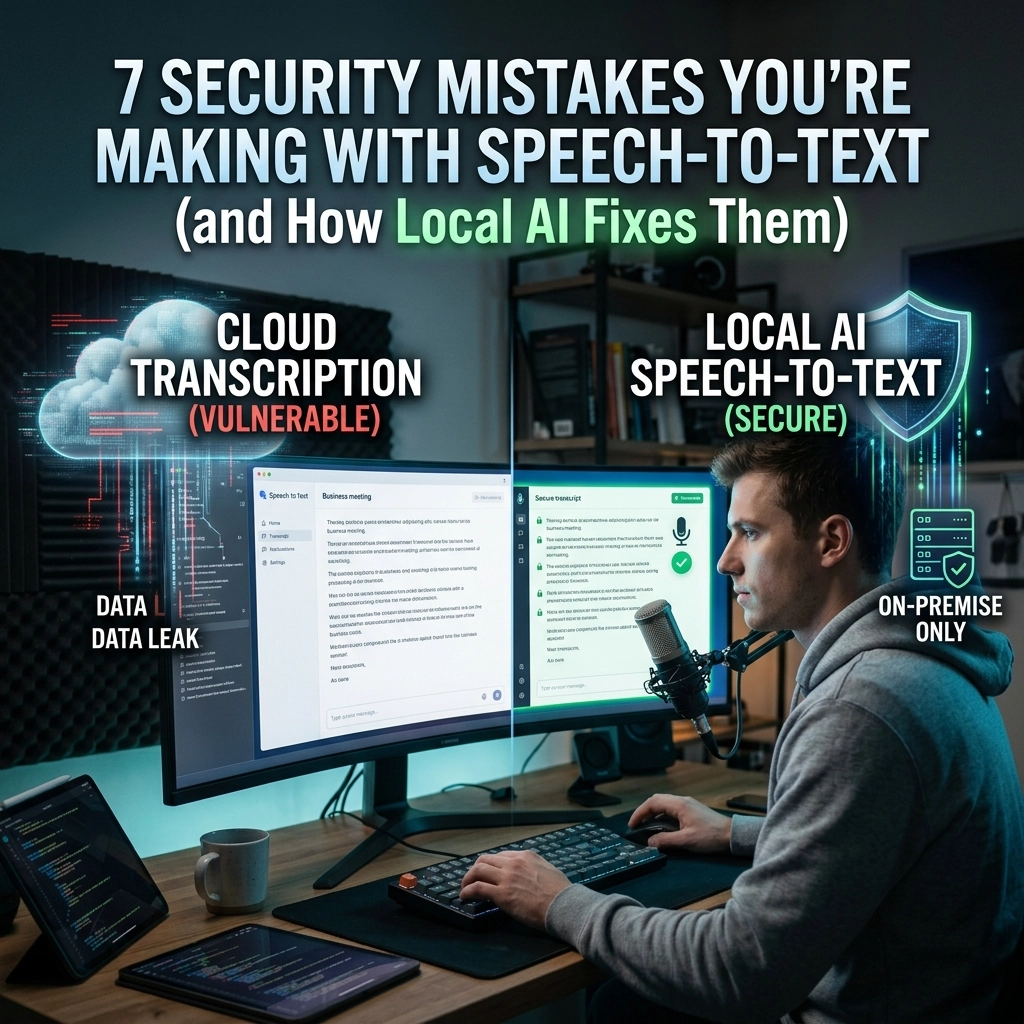
Stop talking to the cloud.
Every time you use a standard speech-to-text app, you are rolling the dice. You think you are just transcribing a meeting or drafting an email. You aren't. You are broadcasting your trade secrets, your client data, and your private thoughts to a server you don't own, managed by people you don't know, in a country you don't live in.
The "old way" of transcription is a security disaster waiting to happen. It relies on the cloud. The cloud is just someone else’s computer. And that computer is a target.
At VoiceType, we see the aftermath of these mistakes every day. Executives losing competitive advantages because a transcript leaked. Healthcare providers facing massive fines because a cloud server was misconfigured.
It ends now. Here are the seven security mistakes you are making right now: and how local AI fixes them forever.
1. You Are Sending Data Across Borders
When you hit "record" on a cloud-based AI, your voice is digitized and sent to a data center. Most of the time, you have no idea where that data center is. It could be in Virginia. It could be in Frankfurt. It could be in a jurisdiction with zero privacy laws.
Data in transit is data at risk. Interception happens. State actors monitor traffic. Large-scale breaches happen before the data even reaches the server.
The Local Fix: Stop moving the data. VoiceType processes everything on your device. Your voice never leaves your hardware. No transit means no interception. You keep your data where it belongs: with you.
2. You Signed Away Your Right to Privacy
Read the fine print. Most "free" or subscription-based speech-to-text services include a clause that allows them to use your data to "improve their models."
This is a polite way of saying they are using your private conversations to train their AI. Your proprietary business strategy is becoming part of a global dataset. You are paying them to take your intellectual property.
The Local Fix: Local AI doesn't need to "call home" to learn. VoiceType doesn't feed on your data. It works for you, not the other way around. You own the model, you own the input, and you own the output.

3. You Are Trusting "Anonymization" (Which Is a Lie)
Cloud companies claim they anonymize your voice data before their human reviewers listen to it. Research proves this is impossible. Voice is a biometric identifier. Your speech patterns, your accent, and the context of your conversation can identify you with terrifying accuracy.
When a "human-in-the-loop" reviews your transcript to fix an error, they are hearing you. They are hearing your secrets.
The Local Fix: Eliminate the middleman. With local AI, there are no human reviewers. No one is "checking" your transcripts in a cubicle halfway across the world. The only eyes on your text are yours.
4. You Are Vulnerable to Multi-Tenant Leaks
Cloud platforms are "multi-tenant." This means your data sits on the same server as thousands of other companies. If one of those companies gets hacked, or if the server’s "walls" are thin, your data is exposed.
It only takes one misconfigured AWS bucket to leak 7,000 hours of sensitive data. This isn't a theory; it has happened. Repeatedly.
The Local Fix: Physical isolation. Your computer is your vault. By using VoiceType, you move your transcription into a "single-tenant" environment: your own. To get your data, a hacker would need to physically take your machine.
5. You Are Dependent on Public Wi-Fi
If you are transcribing on the go, you are likely using public Wi-Fi or cellular networks. Cloud AI requires a constant, high-bandwidth connection. Every packet of voice data sent over a coffee shop’s Wi-Fi is a gift to a man-in-the-middle attacker.
You are literally broadcasting your internal memos into the air for anyone with a $20 antenna to catch.
The Local Fix: Go offline. VoiceType doesn't need the internet. You can be on a plane, in a basement, or in a high-security "SCIF" with zero connectivity. The AI still works. No connection means no leak.

6. You Are Creating a Permanent Digital Trail
Cloud services keep logs. They keep backups. They keep archives. Even if you "delete" a transcript, it often lives on in a backup server for 30, 60, or 90 days. That is a 90-day window for a subpoena or a hack to expose you.
You are building a library of your own vulnerabilities.
The Local Fix: Instant control. When you delete a file on your local machine using VoiceType, it's gone. You control the retention policy. You control the backups. You decide the lifespan of your data.
7. You Are Sacrificing Speed for Risk
The "Old Way" is slow because it’s round-trip.
- Record voice.
- Compress data.
- Send to cloud.
- Process on server.
- Send back to device.
This lag isn't just annoying; it’s a security gap. Every second that data is out of your hands is a second you don't control it.
The Local Fix: Zero latency. Local AI is faster because the distance between the "brain" and the "mouth" is measured in millimeters, not miles. VoiceType gives you instant results with zero exposure.

Reclaim Your Privacy with VoiceType
The world is moving toward "Privacy First." The era of blindly trusting Big Tech with your voice is over. You wouldn't hand a stranger your unlocked phone; why would you hand them your voice?
Privacy isn't a feature. It is a fundamental requirement.
VoiceType was built for the professional who cannot afford a leak. We built it for the lawyer, the doctor, the CEO, and the researcher. We built it for you.
Why VoiceType is the Only Choice:
- 100% Local Processing: Your data never leaves your device. Period.
- No Internet Required: Transcribe anywhere, anytime, with total stealth.
- One-Time Ownership: Stop renting your privacy. Own your tools.
- Direct Efficiency: No lag, no waiting, no "server is down" excuses.
Stop being a data point for someone else's profit. Reclaim your time. Reclaim your secrets. Reclaim your productivity.
It is time to make the switch to local AI. It is time for VoiceType.
Visit voicetype.in and take control of your data today.
The cloud is leaking. Get indoors.
Leave a Reply