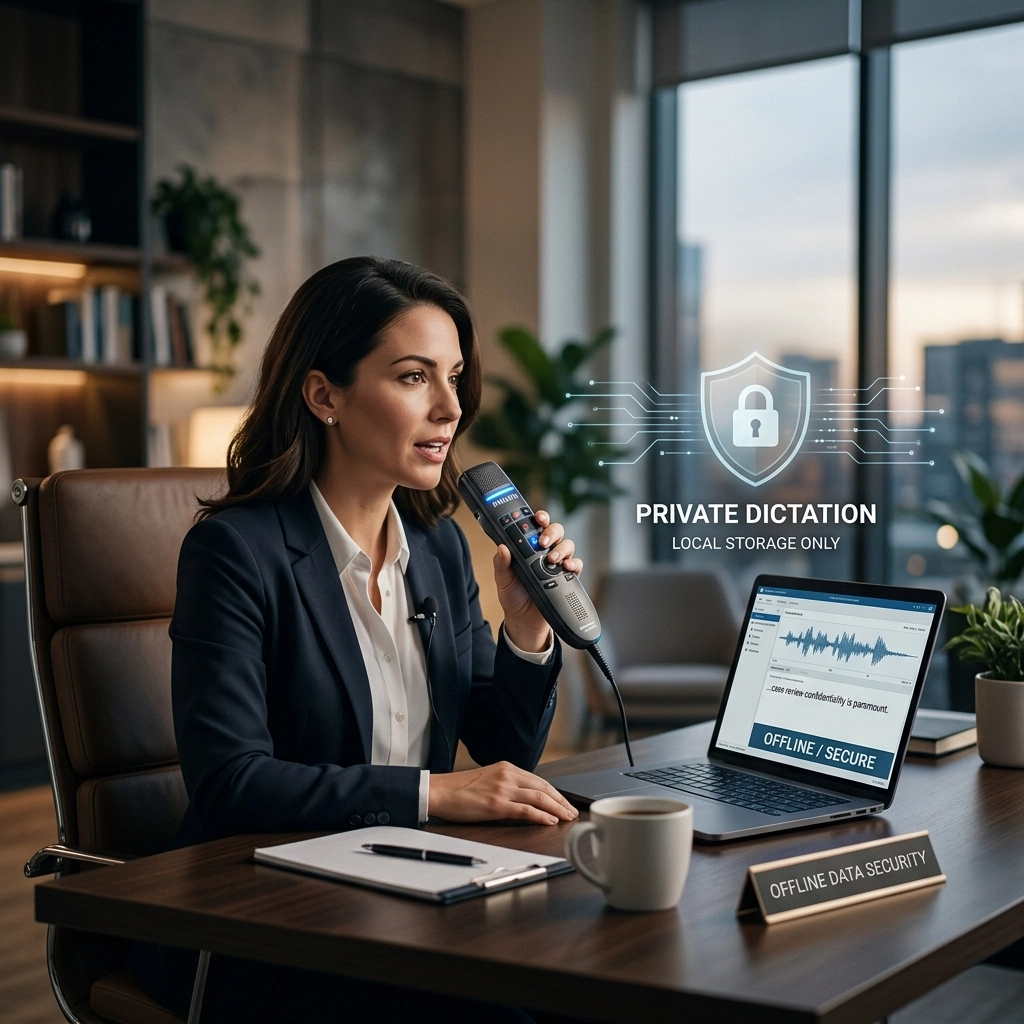
Stop talking to the cloud. It is listening.
Every time you hit the dictation button on a standard mobile app or a browser-based tool, you are making a choice. You are choosing to send your private thoughts, your client's secrets, and your company’s intellectual property to a remote server. You are trusting a third party to guard your voice.
In 2026, that trust is a liability.
Professionals in law, medicine, and executive leadership are hitting the "delete" button on cloud-based dictation. They are moving to local AI. They are choosing privacy. They are switching to VoiceType.
This isn't just a trend. It is a mass migration toward security.
The Invisible Threat of the Cloud
Cloud-based dictation is convenient. It is also a sieve.
When you speak into a cloud-connected microphone, your audio travels across the public internet. It lands on a server owned by a tech giant. There, it is transcribed. Sometimes, it is reviewed by human contractors to "improve the algorithm." Often, it is stored indefinitely.
Think about your last dictation. Was it a confidential legal strategy? Was it a sensitive medical diagnosis? Was it a pre-release product roadmap?
If you used a cloud tool, that data is no longer yours. It lives on a server you do not control. It is subject to subpoenas. It is vulnerable to data breaches. It is a target for hackers who know that voice data is a goldmine of corporate secrets.

Why "Anonymized" Data is a Myth
Big Tech loves the word "anonymized." They tell you your data is safe because your name isn't attached to the file.
They are lying.
Voiceprints are as unique as fingerprints. AI can identify a speaker with startling accuracy based on pitch, cadence, and vocabulary. Even if your name is stripped from the text, the content of your dictation likely contains enough context to identify you, your firm, or your clients.
When your data is in the cloud, you lose the "Right to be Forgotten." You lose control. You become a data point in a machine learning model.
At VoiceType, we believe your voice belongs to you. Period.
The Local AI Revolution: Privacy by Default
The alternative is simple: Local AI.
Modern computers are powerful. Your laptop has more processing power than the servers that powered the early internet. There is no technical reason to send your voice to the cloud for transcription.
VoiceType runs entirely on your machine. The AI engine lives on your hard drive. The processing happens in your RAM. The text is generated locally.
The result? Your data never leaves your device.
No Internet? No Problem.
Cloud dictation fails the moment your Wi-Fi drops. You are stuck in a "Connecting…" loop while your ideas vanish.
Offline private dictation software doesn't care about your signal strength. Work from an airplane. Work from a secure basement office. Work from a remote cabin. VoiceType works wherever you do.
This isn't just about privacy; it is about reliability. Professionals cannot afford to wait for a server to respond. You need your words on the screen now.

The High Cost of "Free" Software
If the software is free, you are the product.
Free dictation tools are funded by data. They harvest your speech patterns, your common phrases, and your professional interests. They use this information to build profiles for targeted advertising or to train proprietary models they then sell back to you.
You are paying for "free" tools with your privacy.
Professional-grade tools like VoiceType operate on a different model. We don't want your data. We don't want your voiceprints. We want to provide a utility that makes you faster and more secure.
Stop renting your productivity from companies that exploit your data. Own your tools.
Who is Making the Switch?
The shift to offline dictation is led by those with the most to lose.
1. Legal Professionals
Attorneys handle the most sensitive information on the planet. A leak of attorney-client privileged communication is a career-ending event. Using cloud dictation for case notes or witness summaries is a gamble. Local AI removes the risk. It keeps the privilege where it belongs: between the lawyer and the client.
2. Healthcare Providers
Patient privacy is non-negotiable. While many cloud providers claim compliance with regulations, the simplest way to stay compliant is to never let the data leave the room. Local dictation ensures that patient notes stay on encrypted, hospital-managed devices.
3. C-Suite Executives
Mergers, acquisitions, and internal restructuring are discussed in private long before they are public. An executive dictating a memo about a secret deal into a cloud app is creating a massive security hole. Offline software seals that hole.
4. Researchers and Engineers
When you are working on the next breakthrough, you don't want your proprietary ideas sitting on a third-party server. Protect your intellectual property by keeping your brainstorms local.

Speed: The Unexpected Benefit of Privacy
There is a common misconception that local AI is slower than the cloud.
The opposite is true.
Cloud dictation suffers from latency. Your audio has to travel to the server, wait in a queue, get processed, and travel back. Even on a fast connection, there is a delay.
VoiceType is instant. Because the AI is sitting directly on your processor, the words appear as fast as you speak them. There is no lag. There is no "thinking" animation. There is only output.
When you eliminate the round-trip to the cloud, you reclaim your flow state. You stop waiting for the machine and start working with it.
How to Reclaim Your Privacy Today
Switching to offline dictation is not a complex technical hurdle. It is a simple software choice.
- Audit your current tools. Look at your dictation apps. Do they require an internet connection? Do they have a "Privacy Policy" that mentions data sharing for "research purposes"? If so, they are a risk.
- Move to Local AI. Download software that processes data on-device.
- Disable cloud sync. Ensure your local files stay local.
Check out our sitemap to see how we are building a suite of tools designed for the privacy-conscious professional.

The Direct Choice
The era of "Cloud First" is ending. The era of "Privacy First" is here.
You wouldn't leave your physical files on a park bench for anyone to read. Don't leave your voice data on a cloud server for any company to harvest.
Choose the software that respects your boundaries. Choose the tool that works as hard as you do. Choose the security of local AI.
VoiceType isn't just about productivity. It’s about peace of mind.
Stop being a data source. Start being a user.
Your words are your power. Keep them yours.
Ready to secure your workflow?
Visit VoiceType and see how private dictation changes everything. No leaks. No lag. No compromises. Just your voice, your text, and your privacy.
Take back control. The switch is easy. The security is permanent.
Leave a Reply