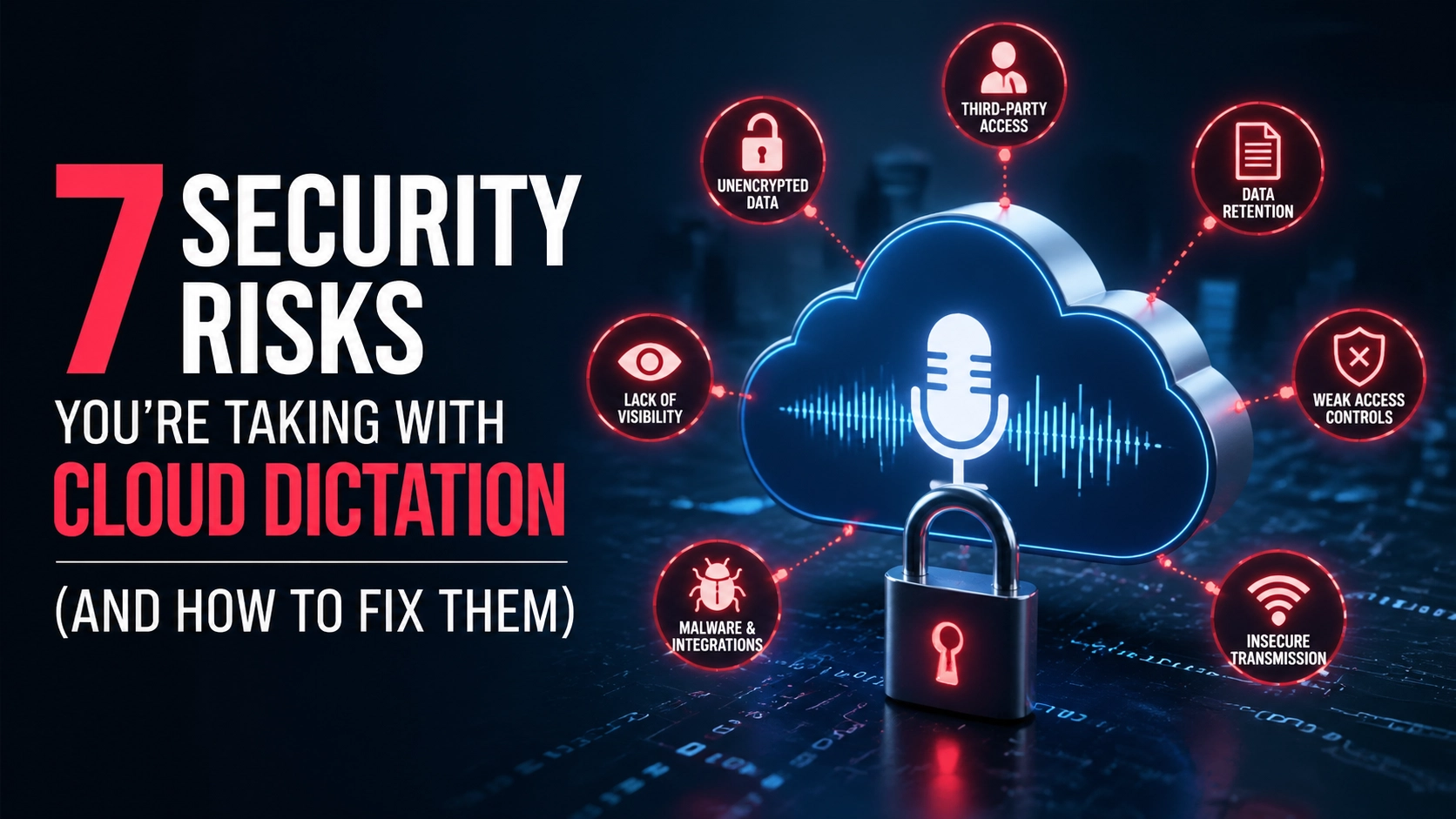
Stop talking to strangers. Every time you use a cloud-based dictation tool, you are doing exactly that. You are handing over your company’s internal strategies, client secrets, and proprietary data to a server you do not own. You are trusting a third party with your voice.
Cloud tools are convenient. They are also leaky. For IT and Security professionals, "convenient" is often a synonym for "vulnerable." If your team is dictating memos, emails, or code notes into a cloud-connected interface, you have a massive hole in your perimeter.
It is time to close it. Here are the seven security risks you are taking right now and how to fix them with local, air-gapped AI.
1. The Data Transit Trap
Encryption is a shield, not a suit of armor. Most cloud dictation services boast about "encryption in transit." This sounds safe. It isn't enough. When you speak into a cloud-connected microphone, your voice is digitized and sent across the open internet.
Intermediate servers handle these packets. Even with TLS, metadata remains visible. Attackers can see who is talking to which service and for how long. More importantly, encryption in transit only protects the data while it moves. Once it hits the provider’s server, it is decrypted for processing. This is the moment of maximum risk.
The Fix: Eliminate the transit. Use local AI dictation that processes audio on the device's hardware. If the data never leaves the machine, it never enters the trap.
2. The Model Training Parasite
Your data is their fuel. Many cloud AI providers use your inputs to "improve their models." This is a polite way of saying they are feeding your intellectual property into their machine learning algorithms.
Imagine dictating a breakthrough patent idea. The cloud tool processes it. The engine learns the patterns. Suddenly, your proprietary logic is part of a global model that your competitors might eventually use. You are paying a subscription to give away your competitive advantage. You are subsidizing your own obsolescence.
The Fix: Demand air-gapped AI. Use tools that do not "phone home" to update models or share data. Your dictation should remain your property, not a training set for a multi-billion-dollar corporation.

3. The "Third-Party" Black Box
Who really sees your transcripts? Most cloud services rely on a chain of sub-processors. One company provides the interface. Another provides the transcription engine. A third handles the cloud storage.
Every link in this chain is a potential point of failure. You might trust the primary vendor, but do you trust their database provider? Do you trust their offshore support team? In a cloud environment, your data lives in a black box. You have no visibility into who has access to the logs, the raw audio files, or the final text.
The Fix: Run the software on your own infrastructure. Move the processing to the edge. When the AI lives on the local CPU or GPU, you control the access logs. You own the box.
4. Regulatory Drift and Compliance Nightmares
Compliance is not static. GDPR, HIPAA, and SOC2 requirements change. Cloud providers often move data across borders to optimize server load. If your dictation containing sensitive PII (Personally Identifiable Information) moves from a server in Berlin to one in Virginia, you may be in breach of local laws instantly.
Managing data sovereignty in the cloud is a full-time job. It requires constant auditing and legal oversight. One small change in a provider’s Terms of Service can turn your workflow into a liability.
The Fix: Hard-code your compliance by keeping data local. If data stays on the user's workstation or a secured local network, it never crosses a geographic border. You stay compliant by default, not by effort.
5. The Permanent Record Problem
Cloud data never truly dies. Even if you hit "delete," traces remain in backups, cache folders, and server logs. For legal and security teams, this "permanent record" is a ticking time bomb.
If your company is ever involved in discovery or an audit, cloud providers can be subpoenaed directly. You might not even know your data has been handed over until it is too used against you. By storing your dictation in the cloud, you are creating a searchable, permanent archive of every spoken thought your employees have ever recorded.
The Fix: Implement ephemeral processing. Local AI tools can process voice to text and then immediately purge the audio buffer from the RAM. No cloud storage means no permanent record for hackers or lawyers to find.

6. The Subscription Kill Switch
You are renting your productivity. Cloud tools require a constant connection and a valid credit card. If the provider’s servers go down, your team stops working. If the provider decides to hike prices or shut down a feature, you have no recourse.
For IT professionals, this is a massive operational risk. You are building workflows on top of a foundation you don't control. High latency or a bad Wi-Fi connection turns a high-end laptop into a paperweight. Your dictation speed is limited by your upload bandwidth, not your hardware’s power.
The Fix: Buy, don't rent. Deploy local software that works offline. Ensure your team can dictate at the speed of thought, even in an elevator, on a plane, or in a high-security facility with no internet access.
7. Shadow IT and Credential Leaks
Cloud dictation is a magnet for Shadow IT. If you don't provide a secure, local alternative, employees will find their own "free" cloud tools. They will use personal accounts to dictate confidential work notes.
These personal accounts rarely have the same security rigor as corporate systems. They lack MFA. They use weak passwords. Once those credentials leak in a standard third-party breach, your corporate data is exposed. You cannot secure what you cannot see, and you cannot see what your employees are uploading to the public cloud.
The Fix: Provide a superior local alternative. Give your team a tool like VoiceType that is faster and more reliable than cloud alternatives. When the secure option is also the fastest option, Shadow IT disappears.
The New Standard: Air-Gapped Productivity
The "old way" of dictation was a privacy disaster. You spoke, the cloud listened, and you hoped for the best. That era is over. Security-conscious organizations are moving back to the edge.
Running AI locally is no longer a performance compromise. Modern hardware can handle complex speech-to-text models in real-time without ever sending a single bit of data to the internet.
At VoiceType, we believe your voice should stay your own. We build tools that prioritize the "local-first" philosophy. No accounts. No cloud. No tracking. Just pure, direct productivity that respects the boundaries of your enterprise.
Take Back Control
Stop being a tenant in someone else's cloud. Reclaim your privacy. Secure your intellectual property.
- Audit your current tools. Find out where your audio data goes.
- Read the fine print. Check if your providers use your data for model training.
- Switch to local. Deploy air-gapped AI dictation across your fleet.
The risks of cloud dictation are real, but the solution is simple. Keep your data where it belongs: with you.
For more information on how to deploy local AI for your team, visit our sitemap or explore the VoiceType homepage.
Efficiency shouldn't cost you your security. It’s time to speak freely again.
Leave a Reply