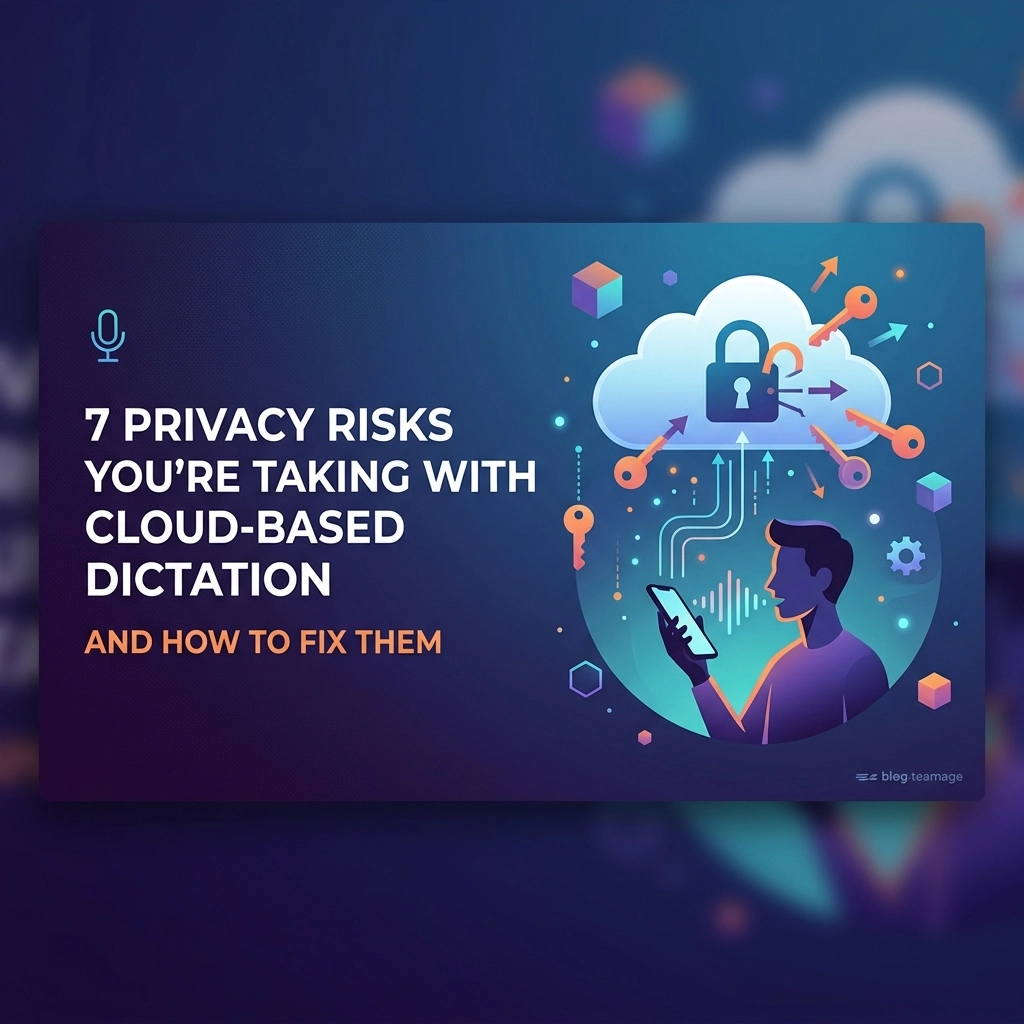
Stop talking to strangers.
Every time you use a cloud-based dictation tool, you are handing over your most personal asset: your voice. You think you are just "typing with your voice." You think it’s a productivity hack. It isn't. It’s a massive security hole.
When you speak into a cloud-connected microphone, your words don't just stay on your screen. They travel. They pass through your router, your ISP, and dozens of data centers before landing on a server owned by a corporation you’ve never met.
At VoiceType, we see this for what it is: a liability. Your ideas are your intellectual property. Your client conversations are confidential. Your internal memos are trade secrets. Why are you broadcasting them to the cloud?
Here are the seven privacy risks you are taking right now: and the exact steps you need to take to fix them.
1. Your Voice is a Biometric Fingerprint
Your voice is not just audio. It is data. It contains your pitch, your cadence, and your unique vocal signature. Unlike a password, you cannot change your voice if it gets stolen.
Cloud providers store your audio to "improve their models." In reality, they are building a database of biometric identifiers. If a hacker breaches that server, they don’t just get your text. They get the ability to synthesize your voice. They get the keys to your biometric identity.
The Fix: Use on-device processing. If the audio never leaves your machine, the biometric data never leaves your room.
2. The "Hot Mic" and Unintended Captures
Cloud dictation apps are notoriously "leaky." They listen for wake words. They wait for triggers. Often, they trigger by mistake.
Studies show that smart assistants and cloud-based dictation tools capture audio they were never meant to hear. A conversation with your spouse, a confidential meeting with a partner, or a sensitive legal discussion: all recorded and sent to the cloud because a software algorithm made a mistake. This isn't a glitch; it's a fundamental flaw in cloud architecture.

3. The Transmission Breach Surface
Data at rest is one thing. Data in motion is another. Even with encryption, the path from your device to the cloud is a breach surface.
Your audio passes through multiple layers of infrastructure. ISPs log traffic. Proxies intercept data. Misconfigured switches leak packets. Every hop is a chance for your data to be intercepted. Even "secure" tunnels have vulnerabilities. The only way to win this game is to not play. Stop sending the data.
The Fix: Cut the cord. Disconnect your dictation from the internet. If an app requires a connection to transcribe, it is a risk you shouldn't take.
4. The Hidden Subprocessor Chain
You might trust the brand on the box, but do you trust their partners?
Most cloud dictation startups don't build their own AI. They rent it. They send your audio to third-party LLM providers or specialized speech-to-text APIs. Your data isn't just with "App X." It’s with "App X," their cloud host, their AI provider, and their analytics partner.
You have no idea who is actually looking at your transcripts. You have no control over how these third parties store, use, or sell your data.
5. Policy is Not a Lock
"We value your privacy." Every company says it. None of them mean it the way you do.
Privacy policies are legal documents, not physical barriers. They can be changed with 30 days' notice. A "zero retention" policy today can become a "data-sharing" policy tomorrow. If a company owns your data on their servers, they hold the power. You are just renting their permission to access it.
The Fix: Trust physics, not policies. Local AI like VoiceType uses your hardware to do the work. The data stays on your disk. No policy change can reach into your computer and steal your files.

6. Acquisition Risk: Your Data is an Asset
Small, privacy-focused startups get bought by big, data-hungry giants every single day.
When a company is acquired, their assets move to the new owner. Those assets include your voice recordings and your transcripts. We’ve seen this happen with major dictation players. A tool you trusted five years ago is now owned by a corporation that builds its entire business model on advertising and data mining.
Your privacy shouldn't be part of someone else's exit strategy.
7. Legal Compulsion and the "Cloud Act"
If your data is on a server, it can be subpoenaed.
Governments and law enforcement agencies can compel cloud providers to hand over data without you ever knowing. National security letters and secret warrants can bypass your consent entirely. If the data exists on a third-party server, it is subject to the laws of the land where that server sits.
On-device processing removes this vector. There is no central server to subpoena. There is no corporate office to raid for your files. Your data is in your hands, where it belongs.
How to Reclaim Your Privacy
You don't have to sacrifice speed for security. You don't have to choose between productivity and privacy. The technology has changed. The "Cloud Era" of AI is ending, and the "Edge Era" is beginning.
The Airplane Mode Test
Want to know if your dictation tool is lying to you? Use the Airplane Mode Test.
- Open your dictation app.
- Turn off your Wi-Fi and Cellular data.
- Try to dictate a sentence.
If the app fails, it’s a cloud tool. It’s a risk. It’s sending your voice to someone else's computer. If it works perfectly, it’s local. VoiceType passes this test every single time.

Own the Machine, Own the Data
Stop renting your intelligence. Cloud-based AI is a subscription to a risk. Local AI is an investment in an asset.
When you use local AI, you are using the power of your own hardware: your Mac or PC: to process your voice. This is faster. It is more reliable. And most importantly, it is private by design.
Imperatives for a Secure Workflow:
- Demand Local: Only use tools that process audio on-device.
- Audit your Permissions: Check which apps have microphone access and revoke them for anything that uses the cloud.
- Encrypt the Output: Even local transcripts should be stored in encrypted folders.
- Verify the Vendor: Look for companies that prioritize "Privacy by Architecture" rather than "Privacy by Policy."
The VoiceType Difference
We built VoiceType because we were tired of the "Privacy vs. Power" trade-off.
We don't want your data. We don't want your audio. We don't even want your transcripts. Our software turns your speech into text using the silicon already inside your computer. It’s direct. It’s blunt. It’s secure.
No cloud. No leaks. No excuses.
Stop compromising. Your voice is yours. Keep it that way.
Take Action Now
- Uninstall cloud-only dictation tools that handle sensitive info.
- Switch to a local-first workflow.
- Reclaim your peace of mind.
Explore how we do it at VoiceType. See the full breakdown of our security model on our sitemap.
Privacy isn't a feature. It’s a right. Stop letting cloud companies tell you otherwise. Stay local. Stay secure. Stay productive.
Leave a Reply