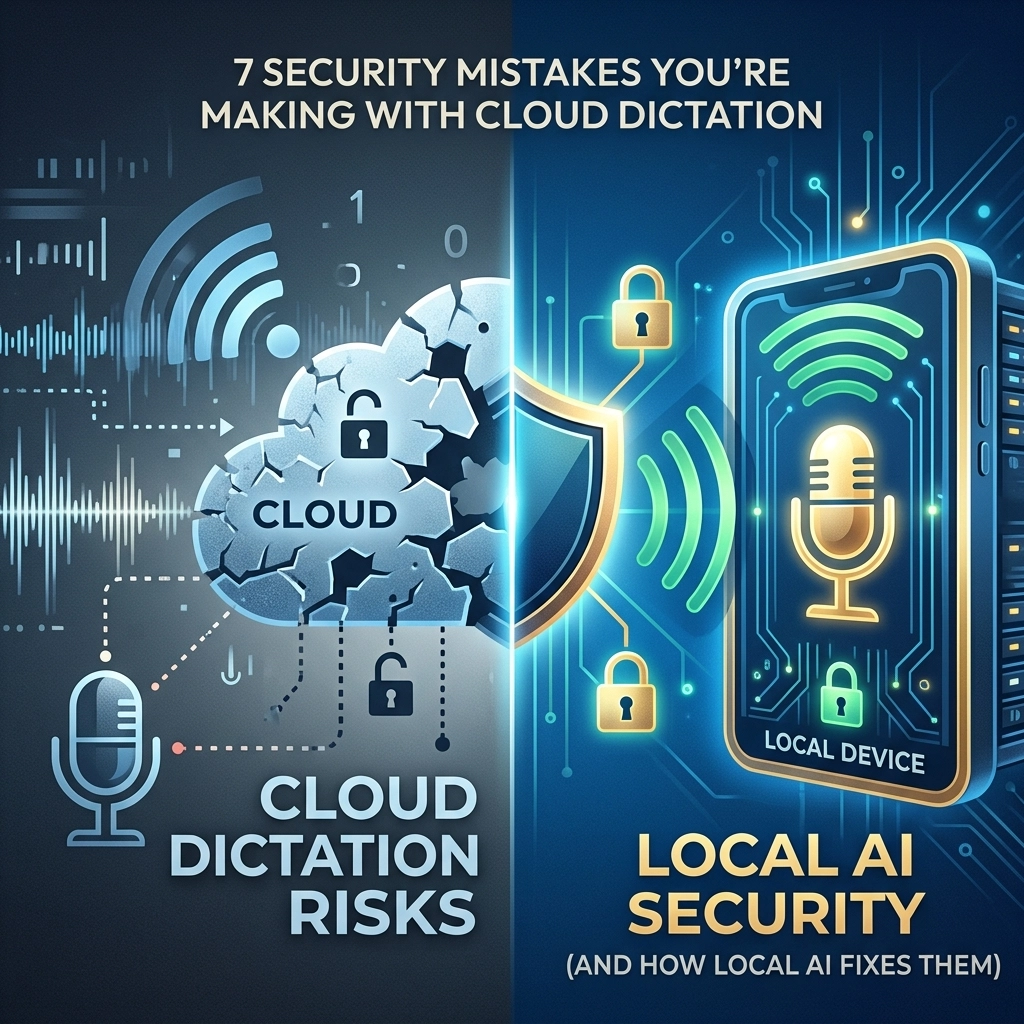
You deal with secrets. You handle client depositions, medical records, or proprietary trade secrets. Every word you speak matters. Every sentence has value. Yet, you are leaking data every single day.
You think dictation software is a harmless utility. You think it is just a tool to save your fingers from typing. You are wrong. If your voice data travels to the cloud, you are gambling with your professional reputation. You are handing your most sensitive information to a third party. You are renting a brain that you do not control.
The "old way" of doing things is broken. It is slow. It is risky. It is a security nightmare waiting to happen.
At VoiceType, we see the gaps. We see where the walls are thin. You need to fix these seven security mistakes before they fix you.
1. You Trust the "Encryption" Smoke Screen
Cloud companies love to talk about "encryption in transit." They tell you your data is safe because it is scrambled while moving from your laptop to their server.
Stop falling for it.
Encryption in transit only protects the data while it is moving. Once it hits their server, they have the keys. They decrypt it to process it. They decrypt it to transcribe it. At that moment, your data is "live." It is sitting on a computer owned by someone else. If that company has a bad day, you have a catastrophic year.
The Local AI Fix:
Eliminate the transit. Stop the movement entirely. Local AI processes your voice on your own hardware. The data never leaves your RAM. It never touches a wire. It never enters the public internet. You don't need to worry about "in transit" security when there is no transit.

2. You Are Feeding the Machine Your Secrets
Most cloud-based tools are "hungry." They need your data to get smarter. When you hit "record," you aren't just getting a transcript. You are providing free training material.
Your legal strategy is now part of an AI’s learning weights. Your patient's diagnosis is helping a tech giant refine its language model. You are paying a subscription fee to give away your intellectual property. It is a bad trade. You wouldn't invite a stranger into your office to take notes for their own book. Why do it with your software?
The Local AI Fix:
Demand an isolated environment. Local AI is a finished product, not a data-hungry parasite. It stays in its lane. It uses your computer’s processor to execute instructions, not to harvest insights. Your secrets stay yours. The machine doesn't learn from you; it works for you.
3. You Ignore the "Human Review" Clause
Read the fine print. Deep in the Terms of Service of most cloud dictation apps, there is a tiny clause about "quality assurance."
This is code for "humans might listen to your audio."
When the AI fails to understand a specific technical term or a heavy accent, a low-paid contractor halfway across the globe might be tasked with listening to that clip to "correct" the transcript. You have no idea who that person is. You have no idea what their security clearance is. You have just allowed a stranger to eavesdrop on a private professional conversation.
The Local AI Fix:
Cut the cord. Local AI removes the middleman. There is no "quality assurance" team in the cloud because there is no cloud. If the AI doesn't understand a word, it stays between you and your machine. No contractors. No eavesdroppers. No leaks.

4. You Are Creating a Data Honeypot
Cloud servers are targets. They are massive vaults filled with the gold of the digital age: data. Hackers don't target your individual laptop; they target the server where 100,000 people store their dictations.
When you use cloud dictation, you are putting your data into a collective honeypot. You are relying on a third party’s IT department to be perfect every second of every day. One misconfigured bucket, one stolen admin credential, and your entire history of dictated notes is on the dark web.
The Local AI Fix:
Decentralize your risk. By keeping your data on your local machine, you become an invisible target. You aren't part of a massive database. You are a single, hardened point. Hackers want the vault, not the individual piggy bank. VoiceType ensures your data lives where you can see it.
5. You Assume Compliance is Someone Else’s Job
You might think you are HIPAA compliant or GDPR compliant because the cloud provider says they are. This is a dangerous assumption. Compliance is a shared responsibility.
If a cloud provider changes their policy, or if they move their servers to a different jurisdiction, you are the one left holding the bag. You are the one who will face the auditors. Relying on a third party's compliance certificates is like trusting a landlord to keep your safe locked. It’s your safe. You should hold the only key.
The Local AI Fix:
Ownership is the ultimate compliance. When data never leaves your device, the circle of trust is as small as possible. You don't need to audit a third party because there is no third party. You satisfy privacy requirements by design, not by contract.

6. You Are Tethered to a Kill Switch
Cloud dictation requires a heartbeat. It needs a constant connection to the mothership. No internet? No dictation. Slow Wi-Fi? Laggy, broken transcripts.
This isn't just a productivity issue; it's a security issue. To stay connected, your device is constantly opening ports and maintaining active sessions. Every active connection is a potential doorway. Moreover, if the company goes bankrupt or their servers go down, you lose access to your own tools. You are renting your ability to work.
The Local AI Fix:
Go 100% offline. Reclaim your independence. Local AI works in a bunker. It works on a plane. It works in a secure, air-gapped facility. It doesn't need to "call home." It is a silent, powerful utility that stays ready regardless of your signal strength.
7. You Are Leaking Metadata Without Knowing It
It’s not just what you say. It’s when you say it, where you say it, and how long you say it for. Cloud providers track metadata. They know you were dictating at 2:00 AM on a Sunday. They know you were at a specific IP address in a specific city.
Metadata is a map of your life and your business operations. It can be used to piece together patterns of behavior that you’d rather keep private. Even if they don't listen to the audio, they are watching the activity.
The Local AI Fix:
Total invisibility. Local AI produces zero metadata footprints on the web. It doesn't log your location to a remote server. It doesn't report your usage patterns to a dashboard. It simply performs the task and stays quiet.

Stop Renting. Start Owning.
The professional world is moving too fast for "old-school" cloud risks. You need speed. You need precision. But more than anything, you need privacy.
Cloud-based tools are built for the masses. They are built for convenience at the expense of security. They are built to turn your voice into their data.
Local AI is built for you. It is built for the professional who cannot afford a single leak. It is built for the person who values ownership over a subscription.
Reclaim your privacy. Reclaim your time. Reclaim your data.
Stop sending your voice into the void. Keep it where it belongs: on your desk, under your control, and behind your firewall.
Visit voicetype.in to see how we are bringing the power of AI back to your local machine.
Direct. Fast. Private. That is the new standard. Anything less is a mistake you can't afford to make.
Leave a Reply