You are leaking data.
Every word you speak into a cloud-connected microphone is a liability. For IT and security professionals, dictation tools are often the "blind spot" in the tech stack. You secure the database. You encrypt the email. Then, your executives dictate sensitive board minutes into a tool that beams every syllable to a third-party server.
Cloud dictation is a sieve. It is convenient, yes. But convenience is the enemy of security.
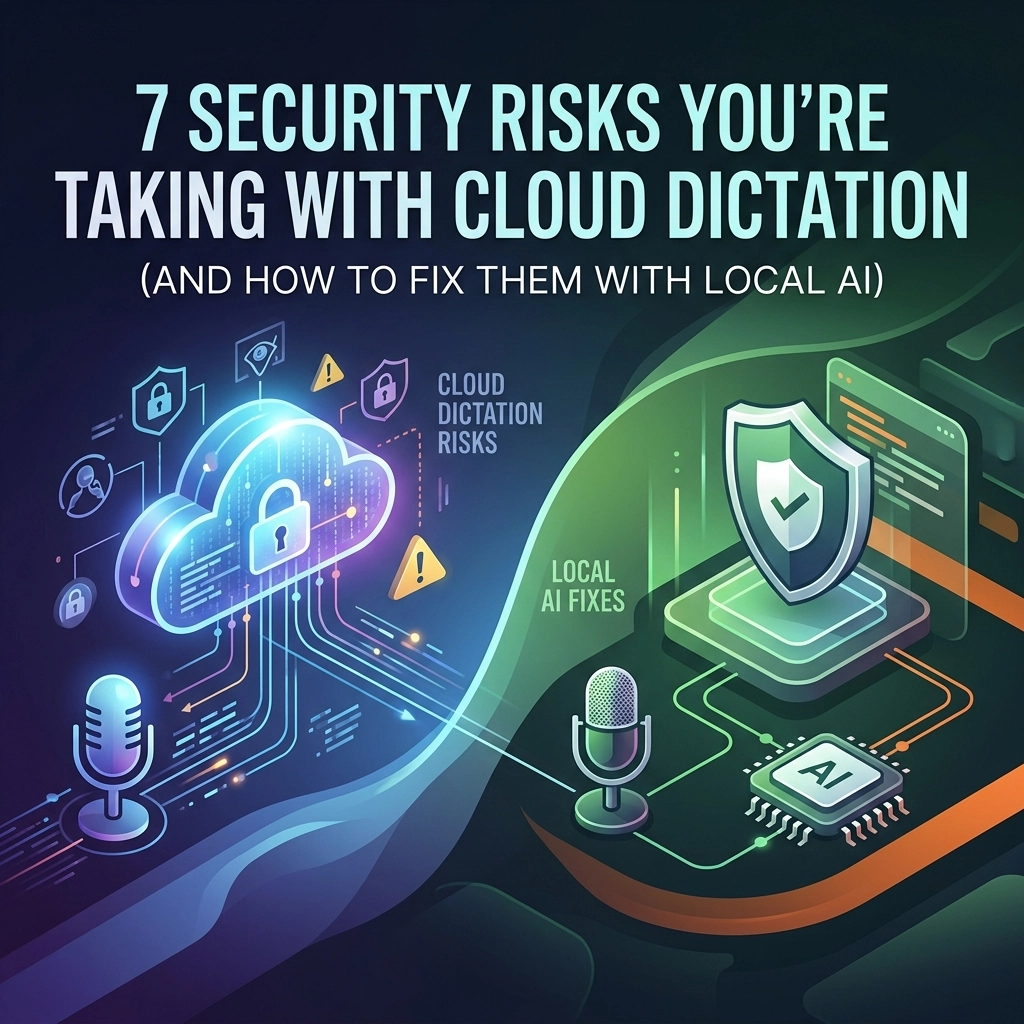
You need to stop treating voice data as ephemeral. It is recorded. It is transcribed. It is stored. In the cloud, it is out of your control. Here are the seven critical security risks you are taking right now and how to fix them with local, air-gapped AI.
1. The Public Server Gamble
When you use cloud dictation, your data travels. It moves from your device, through the open internet, to a server you don't own.
Encryption in transit is standard. Encryption at rest is common. But what happens in between? Data is processed in memory on servers shared with thousands of other users. A single misconfiguration by the provider exposes everything.
You are betting your company’s trade secrets on a third party’s patch management schedule. If they fail, you fail. A breach at the provider level isn't just their problem: it is your legal nightmare.
The Fix: Use local AI. Keep the processing on the silicon you own. If the data never leaves the device, it can’t be intercepted on the wire.

2. The Training Data Trap
"To improve our services."
You see this phrase in every Terms of Service. It sounds innocent. It isn't. Most cloud AI tools use your dictation to train their models. Your legal briefs, your medical notes, and your product roadmaps become the "fuel" for the next version of their AI.
You are paying a subscription to give away your intellectual property. You are effectively crowdsourcing your competitive advantage to a tool that will eventually sell that "intelligence" back to the market.
The Fix: Air-gapped AI. Local models don't "phone home." They don't learn from you to benefit others. Your data stays in your vault.
3. Shadow IT and Unmanaged Endpoints
Dictation is easy to ignore. Employees download an app, click "allow microphone," and start talking.
This is Shadow IT in its purest form. You have no visibility into where that voice data goes. You have no audit trail. You have no "kill switch" when an employee leaves the company. Their phone still has the app. Their cloud account still has the history.
Your security perimeter is only as strong as its weakest link. Right now, that link is a smartphone app connected to a cloud server in a different hemisphere.
The Fix: Centralize on a local-first platform like VoiceType. Give your team a tool that works better than the cloud alternatives but keeps data within your managed environment.
4. Latency and Connectivity Dependency
Security isn't just about privacy; it is about availability.
Cloud dictation requires a stable, high-speed connection. If the internet drops, your productivity dies. In high-stakes environments: hospitals, law firms, secure government facilities: you cannot rely on the "up-time" of a distant data center.
A jittery connection leads to lost words. Lost words lead to errors. Errors in a medical report or a legal document are security risks of a different kind.
The Fix: Process voice locally. Local AI operates at the speed of your processor, not your ISP. It works in the basement. It works on a plane. It works in a SCIF.

5. Compliance and Data Sovereignty
Where is your data right now?
If you use cloud dictation, you probably don't know. It could be in Virginia. It could be in Dublin. It could be in Singapore. For industries governed by GDPR, HIPAA, or SOC2, this lack of geographic certainty is a non-starter.
Data sovereignty isn't a suggestion; it’s the law. Moving voice data across borders without explicit controls puts your organization at risk of massive fines and lost certifications.
The Fix: Eliminate the "transfer" entirely. When processing happens on the local machine, the data never crosses a border. Compliance becomes a checkbox, not a multi-month audit.
6. API Vulnerabilities and Man-in-the-Middle Attacks
Most cloud dictation tools rely on APIs. APIs are the number one attack vector for modern hackers.
Even if the app is "secure," the bridge between the app and the cloud server can be exploited. Man-in-the-middle attacks can intercept the audio stream before it ever reaches the "secure" server.
Every API call is a door. If you have 500 employees dictating for two hours a day, you are opening and closing that door thousands of times. Eventually, someone will stick a foot in it.
The Fix: Close the door. Use an air-gapped system. No API calls. No external requests. No "doors" to kick down.

7. The Subscription Tax and Data Lock-in
This is the "soft" security risk.
Cloud providers want you to "rent" your productivity. They keep your transcripts in their proprietary database. If you stop paying, you lose access. If they change their terms, you have to accept them. If they go out of business, your data vanishes.
This lack of ownership is a long-term risk to business continuity. You are building your internal knowledge base on a foundation of shifting sand.
The Fix: Buy your tools, don't rent them. Local AI gives you permanent ownership of the software and the output. It is a utility you control, not a service you lease.
The Reality of Professional Dictation
Most people think cloud AI is better because it has "more power." That was true in 2022. It is not true in 2026.
Modern local hardware is incredible. The M-series chips and the latest NPU-equipped workstations can run enterprise-grade transcription models faster than the cloud can.
Why send a file 3,000 miles away just to wait for a server to process it and send it back? It is inefficient. It is slow. It is risky.
How Local AI Changes the Game
Imagine a workflow where your voice is converted to text instantly.
Imagine a workflow where your most sensitive thoughts stay on your hard drive.
Imagine a workflow where you are 100% compliant without even trying.
That is the "Local AI" promise. It isn't just about being "secure." It’s about being better.
- Speed: Zero lag. Text appears as you speak.
- Privacy: No accounts. No cloud storage. No training on your data.
- Reliability: It works when the Wi-Fi doesn't.
- Cost: One-time investment. No per-user monthly drain on the budget.
Take Back Your Voice
You spend millions on firewalls and identity management. Don't let your dictation software be the hole in the fence.
The move to local AI is inevitable. The "Cloud First" era was a transition phase. We sacrificed privacy for power. Now, we have the power locally. There is no longer a reason to sacrifice the privacy.
Stop letting your data leave the room. Stop trusting providers who see your voice as "content" to be mined.
Direct your team to evaluate local alternatives. Look at tools like VoiceType that prioritize the "Local First" architecture.
It’s time to bring your dictation home.

The Bottom Line for IT Directors
Your job is to mitigate risk. Cloud dictation is an unmitigated risk.
Switching to local AI is the simplest win you will have this year.
- You reduce the attack surface.
- You simplify compliance.
- You save money.
Make the switch. Secure the voice. Own the data.
Ready to secure your dictation?
Check out how VoiceType enables local, high-performance AI dictation without the cloud risks. No data leaves your machine. Ever.
Leave a Reply