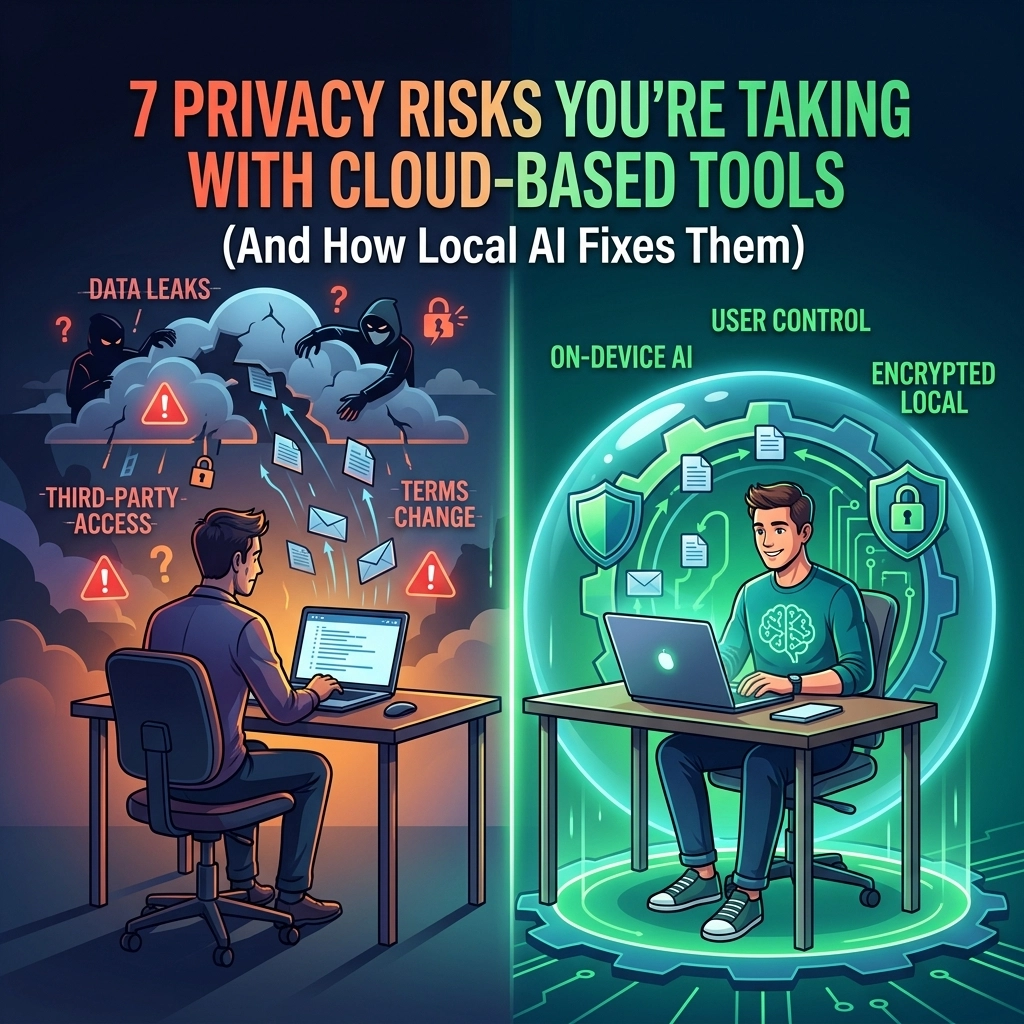
Stop lying to yourself. Your data is not safe in the cloud.
You think your sensitive documents, client recordings, and private notes are locked behind a digital fortress. They aren't. They are sitting on someone else’s computer, subject to someone else’s security protocols, and vulnerable to someone else’s mistakes. Every time you hit "upload" or "sync," you trade your privacy for a little bit of convenience.
For professionals handling high-stakes data: lawyers, doctors, executives, and researchers: this trade is a disaster waiting to happen. You are one breach away from a professional catastrophe.
It is time to look at the reality of cloud-based tools. It is time to understand the risks you are currently ignoring. Here are the seven privacy risks you take every day, and why local AI is the only logical solution.
1. The Centralized Honeypot Risk
Cloud providers are massive targets. They store data for millions of users in centralized locations. To a hacker, a cloud server is a gold mine. One successful breach gives them access to the private lives and corporate secrets of thousands of companies at once.
When you use cloud-based productivity software, you place your data in a honeypot. You bet your career on the hope that the provider’s security team is faster than the world’s most sophisticated cybercriminals. That is a bad bet.
Local AI eliminates the honeypot. Your data stays on your machine. It doesn't live on a server in Virginia or a data center in Dublin. It lives in your hand. Hackers cannot steal what they cannot reach.

2. Accidental Data Exposure and Misconfigurations
Human error is the leading cause of data breaches. It isn't always a hooded hacker in a dark room. Sometimes, it is a tired cloud engineer who misconfigures a storage bucket. Sometimes, it is an update that accidentally sets "private" folders to "public."
You have no control over these mistakes. You are a passenger in a vehicle you aren't driving. If the driver falls asleep, you crash.
With local AI, you are the driver. There are no external configurations to mess up. There are no cloud-side permissions to leak. You control the environment. You control the access. You control the outcome.
3. The Training Trap: Your Data is the Product
Most cloud-based AI tools are not charities. They are businesses. They need data to make their models better. When you feed your sensitive transcripts or proprietary strategy notes into a cloud AI, you are often consenting to have that data used for "model improvement."
Your intellectual property becomes their training data. Your unique insights help build a product that they will sell back to your competitors. You are paying them to steal your edge.
Local AI like VoiceType works differently. It doesn't "learn" from you to help others. It processes your data privately, on your hardware. Your data remains yours. Forever.
4. The Credential Crisis
Cloud tools rely on passwords and tokens. If your login credentials are stolen through phishing, a SIM swap, or a simple guess, your entire digital history is exposed. Once a malicious actor has your password, they can download your entire cloud history in minutes from anywhere in the world.
Local tools change the math. Even if a hacker gets your password, they don't have your data. They would need physical access to your encrypted device. By moving your AI processing offline, you turn a global vulnerability into a local physical security challenge. You move the goalposts.

5. Insecure APIs and Third-Party Backdoors
Modern cloud software is a patchwork of different services. Your "secure" document tool might use a third-party API for transcription, another for translation, and another for storage.
Every API is a potential backdoor. You might trust the main provider, but do you trust the dozen small companies they plug into? Probably not. You likely don't even know they exist. Each link in the chain is a point of failure.
Local AI is a closed loop. There are no external calls. There are no third-party handshakes. The processing happens within the silicon of your own device. No backdoors. No leaks. No excuses.
6. Shadow IT and Employee Leaks
In many organizations, employees use unauthorized cloud tools because they are "easier." This is Shadow IT. An employee might paste a sensitive legal brief into a web-based AI to summarize it, not realizing they just uploaded privileged information to a public server.
Once that data is gone, you can't get it back. It is cached, logged, and stored by the provider.
When you provide a powerful, local AI tool to your team, you eliminate the temptation of Shadow IT. You give them the speed they want without the risk you can't afford. You keep the work inside the building.

7. Data Sovereignty and Jurisdictional Overreach
Where is your data right now? If you use the cloud, the answer is "everywhere." It could be fragmented across servers in five different countries. This creates a nightmare for compliance and data sovereignty. Governments can subpoena cloud providers for your data, often without you even knowing.
If you handle medical records or legal discovery, this is a non-starter. You need to know exactly where your data sits.
Local AI gives you absolute sovereignty. Your data is exactly where you are. It follows your laws, your rules, and your jurisdiction. You don't have to worry about foreign governments or cross-border data transfer regulations. You are the master of your own domain.
The Local AI Solution: Fast, Safe, Private
The "old way" of doing things was to ship your data to a giant server and wait for a response. It was slow. It was risky. It was intrusive.
The "new way" is local.
By leveraging the power of modern processors, tools like VoiceType allow you to perform complex AI tasks: like voice-to-text, summarization, and content generation: directly on your laptop.
Reclaim Your Privacy
Stop renting your privacy. Start owning it. When you work offline, you remove the "what if" from your workflow. What if the server goes down? Doesn't matter. What if they get hacked? You aren't affected. What if they change their privacy policy? It doesn't apply to you.
Experience True Speed
Cloud tools suffer from latency. You have to wait for the data to travel to the server, be processed, and travel back. Local AI happens at the speed of your hardware. It is immediate. It is efficient. It is silent.

The Choice is Yours
You can continue to ignore the risks. You can keep clicking "I Agree" on privacy policies you haven't read. You can keep crossing your fingers every time you upload a sensitive file.
Or, you can take control.
Choose tools that respect your boundaries. Choose software that works for you, not for the data brokers. Choose 100% offline AI.
Your data is your most valuable asset. Stop giving it away. Reclaim your privacy today with VoiceType.
Learn more at voicetype.in.
Leave a Reply