You talk. It types. You save time.
That is the promise of modern dictation software. It sounds like a dream. In reality, it can be a nightmare. You are currently leaking data. You are exposing trade secrets. You are handing over your most sensitive thoughts to companies that do not care about you.
Your voice is not just sound. It is biometric data. It is intellectual property. It is your business.
Most professionals are reckless with their dictation tools. They prioritize convenience over security. They choose "free" over "private." They trust the cloud when they should trust their own hardware.
It is time to stop. It is time to reclaim your privacy. At VoiceType, we see the mess every day. We know where the bodies are buried.
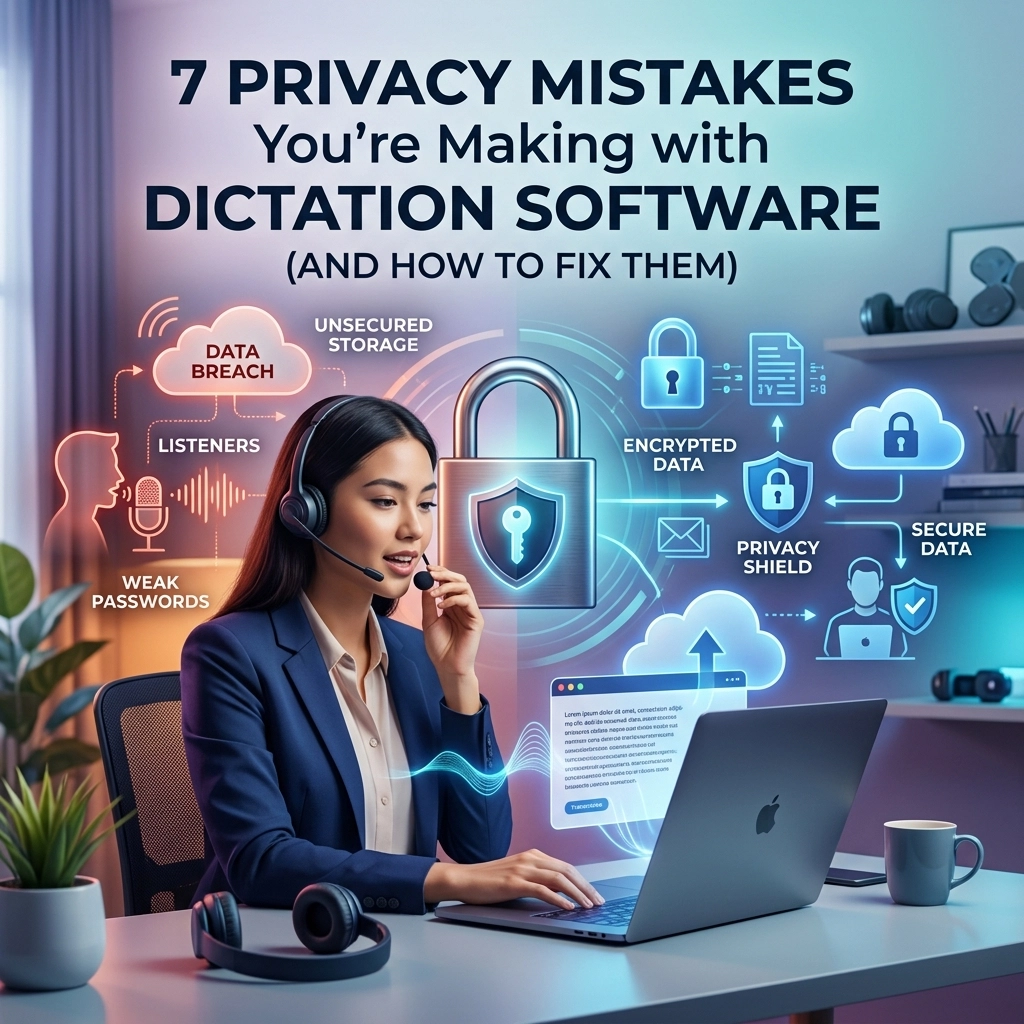
Here are the 7 privacy mistakes you are making right now: and how to fix them instantly.
1. You Are Renting the "Cloud" and Paying with Your Privacy
Most dictation apps are just front-ends for a massive server in a distant city. When you speak, your audio travels across the public internet. It sits on a server you don’t own. It is processed by a company you don’t control.
This is the "Cloud Trap." You think you are using a tool. You are actually feeding a machine.
The Mistake: Sending raw audio data to third-party servers for processing.
If a hacker breaches that server, they have your voice. If a rogue employee at the tech giant gets curious, they can listen to your confidential strategy meetings. You have no "Delete" button that actually works. Once the data leaves your device, it is gone.
The Fix: Go local. Use AI that runs entirely on your machine. No internet required. No data transit. No external servers.
Local AI is the future. It turns your laptop into a fortress. It processes speech on your silicon, using your power, under your rules. If the data never leaves the room, it can never be stolen.

2. You Are Training Your Competitor’s AI
Read the fine print. Most "free" or subscription-based dictation services include a clause about "improving the service."
This is code for: "We are using your data to train our models."
The Mistake: Allowing companies to use your transcripts for machine learning.
Imagine you are a lawyer dictating a complex strategy. Or a doctor describing a rare case. Or an executive outlining a merger. You are literally teaching the AI how you think. You are giving away your edge. You are paying a subscription fee to work for them.
The Fix: Demand a "Zero-Retention" policy or, better yet, use software that doesn't need a policy because it doesn't have a server.
When you use VoiceType, your data stays yours. We don't want your secrets. We don't need your data to make our models better. Our AI is already elite. It works for you, not the other way around.
3. You Are Using Personal "Assistant" AI for Professional Work
You have a phone. It has a built-in assistant. It’s easy to hit the microphone icon and start talking.
This is a massive security hole.
The Mistake: Using consumer-grade AI (like Google Gemini or Apple Intelligence) for sensitive business dictation.
Consumer tools are designed for convenience, not confidentiality. They are tied to your personal identity. They sync across your personal devices. They are part of a data-harvesting ecosystem. Your work notes should not be sitting in the same database as your grocery list and your search history.
The Fix: Segregate your tools. Use professional-grade, privacy-first software for work.
Professional work requires professional boundaries. Use a dedicated tool like VoiceType that is designed for the high-stakes world of business, law, and medicine. Keep your personal life and your professional IP separate.
4. You Are Ignoring the "Shadow AI" in Your Office
If you are a leader, your team is already using AI. If you haven't provided them with a secure tool, they are finding their own. They are using random Chrome extensions. They are using unverified websites. They are using "Shadow AI."
The Mistake: Failing to provide a secure, company-wide standard for dictation and transcription.
One employee using a shady "free" transcription tool can leak your entire quarterly roadmap. It only takes one breach. Most people aren't malicious; they just want to be productive. If you don't give them a safe way to be fast, they will choose the dangerous way.
The Fix: Standardize. Deploy a local-first AI solution across your organization.
Stop the leaks before they start. Give your team the power of AI without the risk of the cloud. When the whole company uses a secure tool like VoiceType, you can sleep at night.

5. You Are Leaving Your Transcripts Unprotected
The audio is only half the battle. Once the AI turns your voice into text, where does that text go?
The Mistake: Saving transcripts in unencrypted cloud folders or "notes" apps.
Many users dictate into an app, copy the text, and paste it into a basic document. Then they save it to a public cloud drive. If your dictation software is secure but your storage isn't, you’ve done half the job. You are still vulnerable.
The Fix: Encrypt everything. Use local storage.
Store your transcripts on your device. Use end-to-end encryption if you must move them. But ideally, keep them off the public web. Your hard drive is a much harder target for a global hacker than a centralized cloud database.
6. You Are Dictating in Public Without a Shield
Privacy isn't just about hackers in hoodies. It’s about the person sitting behind you at the coffee shop.
The Mistake: Dictating sensitive information in public spaces or over unsecured Wi-Fi.
If you are using cloud-based software over public Wi-Fi, you are screaming your data into the void. "Man-in-the-middle" attacks are real. Someone can intercept your audio stream before it even reaches the cloud.
The Fix: Use a VPN and, more importantly, stay local.
If your AI is local, public Wi-Fi doesn't matter. You can be in an airplane, a basement, or a crowded cafe with no internet connection at all. You can dictate with total confidence because there is no signal to intercept.

7. You Are Failing the Compliance Test
Are you in healthcare? You need HIPAA. Are you in legal? You have attorney-client privilege. Are you in finance? You have strict regulatory oversight.
The Mistake: Using dictation tools that do not comply with industry-specific data laws (GDPR, HIPAA, SOC2).
Most dictation apps are toys. They are not built for regulated industries. If you use a non-compliant tool for professional work, you aren't just making a mistake. You are breaking the law. You are inviting fines. You are risking your license.
The Fix: Use software that is compliant by design.
Local AI is the ultimate compliance hack. If no data is collected, stored, or transmitted by a third party, you remove 90% of the compliance headache. You control the data. You own the audit trail. You are the authority.

The Future is Local. The Future is Yours.
The era of "Cloud-First" is ending. It was a trade-off we made because our computers weren't fast enough.
That time is over.
Your laptop is now a powerhouse. It can run elite AI models locally. It can transcribe your voice with 99% accuracy in real-time without ever connecting to the web.
Why would you ever send your data to a third party again? Why would you rent an AI when you can own one?
At VoiceType, we believe in the power of the individual. We believe your thoughts belong to you. We build tools that give you back your time without taking your privacy.
Stop making these mistakes. Stop being a data point for a tech giant.
Take back your voice. Take back your privacy.
Go local. Go VoiceType.
Leave a Reply