Privacy is not a feature. It is a fundamental right.
Every time you hit the record button on a cloud-based dictation app, you are taking a gamble. You are betting that your service provider is honest, that their servers are impenetrable, and that their employees are disciplined. Most of the time, you lose that bet.
In the age of AI, your voice is data. To a cloud provider, that data is oil. They want to refine it, use it, and sell the insights derived from it. You think you are using a tool to get your work done. They think you are providing the raw material for their next model update.
Stop being the product. Start owning your words.
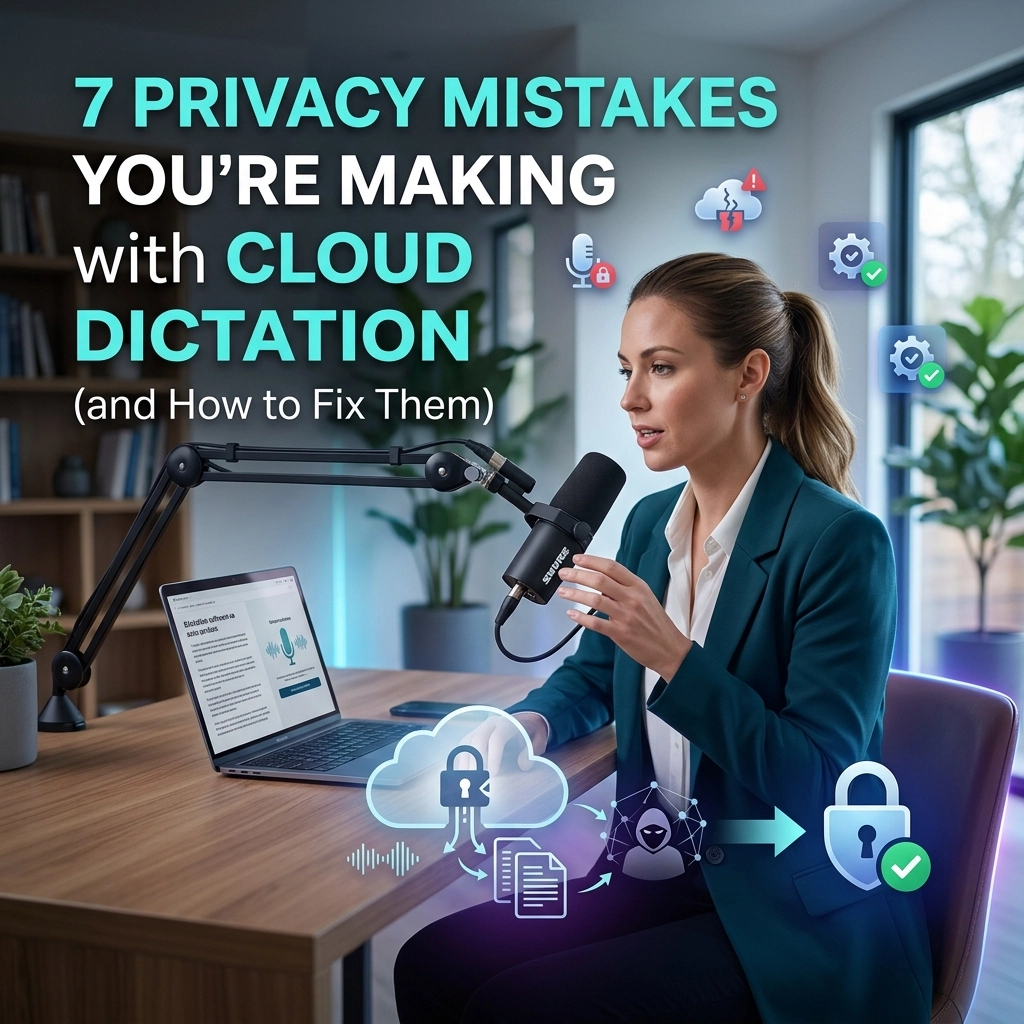
Here are the seven privacy mistakes you are making right now with cloud dictation and the blunt, direct ways to fix them.
1. Using Consumer-Grade Voice Assistants for Professional Work
You are in a rush. You open Siri, Google Assistant, or Alexa. You dictate a sensitive client memo or a medical note. You think it is convenient. It is actually a disaster.
Consumer voice assistants are designed for convenience, not confidentiality. These platforms store your recordings on massive, centralized servers. These recordings are often reviewed by human contractors to "improve the algorithm." When you dictate sensitive info into a consumer app, you are handing your trade secrets to a third party.
The Fix: Use professional-grade, local-first tools. Stop treating your personal phone assistant like a secure workstation. If the software is free and built for the masses, your privacy is the price of admission. Use VoiceType instead. We process everything locally. Your voice stays on your machine.

2. Ignoring "Data Improvement" Opt-In Clauses
Read the fine print. Most cloud dictation services include a sneaky clause. They ask for permission to "improve their services" using your data. By clicking "I Agree," you are giving them a license to listen.
They don't just store the text. They store the audio. They analyze your tone, your vocabulary, and your speech patterns. This data is then used to train AI models that the company will later sell back to you. You are paying them to let them use your brain.
The Fix: Dig into your settings right now. Find the "Help improve our products" toggle and kill it. Better yet, move to a solution that doesn't have a "cloud" to send data to in the first place. Privacy shouldn't be a setting you have to hunt for; it should be the default state.
3. Trusting "Encryption in Transit" as a Total Solution
Marketing departments love the phrase "bank-level encryption." It sounds safe. It sounds robust. It is a half-truth.
Encryption in transit means your data is safe while it travels from your computer to the cloud server. But once it arrives at the server, it is decrypted so the AI can process it. At that moment, your data is vulnerable. If a hacker breaches the server or a rogue employee gains access, your "encrypted" data is wide open.
The Fix: Focus on data at rest and, more importantly, data localization. The only way to ensure your data is never intercepted on a server is to never send it to a server. VoiceType utilizes local AI. The processing happens in your RAM, not on a server in another country. No transit, no risk.

4. Dictating in Public or Semi-Public Spaces
Privacy isn't just about hackers and servers. It’s about the person sitting three feet away from you at the coffee shop.
Dictating client names, financial figures, or internal strategies in a public space is a direct breach of confidentiality. You wouldn't shout your password in a crowded elevator, so why are you dictating your most sensitive documents in a coworking space?
The Fix: Practice physical operational security. Only dictate in private, secure environments. If you must work in public, use a high-quality directional microphone that captures only your voice and minimizes your need to speak loudly. Better yet, wait until you are behind a closed door. Your productivity is important, but your reputation is irreplaceable.
5. Misconfiguring Cloud Storage Permissions
You dictate a note. The app saves it to a cloud folder. You share that folder with a colleague. Six months later, you forget who has access.
Cloud storage is a graveyard of forgotten permissions. "Leaky buckets": misconfigured storage volumes: are the leading cause of massive data breaches. If your dictation app syncs to a cloud drive, you are one wrong click away from making your private thoughts public.
The Fix: Stop syncing to the cloud. Keep your transcriptions on your local drive. If you must share a file, send it directly and set an expiration date. When you use local AI, the "storage" problem disappears. You own the file. You control the folder. You hold the keys.

6. Failing to Account for "Shadow IT"
Shadow IT is when your employees use apps that your IT department hasn't approved.
Your team is tired of typing. They find a "free" cloud dictation tool online. They start using it to transcribe meeting minutes. Suddenly, your company's intellectual property is scattered across five different third-party startups with questionable security protocols. You can’t protect what you don’t know exists.
The Fix: Provide a powerful, sanctioned alternative. People use insecure tools because they are easy. Give them a tool that is even easier and significantly more secure. VoiceType provides the speed of the cloud without the risk of the cloud. Deploy it across your organization and eliminate the need for "shadow" apps.
7. Relying on Subscription-Based Privacy
Most cloud providers treat privacy as a premium tier. They offer a "Free" version that harvests your data and a "Pro" version that promises more security.
You are essentially paying a monthly ransom to keep your own data private. If you stop paying, your access vanishes, and your data remains in their ecosystem. You are renting your privacy, and the landlord can change the locks at any time.
The Fix: Reclaim ownership. Buy software that lives on your hardware. VoiceType isn't a bridge to a distant server; it's a tool that works for you, on your terms. No monthly fees for "privacy features." Just raw, local power.
Why Local AI is the Only Real Solution
The "Old Way" of dictation was slow and manual. The "Current Way" is fast but dangerous: it relies on the cloud. The "New Way" is Local AI.
Local AI is a silent powerhouse. It sits on your computer. It uses your GPU and CPU. It doesn't ask for an internet connection. It doesn't need to "call home."
The benefits are quantifiable:
- Zero Latency: No waiting for data to travel to a server and back.
- Total Privacy: 100% of your audio stays on your device.
- Constant Availability: It works in an airplane, a basement, or a secure facility without Wi-Fi.
Stop compromising. You don't have to choose between productivity and security. You can have both.
Reclaim Your Productivity
The modern professional doesn't have time for slow typing or data leaks. You need to turn your thoughts into text at the speed of sound. But you must do it without handing your life's work over to a tech giant.
Direct your energy toward your work, not toward managing your privacy settings. Let VoiceType handle the heavy lifting. We built it for people who value their time and their secrets.
The choice is simple:
- Continue using cloud tools and hope for the best.
- Switch to local AI and know you're protected.
Fix the mistake. Secure your voice. Own your words.

Ready to ditch the cloud?
Experience the power of local AI dictation today.
Visit VoiceType.in and take back control.
Leave a Reply