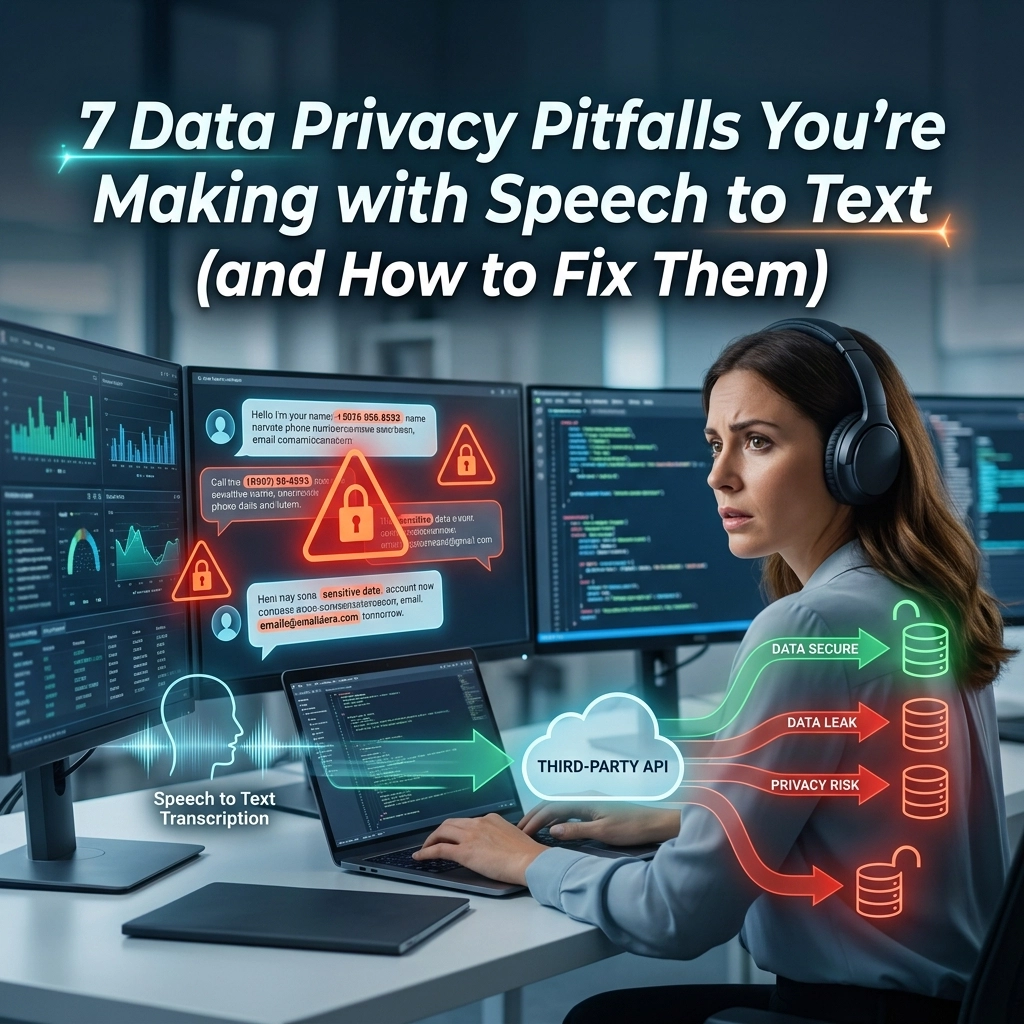
Your voice is your most sensitive biometric. It is unique. It is identifiable. It is valuable.
Every time you use a standard cloud-based speech-to-text tool, you are handing over that value. You are trading your intellectual property for convenience. For IT and Security professionals, this is a nightmare. You spend millions securing your network, only to have users dictate the company’s "crown jewels" into a third-party server.
Stop letting your data bleed out.
The "old way" of dictation relies on someone else’s computer. The "new way" relies on yours. Here are the seven deadly privacy pitfalls of modern speech-to-text and the direct path to fixing them.
1. The Indefinite Storage Trap
Cloud providers want your data. They don't just want the transcription; they want the raw audio. They claim it is to "improve the model." In reality, it is a permanent record of your private thoughts and corporate secrets.
Most cloud tools retain your voice data indefinitely. You have no control over where it lives. You have no say in when it dies. You are renting a service, but they are owning your insights.
The Fix: Own Your Data.
Switch to local AI dictation. Process every syllable on your own hardware. When the processing stays local, the data stays local. No storage in the cloud means no risk of a permanent digital trail. Demand tools that allow for an immediate "zero-retention" environment.

2. The Silent Third-Party Handshake
You trust your provider. Do you trust their partners?
Most cloud-based transcription services don't work alone. They outsource. They use sub-processors. They send your sensitive audio to third-party AI models for "refinement." Your data is bounced around a global web of servers, often crossing borders into jurisdictions with weak privacy laws.
The Fix: Cut the Cord.
Use air-gapped AI. If a tool requires an internet connection to function, it is a security hole. Choose software that works entirely offline. Eliminate the middleman. If there is no connection, there is no sharing.
3. Exposing Personally Identifiable Information (PII)
Dictation is natural. It is fast. It is also unfiltered.
When you dictate, you mention names. You recite credit card numbers. You discuss medical histories. You leak passwords. Standard speech-to-text tools ingest this PII without hesitation. They store it. They index it. If that provider suffers a breach, your most sensitive personal details are up for auction on the dark web.
The Fix: Enforce Local Inference.
Keep your PII on your silicon. By using VoiceType, you ensure that sensitive identifiers never leave your physical device. Local inference means the "brain" of the AI lives in your laptop, not a data center in a different time zone. Protect your identity by keeping it at home.
4. The Transit Vulnerability
Data in motion is data at risk.
Even with encryption, the act of sending audio over the internet is a gamble. Man-in-the-middle attacks are real. Misconfigured buckets are real. Compromised API keys are real. Every packet of data sent to the cloud is a target.
The Fix: Eliminate the Trip.
Stop sending packets. If the data never travels, it can’t be intercepted. Local AI dictation turns your device into a fortress. It removes the "transit" from the equation entirely. Speed up your workflow and lock down your security by keeping the data in the room.

5. The Consent Illusion
"Click here to agree to our terms."
Most users don't read the fine print. They don't realize they’ve given the provider permission to use their voice for marketing, training, or even "human review." Remember the scandals where contractors were caught listening to private home recordings? That wasn't a bug; it was a feature buried in the terms of service.
The Fix: Adopt a "Default-Private" Stance.
Stop relying on legal jargon to protect you. Rely on architecture. When you use a tool like VoiceType, consent is irrelevant because there is no one on the other end to ask for it. You own the software. You own the output. You own the privacy.
6. Privileged Information Breach
Attorneys, doctors, and executives have a legal and ethical duty to maintain confidentiality.
Using a cloud-based transcription tool can technically constitute a waiver of privilege. If you record a strategy session and upload it to a third-party server, you have "published" that data. You have shared it with a stranger. In a court of law, that can be a catastrophic mistake.
The Fix: Air-Gapped Compliance.
Secure your professional privilege. Use local, air-gapped AI that meets the highest standards of confidentiality. Ensure your tools are compliant-by-design. By keeping the transcription process offline, you maintain a closed loop that satisfies even the strictest regulatory requirements.

7. The Bias and Accuracy Reliability Gap
Cloud models are often "one size fits all." They are trained on broad datasets that might not understand your industry jargon or your specific accent. When the cloud model fails, your records are inaccurate. These inaccuracies in legal or medical settings aren't just annoying; they are dangerous.
Furthermore, cloud tools fluctuate in speed based on your internet connection. If the Wi-Fi is down, your productivity is dead.
The Fix: High-Performance Local Engines.
Reclaim your time and your accuracy. Local AI models can be optimized for your specific machine. They provide instant feedback without the lag of a round-trip to a server. They work in the basement, on an airplane, or in a high-security bunker. Reliability is a form of security.
Why IT Pros Are Moving to Local AI
The shift is happening. The trend of "renting" AI is giving way to the era of "owning" AI. IT professionals are realizing that the cloud is just someone else's vulnerability.
The "Old Way": Cloud Dictation
- Data is stored on external servers.
- Privacy depends on a contract.
- Requires constant internet.
- Costs a monthly subscription forever.
- Risk of PII exposure is high.
The "New Way": VoiceType (Local AI)
- Data stays on your hard drive.
- Privacy is guaranteed by physics.
- Works 100% offline.
- You own the utility.
- PII never leaves your sight.

Take Control of Your Voice
Stop treating your voice like public property. Every word you speak into a cloud-connected microphone is a data point for a corporation that doesn't know you.
Reclaim your privacy.
Reclaim your speed.
Reclaim your intellectual property.
VoiceType offers a direct, no-nonsense solution for professionals who refuse to compromise. It is a silent, powerful utility that sits on your machine and works for you: and only you.
Secure your workflow today. Move your dictation to the edge. Stop the leaks. Fix the pitfalls.
The choice is simple: Your data, or their cloud. Choose wisely.
Leave a Reply