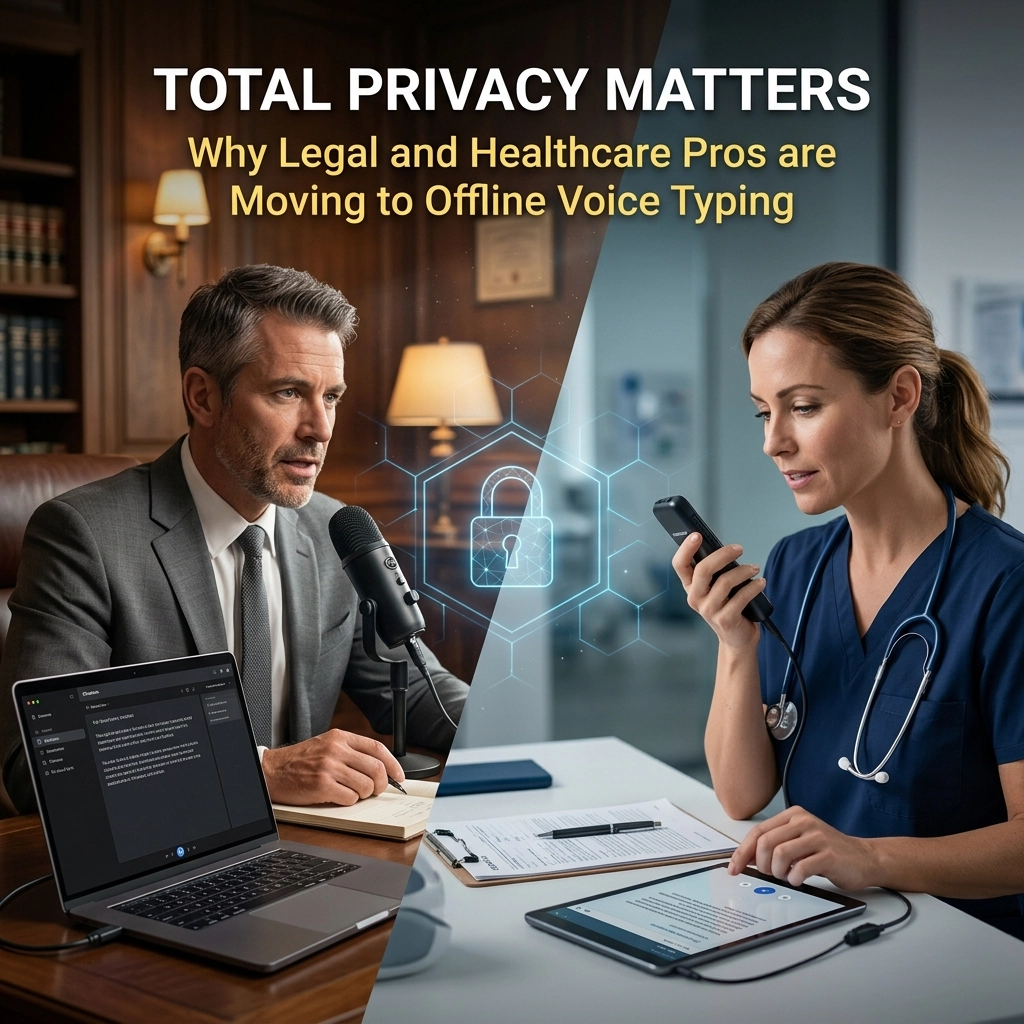
You handle the world’s most sensitive information. You deal with patient records, legal strategies, and confidential testimonies. Every word you type is a piece of a larger, private puzzle.
You are also tired. Your wrists ache from hours of typing. Your schedule is packed. You want the speed of AI. You want the efficiency of voice-to-text. But you have been told a lie. You have been told that for AI to work, your data must live in "the cloud."
The cloud is just someone else’s computer.
For a healthcare professional or a lawyer, the cloud is a liability. It is a leak waiting to happen. That is why the industry is shifting. The smartest pros are moving back to the machine. They are choosing 100% offline voice typing. They are choosing absolute privacy.
The Cloud Illusion: Why "Secure" Isn't Enough
Stop trusting the "secure" label.
When you use a cloud-based dictation tool, your voice travels. It leaves your office. It crosses the internet. It lands on a server owned by a corporation. They tell you it is encrypted. They tell you it is safe. But they don't tell you what happens next.
Many cloud providers use your data. They log it. They analyze it. They use your voice recordings to "train" their models. They are building their product on the back of your confidential client meetings.
Think about your voice. Your voice is a permanent identifier. It is biometric data. Unlike a password, you cannot reset your voiceprint if it gets hacked. Once your audio is on a server, you lose control.

High Stakes, High Risks
A data breach isn't just a technical glitch. For you, it is a professional catastrophe.
- For Doctors: A leak of Protected Health Information (PHI) means massive fines and lost trust.
- For Lawyers: A breach of attorney-client privilege can end a career.
Offline voice typing removes the middleman. No data transmission means no interception. No servers mean no mass breaches. You aren't "renting" security from a third party. You are owning it.
The HIPAA Trap: Compliance vs. Reality
In the healthcare world, HIPAA is the baseline. Most cloud companies offer a Business Associate Agreement (BAA). They claim this makes them "HIPAA compliant."
But compliance is not the same as security.
A BAA is a legal document, not a digital shield. It tells you who to sue when things go wrong. It doesn't stop the data from leaving your sight.
Built-In Privacy
Offline solutions like VoiceType don't need to patch on security features. The privacy is built into the architecture. When the processing happens entirely on your local device, the data never exists in a vulnerable state.
- No Internet Required: Work in a basement clinic. Work in a secure hospital wing with no Wi-Fi. It doesn't matter.
- No Logs: What you say stays on your screen. There is no trail of audio files sitting in a data center in another country.
- Zero Exposure: You bypass the "Security Rule" complexities of encryption-in-transit because there is no transit.
Healthcare professionals are realizing that the safest way to handle PHI is to never let it leave the room.

Legal Privilege in a Digital World
Lawyers live and die by confidentiality. Your clients tell you things they wouldn't tell their own families. You have a duty to protect that information.
When you dictate a legal brief into a cloud-based app, you are essentially inviting a third-party tech company into your private consultation. Is that really "privileged"?
Protect Your Strategy
Legal work is competitive. Your strategies are your intellectual property. Why risk having those strategies sitting on a server that could be subpoenaed or compromised?
Offline voice typing gives you the speed of modern AI without the ethical grey areas. You dictate your motions, your notes, and your strategy sessions directly into your document. The computer processes your voice locally. The text appears. The audio vanishes.
This is how you maintain a truly "closed" system.
Speed Without the Sacrifice
Many people think offline means "old" or "slow." They think you need a giant server farm to process human speech.
That was true ten years ago. It is not true today.
Modern computers are incredibly powerful. Your laptop has more than enough "juice" to run advanced AI models locally. Offline voice typing is now just as accurate: and often faster: than cloud alternatives.
The Numbers Don't Lie
Consider the productivity gains:
- Dictation is 3 to 4 times faster than typing.
- Clinicians report up to a 70% reduction in documentation time.
- Lawyers can draft initial motions in minutes, not hours.
When you move offline, you also eliminate "internet lag." You don't have to wait for the little spinning circle to finish "processing." There is no delay between your voice and the text appearing on the screen. It is instant. It is visceral. It is efficient.

Reclaiming Ownership of Your Work
We live in a "subscription" world. Everything is a monthly fee. Everything is a "service." But your productivity shouldn't be something you rent.
When you use a cloud service, you are dependent. If their servers go down, your work stops. If they change their privacy policy, you have to accept it. If they raise their prices, you have to pay.
The Silent Utility
VoiceType positions itself as a silent, powerful utility. It is a tool that works for you, not the other way around.
- Own Your Data: You never have to ask a corporation for a copy of your logs.
- Own Your Time: No more fighting with slow connections or login screens.
- Own Your Privacy: Your office stays private. Period.
This is the "straight-talk" reality: Cloud tools are built to benefit the provider. Offline tools are built to benefit the user.
How to Make the Switch
Moving to offline voice typing is not a technical project. It is a simple choice.
You don't need a degree in IT. You don't need to install complicated server hardware. You just need software that respects your boundaries.
- Stop using "free" cloud tools. If the product is free, your data is the price.
- Evaluate your hardware. Most modern Mac or Windows machines are ready for local AI.
- Install a local engine. Use a tool like VoiceType that handles the heavy lifting on your processor.
Once you switch, you will feel the difference immediately. There is a psychological peace of mind that comes from knowing your words aren't floating around in space.

The Professional Standard
In the next few years, we will see more headlines about data breaches. We will see more scandals involving AI training and private data. You can either be a part of those headlines or you can be protected.
The "New Way" of working is local. It is fast. It is safe. It is satisfying.
Legal and healthcare pros are the front line of privacy. You set the standard for how sensitive information is handled. Don't let a "convenient" cloud tool compromise your professional integrity.
Reclaim your time. Reclaim your privacy. Move to offline voice typing.
Stop typing. Start talking. Stay private.
Visit voicetype.in to see how simple total privacy can be.
Leave a Reply