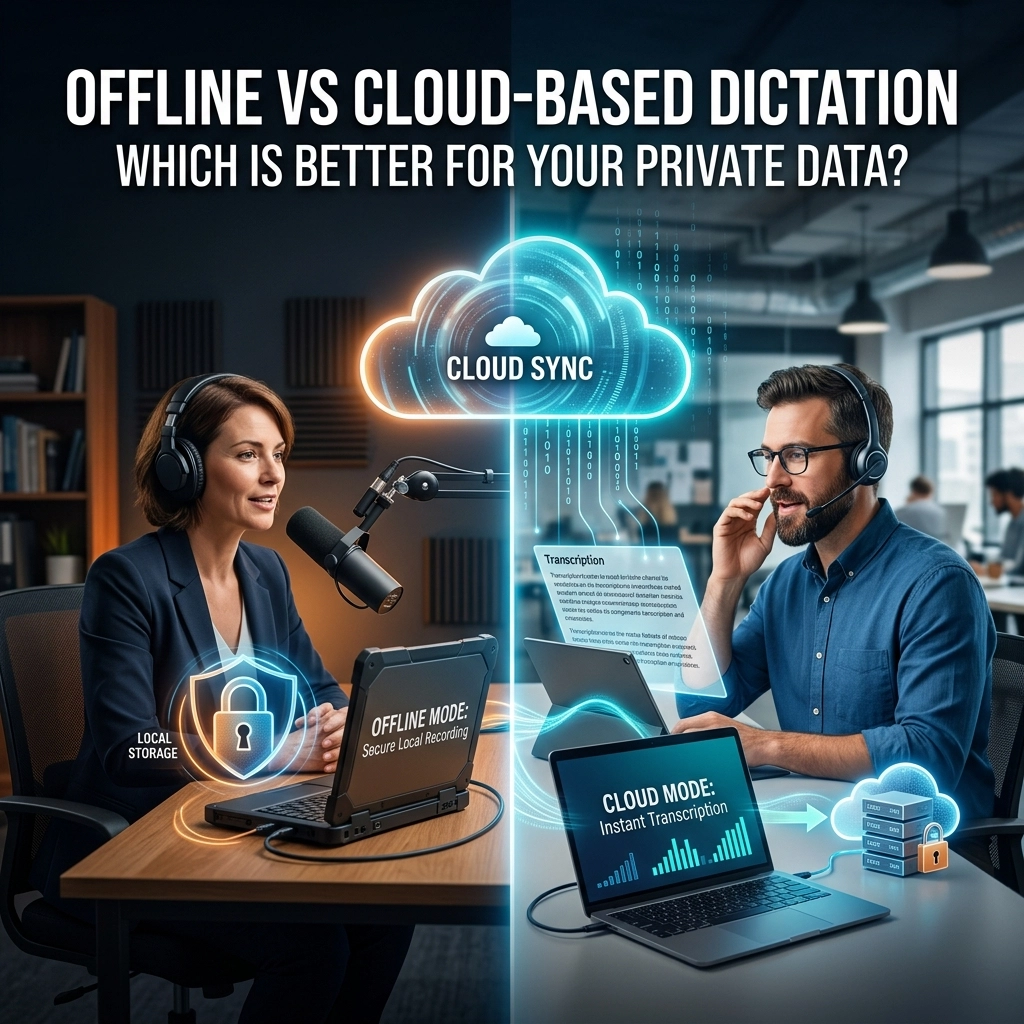
Stop sending your secrets to the cloud.
Every time you speak into a standard dictation app, your voice travels. It leaves your room. It leaves your building. It crosses oceans and enters a server owned by a giant corporation. You don’t know who sees it. You don’t know how it is stored. You don’t know if it is being used to train the next version of their AI.
For a professional, this is a disaster.
If you are a lawyer, a doctor, or an executive, your words are your capital. They are protected by NDAs, HIPAA regulations, and attorney-client privilege. The moment those words leave your device, you lose control.
The choice is simple: Offline or Cloud. One is a fortress. The other is a sieve.
The Illusion of Cloud Security
Cloud companies love to talk about encryption. They mention SOC 2 Type II compliance. They boast about HIPAA certificates. They promise your data is safe "in transit."
Do not believe the hype.
Encryption only protects data while it moves. Once it arrives at the server, it is decrypted. It exists on someone else’s hardware. It sits in a database that can be hacked. It is accessible by employees with high-level permissions.
A data breach is not a "if" scenario. It is a "when" scenario.
In 2026, the average cost of a data breach has climbed to $4.44 million. That is not just a number on a spreadsheet. That is a business-killing event. It is a reputation-destroying catastrophe.
When you use cloud-based dictation, you are renting security. You are trusting a third party to guard your most sensitive thoughts. You are betting your career on their ability to stay one step ahead of hackers.
Stop betting. Start owning.

Zero Transit Means Zero Risk
Offline dictation operates on a different logic.
Your voice stays on your machine. Your transcripts stay on your machine. Your metadata stays on your machine.
Nothing leaves. Not a single bit.
When you dictate a confidential legal strategy, the audio file is processed by your local CPU or GPU. The text appears on your screen instantly. It never touches the internet.
This is the ultimate security wall. You cannot hack a device that isn't broadcasting data. You cannot leak a file that never travels.
Think about the physical reality of your work. You handle proprietary code. You discuss patient histories. You draft merger agreements. These are not general conversations. These are high-stakes assets.
Offline dictation treats your data like an asset. Cloud dictation treats it like a commodity.
The Performance Gap: Speed vs. Latency
Privacy isn't the only reason to ditch the cloud. There is the issue of speed.
Cloud-based dictation is slow. It has to be. Your voice has to be compressed, uploaded, processed, and then the text has to be sent back. This creates a lag, a gap between your thought and the text on the screen.
Average cloud latency ranges from 350ms to 1700ms. It feels like a hesitation. It breaks your flow. It reminds you that you are tethered to a server.
Offline dictation is different. On modern hardware, such as Apple Silicon, latency drops to 50ms. That is effectively real-time. The words appear as you speak them.
No waiting. No spinning icons. No "Processing…" bars.
Just pure productivity.
When you work at the speed of thought, you produce better work. You stay in the zone. You don't get distracted by a lagging cursor.

Work Everywhere, No Matter What
The cloud requires a connection. It demands high-speed WiFi or a stable 5G signal.
What happens when you are on a plane? What happens in a hospital basement with thick concrete walls? What happens when your home internet goes down during a deadline?
With cloud dictation, you stop working. You become a prisoner of the network.
Offline dictation offers total freedom. It works in the middle of the desert. It works in a lead-lined room. It works when the world goes offline.
Reliability is a professional requirement. You cannot tell a client that their document is late because your dictation software couldn't connect to a server in Virginia.
Take your tools with you. Everywhere.
The Accuracy Myth
For years, cloud companies claimed they had the edge in accuracy. They argued that their massive server farms could run larger models than your laptop.
That era is over.
Local AI models have caught up. Today, the accuracy gap is negligible. Top-tier cloud services hit around 95–98% accuracy for English. Modern offline models are hitting 94–97%.
In a real-world professional setting, you won't notice the difference in word error rate. You will, however, notice the difference in privacy.
Is a 1% increase in accuracy worth a 100% increase in data risk?
The answer is no.

You Are Not the Product
Most cloud-based tools follow a "freemium" or subscription model. Often, the hidden cost is your data.
Many providers include clauses in their terms of service that allow them to use your voice data to "improve their services." This is tech-speak for training their AI on your voice.
Think about that. You are paying them to take your proprietary information and use it to build a product they will sell back to you later.
It is an exploitative cycle.
Offline software like VoiceType breaks this cycle. You buy the tool. You own the tool. Your data remains yours. We don't want your voice samples. We don't want your transcripts. We don't want your secrets.
We provide the engine. You provide the fuel. The engine stays in your garage.
Reclaiming Your Professional Integrity
Professionalism is built on trust.
Your clients trust you to keep their information safe. Your patients trust you with their lives. Your partners trust you with their vision.
Using cloud-based tools for sensitive data is a breach of that trust. Even if no leak occurs, the potential for a leak is a liability.
By switching to a 100% offline workflow, you are making a statement. You are telling your clients that their privacy is non-negotiable. You are showing that you understand the risks of the digital age and have taken steps to mitigate them.
It is a competitive advantage.
The Hard Numbers of Choice
Let’s look at the facts:
| Feature | Cloud-Based Dictation | Offline Dictation (VoiceType) |
|---|---|---|
| Data Privacy | High Risk (Third-party servers) | Zero Risk (Stays on device) |
| Latency | 350ms – 1700ms | 50ms – 300ms |
| Internet Required? | Yes, always | No, never |
| Data Ownership | They use it to train AI | You own it 100% |
| Cost of Breach | $4.44M average | $0 (No data to breach) |
The math doesn't lie.

How to Make the Switch
Transitioning to an offline workflow is not difficult. It doesn't require a degree in computer science.
- Audit your current tools. Look at where your data goes. If it’s hitting a cloud server, it’s a risk.
- Download local models. Use software designed for local execution.
- Cut the cord. Test your workflow without an internet connection. If it works, you’re safe.
- Inform your clients. Tell them you use 100% offline, privacy-first technology. Watch their confidence grow.
You can find more resources on how to optimize your setup at our sitemap.
Final Verdict: The Fortress Wins
The cloud is convenient for casual users. It is fine for grocery lists. It is acceptable for a quick text message to a friend.
But you are a professional. You handle sensitive data. You work under pressure. You require absolute privacy and instant performance.
The cloud is a liability you don't need.
Offline dictation is the only way to ensure your private data remains private. It is faster. It is more reliable. It is more ethical.
Don't wait for a data breach to tell you what you already know.
Reclaim your privacy. Reclaim your speed. Reclaim your work.
Switch to offline. Switch to VoiceType.
Leave a Reply