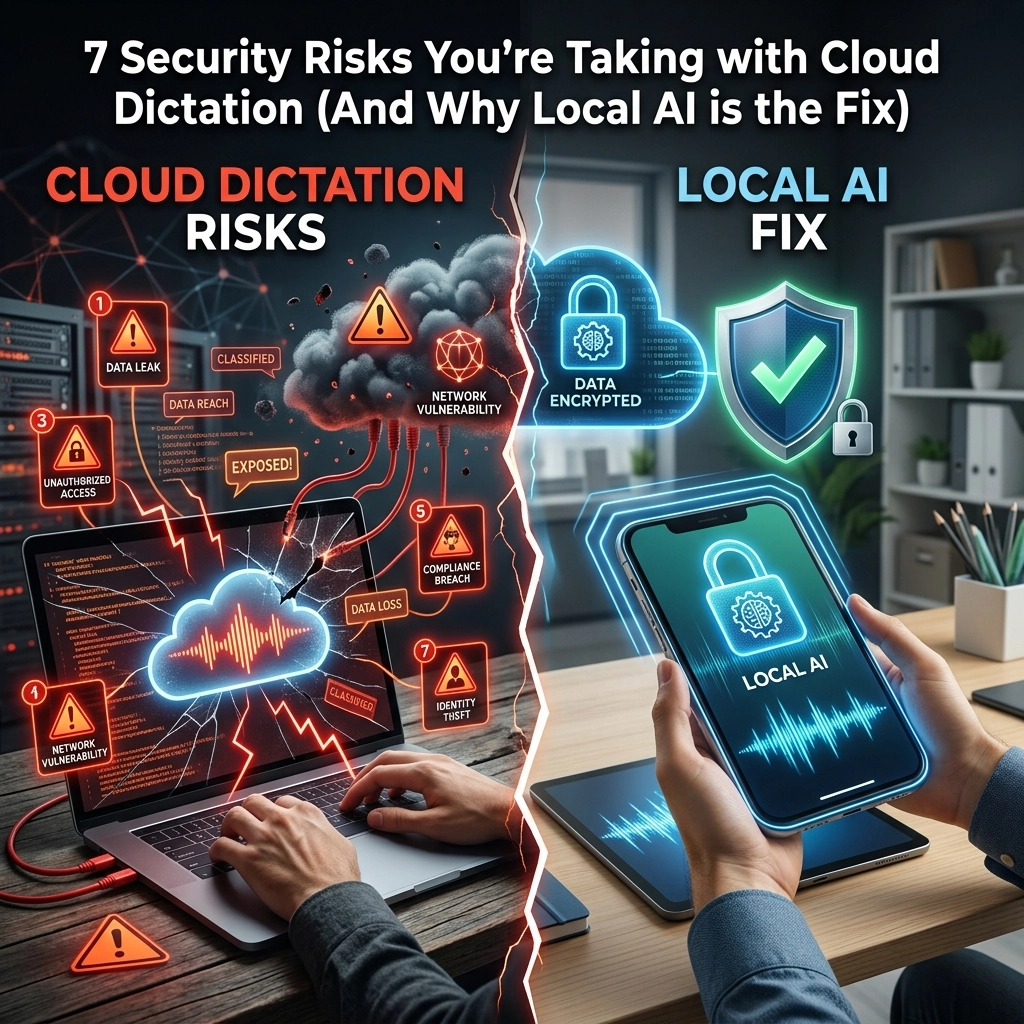
You talk. They listen.
When you use a cloud-based dictation tool, you are making a trade. You trade your privacy for convenience. You trade your data for a service. Most professionals don't realize how lopsided this trade actually is.
Your voice is unique. Your data is sensitive. Whether you are a lawyer dictating a case brief, a doctor recording patient notes, or an executive outlining a new strategy, your words are your most valuable asset. Sending those words to a third-party server is a gamble.
Stop gambling with your intellectual property.
Cloud-based dictation tools introduce vulnerabilities that you cannot control. You are handing over the keys to your most confidential information and hoping the door stays locked. It won't.
Here are the 7 security risks you are taking every time you hit "record" on a cloud-based tool: and why local AI is the only professional solution.
1. The Honeypot Effect: Centralized Targets
Cloud providers are honeypots. They store millions of hours of audio and text from thousands of users on centralized servers. This makes them the ultimate target for hackers.
If a hacker breaches a local device, they get one person’s data. If they breach a cloud provider, they get everyone’s data. You are part of that "everyone." When you use cloud tools, you aren't just responsible for your own security; you are at the mercy of the provider’s security.
One breach. Millions of victims. Your sensitive transcripts could be leaked in a single afternoon.
2. Misconfiguration: The Human Element
Security isn't just about code. It’s about people. Most cloud data leaks don't happen because of a complex hack. They happen because an administrator forgot to check a box.
A misconfigured storage bucket. A publicly accessible database. An outdated security patch. These are common errors that expose sensitive data to the open web. You have no way to verify if your provider has configured their servers correctly today. You just have to trust them.
In a professional environment, "trust" is not a security strategy.

3. Inadequate Identity and Access Management (IAM)
Who has the keys to your data? In a cloud environment, it’s not just you.
It’s the engineers at the cloud company. It’s the automated scripts running on their servers. It’s anyone who manages to phish a high-level employee at the service provider.
Even if you use a strong password, you are only as secure as the weakest link in the provider's chain. Inadequate IAM practices are a leading cause of data exposure. If the provider's internal access controls are weak, your private dictations are essentially public property for anyone with internal access.
4. Data Sovereignty: Where Is Your Voice?
When you upload audio to the cloud, it doesn't stay in your office. It travels. It might cross borders. It might be stored in a data center in a country with zero privacy laws.
This is a legal nightmare for professionals. If you are a lawyer in the UK but your dictation is stored on a server in a jurisdiction with lax data protection, you may be in violation of your own professional ethics and local laws like GDPR.
Cloud providers move data to optimize costs. They don't move it to optimize your privacy. You lose control over the physical location of your information the moment it leaves your device.
5. Insecure APIs and Third-Party Integrations
Most cloud dictation tools don't work in a vacuum. They connect to other services. They use APIs to send your text to your email, your CRM, or your notes app.
Every connection is a hole. Every integration is a potential backdoor for attackers. If the API connection is insecure, your data can be intercepted in transit. You are building a chain of services, and the entire chain is only as strong as its weakest API.

6. Invisible Mining: You Are the Product
"Free" or "Low-cost" cloud tools aren't actually cheap. You pay with your data.
Many cloud providers use your dictations to train their machine learning models. They analyze your speech patterns, your vocabulary, and your content to improve their product. They claim the data is "anonymized," but voice data is inherently biometric. It identifies you.
Your confidential business strategies and private client details are being fed into an engine to help a multi-billion dollar corporation build a better product. You are working for them, and you’re paying them for the privilege.
7. The Tether: Connection Reliability
This isn't just a security risk; it’s a productivity risk. Cloud tools require a constant, stable internet connection.
If your Wi-Fi drops, your dictation stops. If the provider's server goes down, you are locked out of your own files. You are tethered to an infrastructure you don't own and cannot repair.
True professional tools should work anywhere: on a plane, in a basement, or in a high-security facility with no internet access. If it requires a connection, it’s a toy, not a tool.
The Fix: Local AI and the Power of Offline
The solution is simple: Local AI.
At VoiceType, we believe your data should never leave your sight. We have moved the entire AI processing engine from the cloud to your local machine. This isn't a "private cloud." It is 100% offline.
Absolute Privacy
When the AI lives on your hardware, the risks listed above disappear. There is no "honeypot" for hackers to target. There are no misconfigured servers. There are no data sovereignty issues because your data never crosses a border. It stays on your hard drive.
Ownership, Not Renting
Cloud tools are "rented" software. You pay every month for access to their servers. If you stop paying, you lose the service. If they change their terms, you have to accept them.
Local AI is an investment in your own infrastructure. You own the capability. You aren't reliant on a third party’s uptime or their shifting privacy policies.
Performance Without Latency
Sending audio to a server and waiting for a transcript creates lag. Processing that audio locally is near-instant. By eliminating the "round trip" to the cloud, you get a faster, more responsive experience.

Why Professionals Are Switching
The world is waking up to the dangers of the "Cloud-First" mentality. For sensitive work, "Cloud-First" means "Security-Last."
- Legal Professionals: Dictate case notes without fearing a subpoena for a third-party server.
- Medical Professionals: Ensure HIPAA compliance by keeping patient audio off the public internet.
- Executives: Protect trade secrets and quarterly strategies from corporate espionage and data mining.
Reclaim Your Privacy
You deserve a tool that works for you, not for a data-hungry corporation. You deserve the speed and accuracy of modern AI without the baggage of cloud vulnerabilities.
Stop uploading your secrets. Start working locally.
VoiceType is built for the professional who refuses to compromise. We provide the power of the most advanced AI models, running directly on your device. No internet required. No data shared. No risks taken.
It’s time to move your workflow out of the clouds and back onto solid ground.
Visit voicetype.in to see how we are redefining privacy for the modern professional.
Your words are yours. Keep them that way.
Leave a Reply