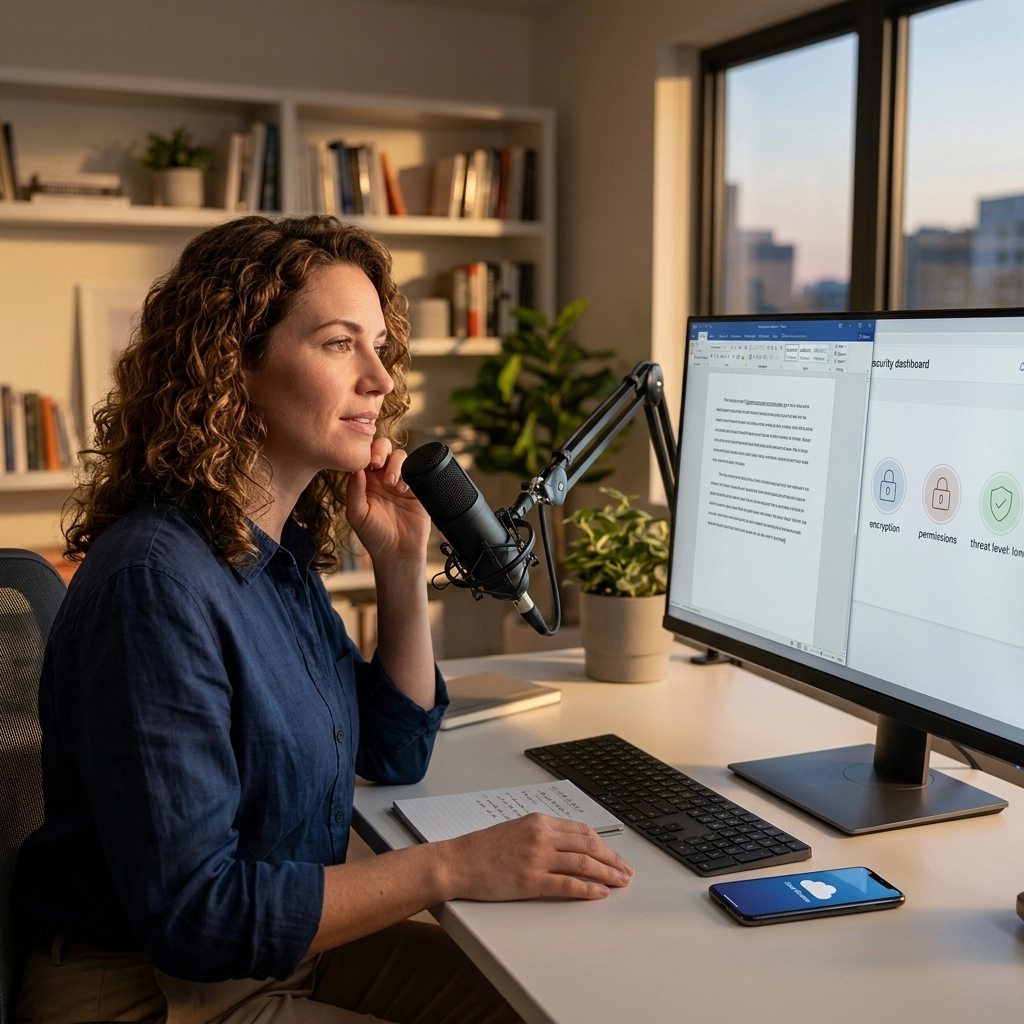
You think you are alone when you talk to your computer. You aren't. Every time you hit that microphone icon on a standard cloud-based dictation app, you are inviting a crowd into the room. You are speaking to a server. You are speaking to a data center. You are speaking to a corporation’s "improvement" team.
Your voice is personal. Your ideas are proprietary. Your data is your business. Yet, millions of professionals hand over their most sensitive thoughts to cloud providers every single day. They do it because it’s convenient. They do it because they don't know any better.
Stop being one of them.
At VoiceType, we see the cracks in the cloud. We see the risks you take when you "rent" your productivity from a server-side giant. Here are the seven mistakes you are making with cloud dictation right now and the direct steps you must take to reclaim your privacy.
1. You Trust "Zero Data Retention" Marketing
Marketing is not architecture.
When a cloud dictation app promises "zero data retention," they are making a policy choice, not a technical one. They are telling you that they choose to delete your data after a certain period. But policies change. Terms of service get updated with a 30-day notice. Companies get acquired by data-hungry conglomerates.
If the audio leaves your device to be processed, it is vulnerable. A subpoena, a national security letter, or a simple implementation bug can turn "zero retention" into "permanent storage" instantly.
The Fix: Stop trusting promises. Start trusting physics. Use an app that processes audio on your local hardware. If the data never leaves your RAM, there is nothing for a hacker to steal and nothing for a company to "retain."
2. You Ignore the "Middleman" Problem
Your data doesn't just go to the app you downloaded. Most cloud-based dictation tools are shells. They are front-ends for other services. They use third-party APIs from Big Tech giants like OpenAI, Google, or Microsoft to do the actual heavy lifting.
Check the subprocessor list. If it exists, you will see a web of companies that all have a "right" to touch your data. Each one is a potential leak point. Each one is a new surface for an attack.

The Fix: Demand transparency. If an app cannot function without an internet connection, it is using a middleman. VoiceType doesn't have a middleman. We built the engine to run on your machine. Your voice stays between you and your processor.
3. You Fail the "Airplane Mode" Test
This is the simplest test in tech. Open your dictation app. Turn off your Wi-Fi. Toggle Airplane Mode. Now, try to speak.
Did it work? If it didn't, you are being watched.
Cloud apps require a constant heartbeat of data transmission. They need the cloud to "think." This means if you are on a plane, in a secure facility, or just want to save your bandwidth, you are out of luck. More importantly, it confirms that your voice is being streamed to a remote server in real-time.
The Fix: Run the test today. If your productivity tool dies the moment the internet drops, find a new tool. Modern AI is powerful enough to run locally. VoiceType proves it. We don't need the cloud’s permission to help you write.
4. You Give Away a "License to Use" Your Voice
Have you read the fine print lately? Most cloud services include a clause that grants them a license to "access, copy, modify, and use" your content to improve their services.
They use your legal briefs, your medical notes, and your trade secrets to train their next model. You are paying them to let them use your intellectual property. It is a one-sided deal that favors the corporation, not the creator.
The Fix: Read the "Ownership" section of your software agreement. If it says anything about "improving models" or "broad licenses," delete the app. You should own 100% of your output. No exceptions.

5. You Dictate Sensitive Data into the "Hot Mic"
People treat dictation like a private diary. They dictate passwords, client names, financial figures, and health information. They do this while connected to public Wi-Fi or unencrypted home networks.
When you use cloud dictation, you are creating a "Hot Mic" scenario. Your sensitive data is flying through the air, hitting an ISP, passing through multiple data centers, and landing on a server you don't control.
The Fix: Treat the cloud like a public stage. If you wouldn't shout it in a crowded coffee shop, don't dictate it into a cloud app. Or, switch to local-first AI. When you use VoiceType, the "mic" only talks to your computer. It’s the digital equivalent of a soundproof room.
6. You Think Encryption is a Magic Shield
"We use AES-256 encryption!"
That sounds great. It’s also a distraction. Encryption in transit only protects the data while it's moving. Once it reaches the cloud server, it has to be decrypted to be processed by the AI. At that moment, the data is "live."
If that server is compromised, the encryption doesn't matter. If an employee at the cloud company has admin access, the encryption doesn't matter. Encryption is a lock on the delivery truck, but the warehouse doors are wide open.
The Fix: Focus on the destination, not the transit. The best way to secure data is to never send it in the first place. Local processing eliminates the need for the "delivery truck" entirely.

7. You Are Renting Your Privacy, Not Owning It
The subscription model is a trap for your data. When you pay a monthly fee for a cloud service, you are locked into their ecosystem. They have your history, your voice profiles, and your habits. They use this "data gravity" to keep you from leaving.
Subscribed software is "rented" software. The moment you stop paying, you lose access. The moment they change their privacy policy, you have to accept it or lose your workflow.
The Fix: Move to a "Buy Once, Own Forever" model where possible. Local AI tools allow you to keep your software and your privacy on your own terms. You aren't a tenant; you are the owner.
Why Local AI is the Only Real Solution
The "Old Way" of doing things is dead. It was slow, it was risky, and it was invasive.
The "New Way" is local.
At VoiceType, we built our software on a simple premise: Your computer is powerful enough to handle your voice. You don't need a supercomputer in Virginia to transcribe a memo. You need efficient code and local power.
When you switch to local AI, you reclaim:
- Speed: No more "processing" lag while the server thinks.
- Security: Your data stays on your hard drive. Period.
- Stability: Work anywhere: the woods, an airplane, or a basement.
- Sanity: No more worrying about the next big data breach.
The cloud was a temporary bridge to the future. That future is here, and it lives on your desk, not in a data center.
Stop making these mistakes. Stop handing over your voice to people who don't care about your privacy.
Take back control.

Visit voicetype.in and see how we’re making dictation fast, direct, and: most importantly( private.) It’s time to speak freely again.
Leave a Reply