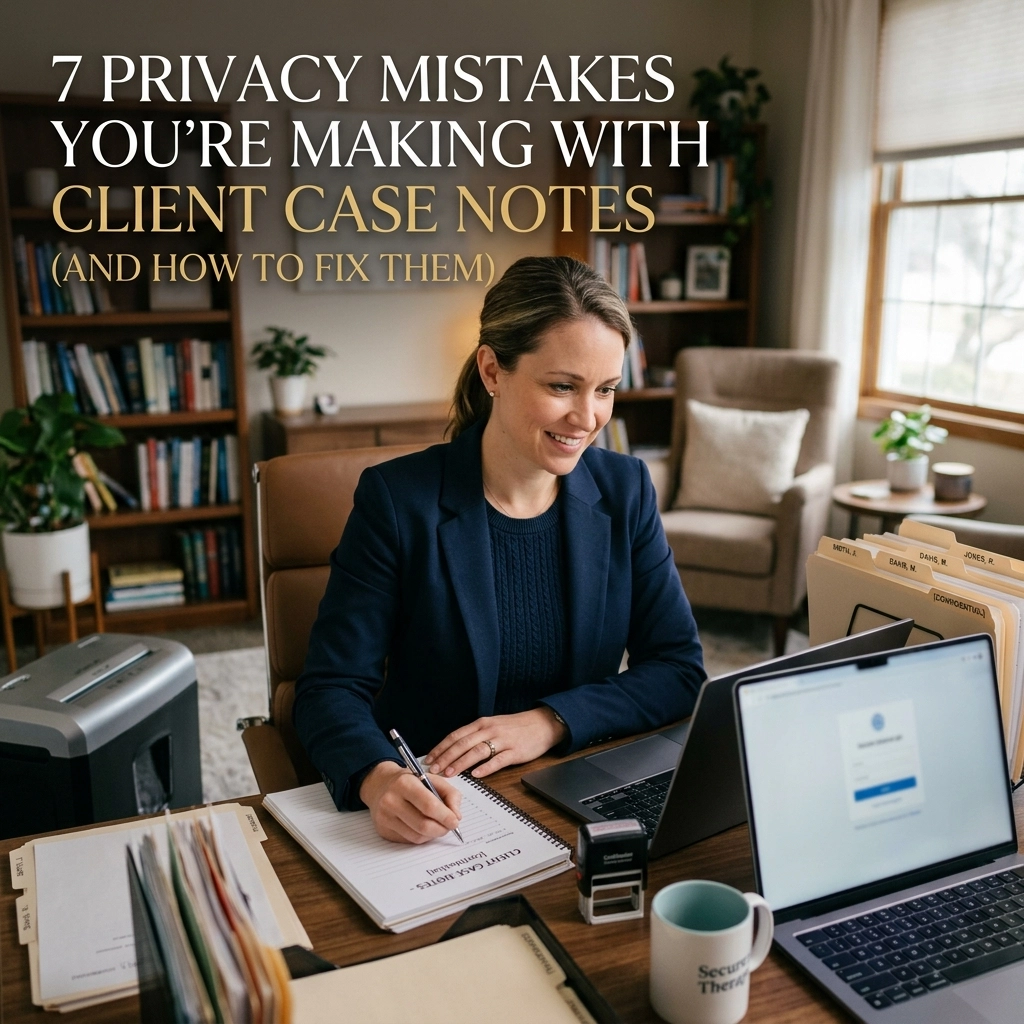
Privacy is not a suggestion. For a legal professional, privacy is the product. You sell confidentiality. You trade in trust. If your client case notes are exposed, your practice is dead. It is that simple.
Most lawyers operate under a thin veil of "good enough" security. You use the tools everyone else uses. You follow the same sloppy habits as your peers. You assume that because nothing has gone wrong yet, nothing will. You are wrong.
The digital landscape has shifted. Hackers are smarter. AI is hungrier for data. Regulatory bodies are less forgiving. If you are still handling case notes like it’s 2015, you are making dangerous mistakes.
Here are the seven privacy mistakes currently rotting the foundation of your practice: and the direct, no-nonsense fixes to reclaim your security.
1. The "Cloud-First" Dictation Trap
You dictate a memo. You use a popular app on your phone. That audio file travels across the country to a server you don't own. It sits there while an AI processes it. It stays there until you remember to delete it.
Every second that data lives on someone else's server, you are at risk. You are renting your security. If that provider has a breach, your client’s most sensitive secrets are on the dark web. You cannot control what you do not own.
The Fix: Go Offline.
Stop sending your voice to the cloud. Use dictation software that processes everything locally on your hardware. If the data never leaves your computer, it can’t be intercepted. VoiceType provides HIPAA-ready, offline dictation that keeps your notes on your machine. No servers. No leaks. No compromises.

2. Using "Free" AI Tools for Transcription
There is no such thing as a free lunch. If you aren't paying for the product, your data is the product. When you feed your case notes into a free AI transcription tool, you are likely consenting to "train" their model.
You are literally teaching a machine how to think using your client's privileged information. This is a catastrophic breach of attorney-client privilege. You are giving away the intellectual property of your firm to a tech giant for the price of a few saved minutes.
The Fix: Pay for Privacy.
Use a professional, paid utility that explicitly guarantees zero data retention and zero AI training. You need a tool that works like a silent servant, not a data-hungry partner. Demand software that operates in a "closed-loop" environment.
3. Dictating in Public and Semi-Public Spaces
You’re a busy CEO. You’re a high-stakes litigator. You dictate on the train. You take notes in the back of an Uber. You think you’re being efficient. You are actually broadcasting confidential information to anyone with a smartphone and a recording app.
Modern microphones are incredibly sensitive. Background noise removal is powerful. That "private" conversation you had in the airport lounge? It’s easily recoverable by anyone sitting within twenty feet of you.
The Fix: Physical Perimeters.
Treat your case notes like a top-secret briefing. Dictate only in secure, private environments. If you must work on the go, use a specialized microphone that captures only close-proximity audio. Better yet, wait until you are behind a closed door. Speed is never worth a disbarment hearing.
4. The Transcription Middleman
Many firms still rely on third-party transcription services. You send a recording; a stranger listens to it and types it up. Even if they sign an NDA, you have introduced a human point of failure.
Humans are curious. Humans make mistakes. Humans lose laptops. Every time a third party touches your case notes, the circle of trust expands: and a circle that big is easily broken.
The Fix: Automate Locally.
Eliminate the middleman. Use high-speed AI transcription that happens instantly on your own device. When you dictate with VoiceType, the "transcriptionist" is a piece of code running on your local processor. It doesn't have a memory. It doesn't have a social media account. It just does the job and disappears.

5. Leaving "Digital Breadcrumbs" in Metadata
When you create a document, you aren't just creating text. You are creating metadata. This hidden data tells the story of when the note was created, who edited it, and the GPS coordinates of where you were sitting at the time.
If you share these notes or store them in unsecured folders, you are leaving a map for anyone who wants to track your movements or your work habits. For high-profile cases, this metadata is a goldmine for the opposition.
The Fix: Clean Your Files.
Use tools that minimize metadata creation. Store your files in encrypted containers that mask file details. Most importantly, use an offline workflow that prevents your location and device ID from being synced to a central log every time you hit "record."
6. Mixing Personal and Professional Hardware
You dictate a note on your personal phone. It syncs to your personal iCloud or Google Drive. Your kid picks up your iPad to play a game. Suddenly, your client’s sensitive case strategy is sitting in the "Recent Photos" or "Files" app of a device used by your entire family.
This is the "Consumerization of IT" at its worst. Convenience is the enemy of security. Your personal life and your legal practice must be separated by a digital Great Wall.
The Fix: Dedicated Workflows.
Keep your professional work on professional hardware. If you must use a mobile device, use an app that keeps its data partitioned from the rest of the OS. VoiceType’s focus on local processing ensures that your notes stay within the app’s secure environment, not floating around in your personal cloud.

7. Neglecting HIPAA Standards (Even if You Aren't a Doctor)
Many lawyers assume HIPAA doesn't apply to them. If you handle personal injury, medical malpractice, or insurance defense, you are a "Business Associate." You are legally required to protect Protected Health Information (PHI) to the same standard as a hospital.
Even if you don't handle PHI, HIPAA-ready security is the gold standard. If your tools aren't HIPAA-ready, they aren't lawyer-ready. You are settling for inferior protection.
The Fix: Raise Your Standards.
Adopt HIPAA-ready tools for all case notes, regardless of the practice area. Why settle for less? If a tool is secure enough for a surgeon, it’s secure enough for a partner. It’s a binary choice: either your data is protected by the highest standards, or it is vulnerable.
The Solution: Reclaim Your Privacy with VoiceType
The old way of taking notes is slow, risky, and annoying. You write by hand (slow). You use cloud apps (risky). You fix typos for an hour (annoying).
The new way is fast, safe, and satisfying.
VoiceType is the silent, powerful utility you’ve been waiting for. It is designed for the CEO who doesn't have time for a data breach. It is built for the lawyer who demands absolute sovereignty over their words.
Why VoiceType?
- 100% Offline: We don't want your data. We don't see your data. It stays on your device.
- HIPAA-Ready: We meet the strictest privacy standards in the world so you can sleep at night.
- Local AI: Experience the power of cutting-edge AI without the "phone-home" privacy risks.
- Zero Subscriptions to Data: You own the software; you own the output.
Stop playing roulette with your client's lives. Your reputation took decades to build. Don't let a single "syncing" icon destroy it.

Take Action Now.
- Audit your current dictation workflow.
- Delete any "free" transcription apps on your phone.
- Switch to a local-first, offline solution.
Visit voicetype.in to see how we are helping legal professionals reclaim their time and their privacy.
Privacy is power. Own it.
Leave a Reply