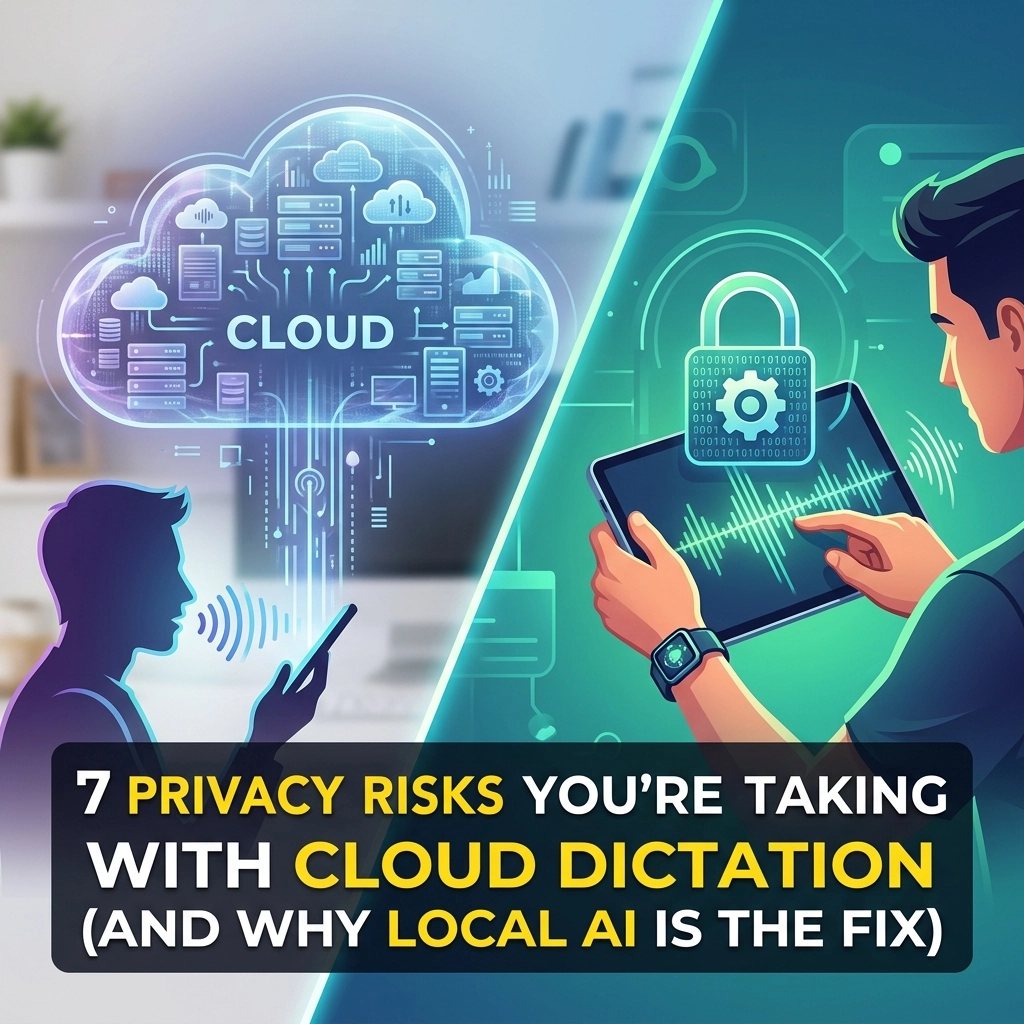
Your voice is your most valuable asset. It carries your ideas, your strategies, and your clients' deepest secrets. Every time you hit "record" on a standard cloud-based dictation app, you are making a choice. You are choosing convenience over security. You are betting your professional reputation on a stranger’s server.
Stop gambling with your data.
The cloud is not a magical, safe ether. It is someone else’s computer. When you use cloud dictation, your voice isn't just "processed." It is transmitted, stored, and analyzed. It passes through dozens of hands before it ever reaches your screen.
At VoiceType, we believe privacy isn't a feature. It is a fundamental right. Professional work requires absolute confidentiality. If your AI tool needs an internet connection to think, it’s not working for you. It’s working for the provider.
Here are the seven critical privacy risks you take every time you use cloud dictation, and why local AI is the only logical fix.
1. Transmission is a Breach Surface
The moment your audio leaves your microphone, it is vulnerable. To reach a cloud server, your voice data must travel through your local Wi-Fi, your Internet Service Provider (ISP), and multiple data-center switches.
Encryption protects the content, but it doesn't hide the activity. Every "hop" in the network is a potential point of failure. Misconfigured routers, man-in-the-middle attacks, and ISP logging are real threats. You are sending your intellectual property across a public highway.

Local AI changes the game. With VoiceType, the audio never leaves your device. It moves from your microphone to your processor. No highway. No hops. No exposure. Your data stays in the room.
2. The Subprocessor Shadow
Read the fine print. Most cloud dictation services don't just use their own tech. They use subprocessors. They send your audio to third-party LLM providers, analytics firms, and storage giants.
You signed a contract with one company. They signed contracts with ten others. You have zero visibility into how these subprocessors handle your data. They might cache it. They might log it for "quality assurance." They might use it to train their next model.
When you use local AI, the chain ends with you. You are the only processor. You own the stack. You own the results.
3. Policy Fluidity (The 30-Day Trap)
Privacy policies are not written in stone. They are digital files that can be updated with a simple email notification.
Today, a company might promise "zero data retention." Tomorrow, they might be acquired or pivot their business model. Suddenly, your data is an "improvement asset." Most terms of service give companies the right to change their privacy stance with 30 days' notice.
Do you have the time to audit every policy update for every app you use? Probably not. Local AI is structural security, not policy-based security. A policy can change; the physical absence of a cloud server cannot.
4. Acquisition and Asset Risk
In the tech world, data is the new oil. When a cloud-based AI company gets acquired, their database is the primary prize.
Consider the major acquisitions in the last few years. When a giant corporation buys a small dictation startup, they aren't just buying code. They are buying the history of every user on that platform. Your private notes, legal briefs, and medical transcriptions become assets on a corporate balance sheet.
By keeping your AI local, you remove yourself from the ledger. Your data cannot be sold because the vendor never had it in the first place.
5. Legal Compulsion and Subpoenas
Cloud servers are a gold mine for legal discovery. If a government agency or a litigator wants your data, they don't have to come to you. They can go to the cloud provider.
Providers are often legally compelled to hand over data without ever notifying the user. Even if a provider has a "deletion policy," a timely subpoena can force them to preserve data they would otherwise discard.
If the data doesn't exist on a server, it cannot be seized from a third party. Local AI ensures that your private thoughts remain under your physical control. If someone wants your data, they have to deal with you directly.

6. Implementation and Logging Bugs
Software is built by humans. Humans make mistakes.
Even the most secure cloud companies suffer from implementation bugs. A developer might accidentally leave a "debug log" active that records raw audio. A routing error could send your transcript to another user’s dashboard. Caching layers might hold onto data long after it was supposed to be deleted.
These aren't hypothetical scenarios; they happen to the biggest tech firms in the world. When your processing happens locally, a bug in the software still doesn't result in a data leak. Without an outbound connection, there is nowhere for the data to leak to.
7. Regulatory and Consent Landmines
Privacy laws like GDPR, CCPA, and various state-level wiretapping laws are getting stricter. In many jurisdictions, recording a conversation and sending it to a third-party server for processing requires explicit consent from all parties.
If you use cloud dictation in a professional setting, you are technically transmitting sensitive information to a third party. This can trigger a cascade of regulatory requirements. Are you sure your cloud provider is compliant with the specific laws of your client’s jurisdiction?
Local AI simplifies your compliance. Because the data is processed on-device, it is often treated as a private note-taking exercise rather than a data transmission event. You stay compliant by staying local.
The Fix: Why Local AI is the Future
The "Old Way" of working was about outsourcing everything to the cloud. It was fast, but it was fragile. It was convenient, but it was compromised.
The "New Way" is about reclaiming your power. Local AI is now fast enough and powerful enough to outperform the cloud without the risks.

Performance Without Compromise
You shouldn't have to choose between speed and safety. Local AI models now run natively on your laptop or desktop. They don't wait for a server response. They don't lag when your Wi-Fi is spotty. They work at the speed of your thought.
Physical Ownership
When you use VoiceType, you aren't renting a service. You are using a tool. It is the difference between renting a safe-deposit box at a bank and having a safe in your own home. You hold the key. You control the access.
Verifiable Privacy
How do you know an app is truly local? Turn off your Wi-Fi. If the app stops working, it’s a cloud app. If it keeps running perfectly, it’s local.
VoiceType works entirely offline. We don't want your data. We don't need your data. We built the tool so you can do your best work without looking over your shoulder.
Reclaim Your Privacy Today
The era of "Cloud-First" is ending. The risks are too high, and the rewards are no longer unique. Professionals in law, medicine, finance, and creative industries are moving back to local processing because it is the only way to guarantee absolute confidentiality.
Don't wait for a data breach to change your habits. Protect your intellectual property now.
Stop uploading your ideas. Start processing them locally.
Experience the power of secure, professional dictation. See what VoiceType can do for your workflow.
No clouds. No leaks. Just your voice, transcribed perfectly, on your terms.
Leave a Reply