You talk. Your computer listens. Your words turn into text. It feels like magic. It feels like a massive productivity win. But for most professionals, this convenience comes with a hidden, dangerous price tag.
If you handle sensitive data, your voice is a liability. If you are a lawyer, a doctor, or an executive, your spoken words are your most valuable assets. Yet, every day, thousands of professionals hand those assets over to strangers. They upload trade secrets to the cloud. They transmit patient records over public networks. They trust companies they have never met with information that could ruin their careers.
Stop treating your voice like public property.
Cloud-based tools are not your friends. They are data vacuums. They thrive on your information. They rent you a service while they harvest your intelligence. It is time to see the cracks in the system. It is time to fix your workflow.
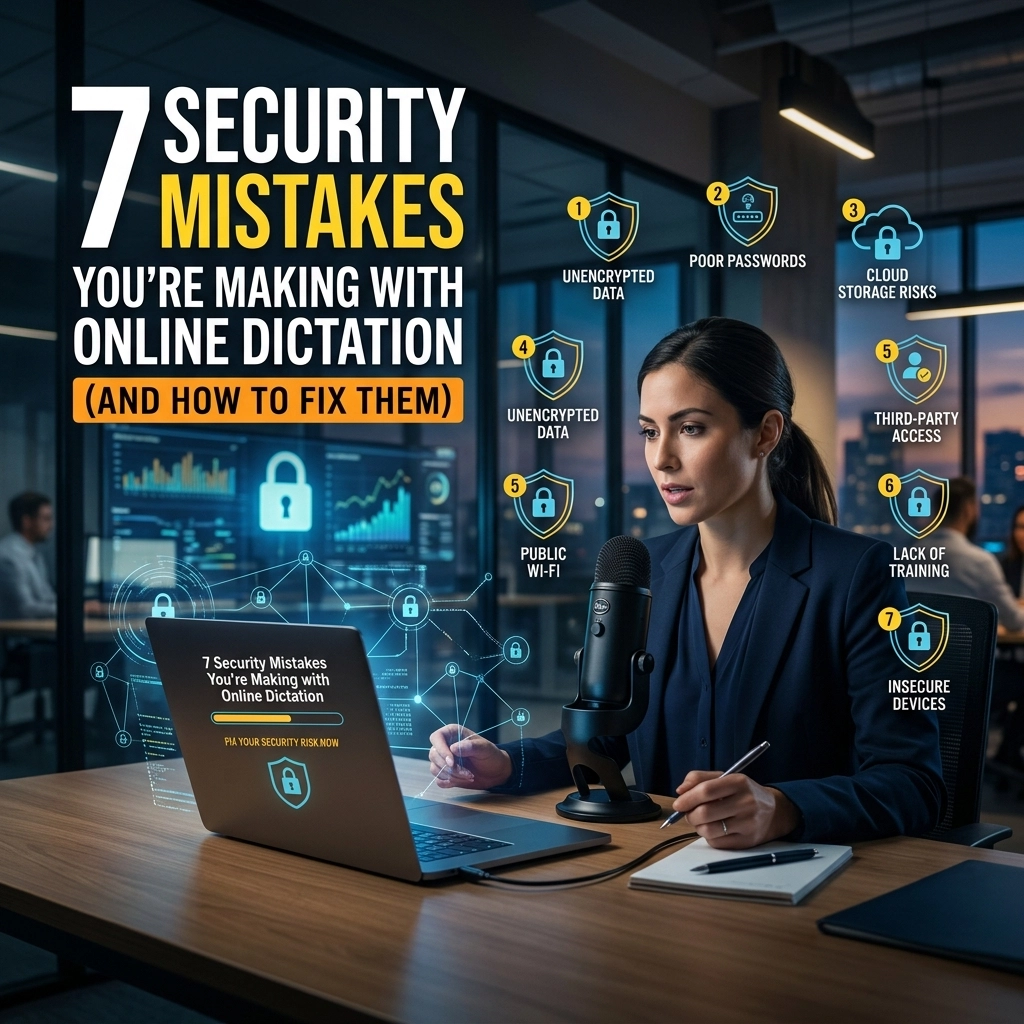
Here are the 7 security mistakes you are making with online dictation and exactly how to fix them.
1. You Are Shipping Your Data to the Cloud
Every time you hit "record" on a standard dictation app, your voice leaves your room. It travels through your router. It bounces off satellites. It lands in a server farm halfway across the world.
Think about that. Your confidential strategy session is now sitting on a hard drive you don't own. You have no control over who sees it. You have no say in how it is protected. You are essentially shouting your secrets into a crowded room and hoping everyone has their ears plugged. They don't.
The Fix: Stay Offline.
Stop sending your data away. Use software that processes everything locally. If the transcription happens on your laptop, the data never leaves your sight. No cloud. No servers. No leaks. VoiceType keeps your words where they belong: on your machine.

2. You Are Feeding the AI Machine
Why are most online dictation tools so "affordable"? Because you are the product.
Modern AI models need data to grow. They need millions of hours of human speech to learn accents, industry jargon, and context. When you use a cloud-based tool, you often agree to let them use your audio to "improve their services."
This is a polite way of saying they are using your private business meetings to train their next software update. Your intellectual property is being used to build a product for someone else. You are paying them to take your secrets.
The Fix: Own Your Intelligence.
Choose tools that guarantee zero data retention. Demand a solution that doesn't "learn" from your specific inputs unless it stays on your device. Your expertise is your edge. Don't give it away for free.
3. You Trust "Encryption" That Isn't Enough
Many services brag about "encryption in transit." It sounds secure. It sounds technical. It is a distraction.
Encryption in transit only protects your data while it is moving from your computer to their server. Once it arrives at the server, the service provider usually holds the keys. They can see it. They can read it. If a government agency demands it or a hacker breaches their main hub, your "encrypted" data is wide open.
The Fix: Eliminate the Middleman.
The best way to protect data is to never transmit it. If there is no transit, you don't need to worry about the strength of the encryption. Physical isolation is the ultimate security. Work entirely within your own hardware.

4. You Are Ignoring the "Delete" Fallacy
You think you are safe because you hit the "delete" button after your transcript is done. You are wrong.
In the world of cloud computing, "delete" is often just a suggestion. Data is backed up. It is cached. It is stored in redundancy loops. Your audio file might live on a backup server for months or years after you think it is gone. You are leaving a digital trail of breadcrumbs that leads straight to your most sensitive conversations.
The Fix: Absolute Data Sovereignty.
When you work offline, "delete" actually means delete. You control the disk. You control the trash bin. You control the overwrite process. Take back the power to truly erase your tracks.
5. You Are Vulnerable to Connection Hijacking
Online dictation requires a stable internet connection. But a connection is a door. Every time you connect to a cloud service: especially on public Wi-Fi or in a shared office: you are opening that door.
Man-in-the-middle attacks are real. Hackers can intercept your audio stream in real-time. They don't need to break into the cloud; they just need to catch the data while it's flying through the air.
The Fix: Cut the Cord.
The most secure network is no network. Reliable dictation should work in a basement, on an airplane, or in a high-security bunker with no Wi-Fi. If the software doesn't need the internet to function, the door is locked from the inside.

6. You Are Risking Regulatory Non-Compliance
If you work in law, finance, or healthcare, you are bound by strict privacy laws. HIPAA, GDPR, and CCPA are not suggestions. They are mandates.
Using a random cloud-based transcription app can put you in direct violation of these laws. If that app stores data in a region with weak privacy protections, you are liable. If they suffer a breach, you are the one who loses your license. Is a "free" app worth a multi-million dollar lawsuit?
The Fix: Hard-Coded Privacy.
Use a professional-grade utility that is private by design. By keeping all data on-device, you simplify your compliance path. You don't have to wonder where the data is: it’s right in front of you. VoiceType is built for professionals who cannot afford a single mistake.
7. You Are Relying on Rented Software
Most dictation services are subscriptions. You pay every month for the "privilege" of using their servers. If you stop paying, you lose access. If their servers go down, your productivity hits zero. You are a tenant in your own workflow.
This creates a security risk because you are dependent on their uptime and their corporate stability. If they get bought out by a company with lower ethical standards, your data goes with them. You are not in control of your own tools.
The Fix: Buy, Don't Rent.
Invest in tools that live on your machine. You want a silent, powerful utility that works behind the scenes. No logins. No subscriptions. No constant pings to a home office. Just a tool that does its job whenever you need it, forever.

The New Standard: 100% Offline Dictation
The old way of dictating is over. The "old way" was slow, risky, and annoying. It forced you to trade your privacy for speed. It made you dependent on the cloud. It turned your voice into a commodity.
The new way is different. The new way is fast, safe, and satisfying.
Imagine a world where you speak, and the text appears instantly. No loading bars. No "connecting to server" messages. No fear that your words are being recorded by a corporation.
This isn't a dream. This is what local AI looks like. By using the power of your own computer's processor, you can achieve world-class accuracy without a single byte of data leaving your hard drive.
Why Privacy is Your Greatest Productivity Hack
When you know your data is 100% private, you work differently.
- You speak more freely.
- You dictate sensitive memos without hesitation.
- You process client notes immediately after a meeting.
- You stop worrying about "the cloud" and start focusing on your work.
Security isn't just about preventing disasters; it's about giving you the confidence to move faster.
Stop making these 7 mistakes. Stop trusting the cloud with your voice. Reclaim your time. Reclaim your privacy. Reclaim your peace of mind.
Get the tool that respects your boundaries. Get the tool that works as hard as you do, without ever talking back to a server.
Visit voicetype.in and experience the power of 100% offline, private dictation today. Your voice is yours. Keep it that way.
Leave a Reply