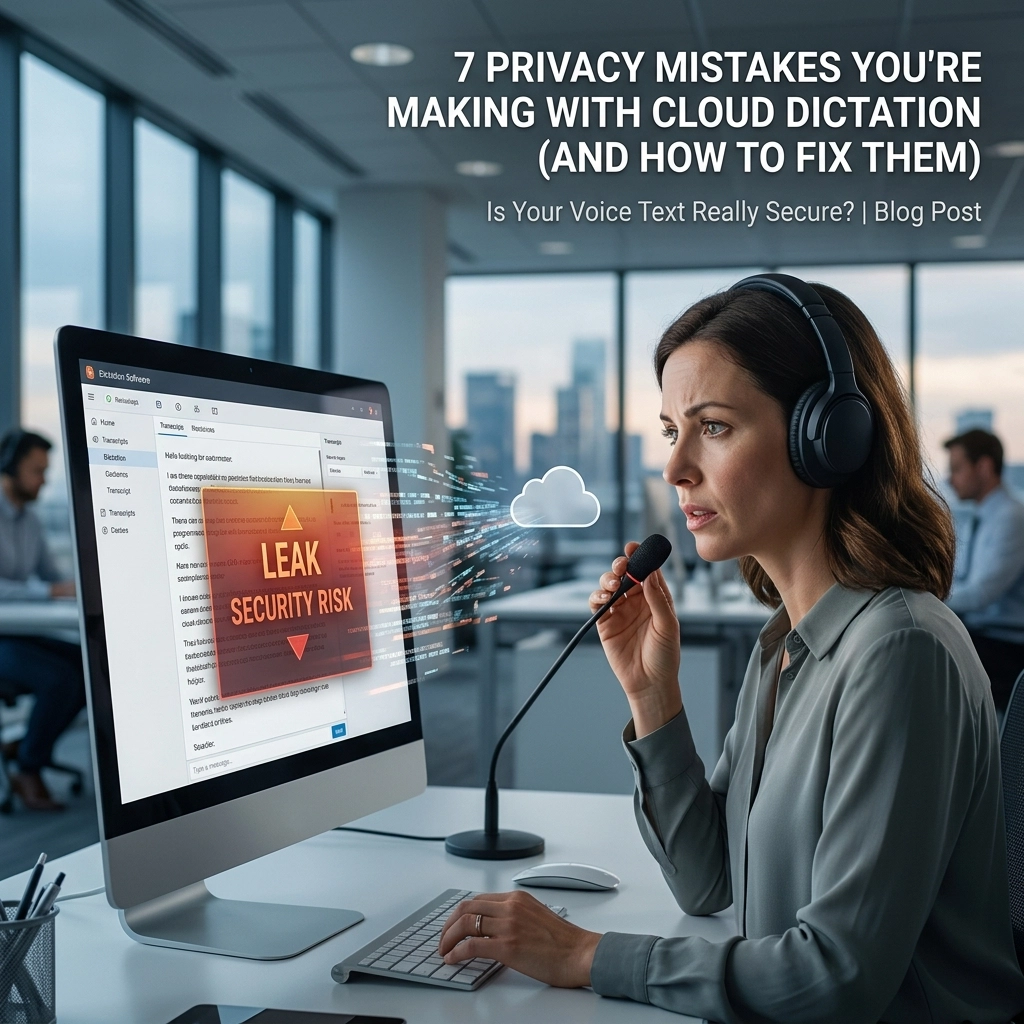
You are being watched.
Not by a person in the room, but by a server thousands of miles away. Every time you hit "record" on a standard dictation app, you are opening a door. You are handing over your thoughts, your client secrets, and your intellectual property to a third party.
Most professionals think they are buying productivity. In reality, they are renting a security risk.
Privacy is not a feature. It is a fundamental requirement. If you handle sensitive data: legal briefs, medical notes, corporate strategy, or financial records: the "old way" of dictating is a ticking time bomb.
Stop making these seven mistakes. Reclaim your privacy today.
1. You Are Transmitting Data into the Void
The biggest mistake is the most basic: allowing your voice to leave your room.
Popular cloud dictation services work by capturing your audio and sending it to a remote server for processing. This is called "Data in Transit." Even if the connection is encrypted, the data still leaves your device. It travels across the open internet. It lands on a machine you do not own and cannot control.
Every mile that data travels is an opportunity for interception. Hackers look for these streams. State actors monitor them. Why take the risk?
The Fix: Process everything locally. Use tools that run 100% offline. If the data never leaves your computer, it can never be intercepted. It’s that simple.

2. You Are Relying on "Trust Me" Policies
Read the fine print. Most cloud-based tools include clauses that allow them to "improve their services" using your data.
This is tech-speak for "we are listening to your recordings to train our AI." When you use a cloud service, you are often paying them to take your data. You are the product and the customer at the same time. This is a massive conflict of interest for any professional handling confidential information.
Legalese does not prevent a data breach. A signed agreement does not stop a rogue employee or a server misconfiguration. Trust is a vulnerability.
The Fix: Remove trust from the equation. When you use 100% offline software like VoiceType, there is no one to "trust" because there is no one on the other end. You own the software. You own the data. You own the outcome.
3. You Are Ignoring the "Personal Device" Trap
You use your phone for work. You use it for personal calls. You use it for dictation.
This is a disaster waiting to happen. Most cloud dictation apps automatically sync your recordings to a personal cloud account: think iCloud, Google Drive, or Dropbox. If your personal account is compromised, your professional secrets are gone.
If you share a device with a family member, they might accidentally access a sensitive recording. If you lose your phone, your data is sitting in a cloud bucket waiting for the next person who cracks your password.
The Fix: Isolate your professional work. Use a dedicated system that saves files locally to an encrypted folder on your professional machine. Disable all auto-sync features. Keep your work on your hardware.
4. You Are Working Over Public Wi-Fi
You’re at a coffee shop. You’re at the airport. You have a brilliant idea or a quick memo to record. You open your cloud dictation app and start talking.
You just handed your data to everyone on that network.
Public Wi-Fi is a playground for "Man-in-the-Middle" attacks. Even with basic encryption, sophisticated attackers can see where your data is going and potentially spoof the destination. Cloud dictation requires a constant internet connection. That connection is your weakest link.
The Fix: Go dark. Use dictation software that works in Airplane Mode. If you don't need the internet to process your voice, you can work from anywhere: a plane, a train, or a secure bunker: without ever worrying about who is sniffing the Wi-Fi.

5. You Are Missing the Business Associate Agreement (BAA)
For healthcare and legal professionals, this isn't just a mistake: it’s a legal liability.
Using a general-purpose cloud tool for Protected Health Information (PHI) or sensitive legal discovery without a BAA is a direct violation of compliance standards. Most "free" or consumer-grade cloud tools will not sign a BAA. They are not built for your industry. They are built for the masses.
If a breach occurs and you don't have the proper contractual protections, the fines will be the least of your worries. Your reputation will be destroyed.
The Fix: Switch to a professional-grade solution that prioritizes security over "social sharing." Better yet, eliminate the need for a BAA entirely by using an offline tool. If the data never reaches a third-party server, there is no third party to regulate. You are the custodian. You are compliant.
6. You Are Leaving a Digital Breadcrumb Trail
Cloud systems love logs. They log when you log in. They log how long you dictated. They log your IP address. They log your location. They keep a history of every file you have ever processed.
This metadata is a map of your professional life. Even if the content of your dictation is "secure," the metadata tells a story. It shows who you are talking to, when you are working, and what projects you are focused on. In a world of corporate espionage and aggressive litigation, this trail is a liability.
The Fix: Erase the trail. Offline dictation leaves no digital footprint on the web. There are no server logs to subpoena. There is no usage history stored in a "dashboard" in the cloud. Your work remains a private conversation between you and your computer.

7. You Are Settling for "Rent" Instead of Ownership
The "Software as a Service" (SaaS) model is a trap for privacy. When you pay a monthly subscription for a cloud tool, you are renting access to their brain. If they go out of business, your data might vanish. If they change their terms, you have to comply. If they get hacked, you are a victim.
You are at the mercy of their security budget and their corporate whims.
This is a weak position to be in. As a professional, you should own your tools. Your hammer doesn't require a Wi-Fi connection to drive a nail. Your dictation software shouldn't require a server connection to write a sentence.
The Fix: Buy, don't rent. Invest in software that lives on your machine. VoiceType is a silent, powerful utility. It doesn't ask for a login. It doesn't need to "call home." It simply works.
The Solution: Total Privacy with VoiceType
The old way of dictating is noisy, risky, and dependent on others. The new way is silent, secure, and entirely yours.
VoiceType is built for the professional who refuses to compromise. We don't want your data. We don't want your audio. We don't even want to know what you're writing. We just want to give you the fastest, most accurate dictation experience on the planet: completely offline.
- 0% Data Transmission: Your voice stays on your device.
- 100% Offline: No internet required. No cloud risks.
- Total Ownership: You control the environment. You control the security.
Stop feeding the cloud. Reclaim your time. Reclaim your focus. Most importantly, reclaim your privacy.
Visit https://voicetype.in to see how we are changing the way professionals work.
The best way to secure your data is to never give it away in the first place. Get VoiceType. Get back to work.
Leave a Reply