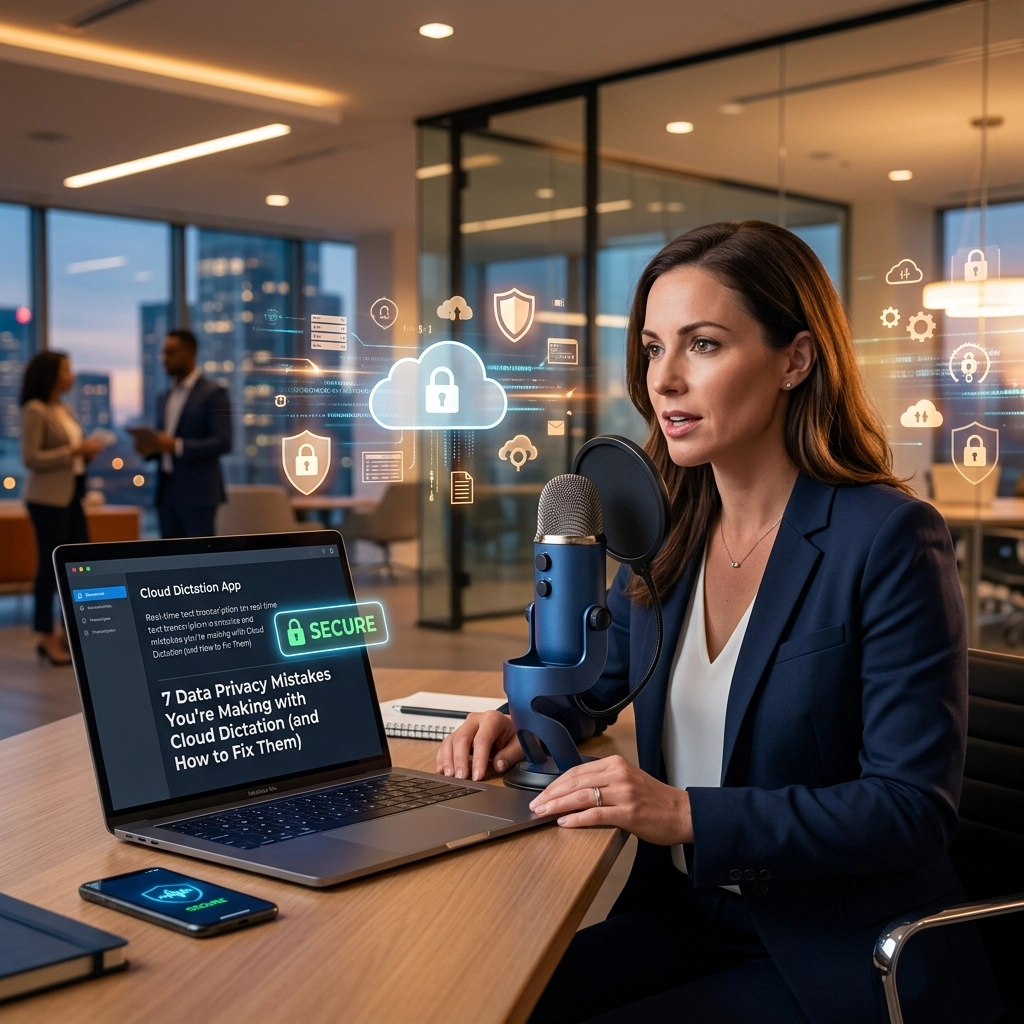
Security is not a feature. It is a foundation.
For IT and security professionals, the rise of AI dictation is a double-edged sword. On one side, productivity gains are massive. On the other, the data leak surface area has exploded. Most teams are flying blind. They treat audio data as "transient" or "temporary."
They are wrong.
Audio is a biometric fingerprint. It contains names, trade secrets, and sensitive client data. When you use cloud-based dictation tools, you are not just using a service. You are exporting your company’s most valuable intellectual property to a third-party server.
Stop compromising. Start securing. Here are the seven critical data privacy mistakes you are making with cloud dictation and the immediate steps to fix them.
1. You Are Transmitting Biometric Data to Unvetted Servers
Every time a user clicks "Record" in a cloud-based app, an audio file travels across the public internet. It lands on a server you do not own. It is processed by hardware you do not control.
This is the "Exit Point" mistake. You have spent millions on firewalls and endpoint security, only to let users stream high-fidelity internal meetings to a remote data center. Cloud providers claim they delete the data. Can you prove it? In an audit, "trust us" is not a defense.
The Fix: Eliminate the Transmission.
Stop the data at the source. Use local AI dictation that processes audio on the machine's NPU or GPU. If the audio never leaves the laptop, the attack surface is zero. Local processing is the only way to ensure 100% data residency.

2. You Are Relying on the "BAA Illusion"
Many IT departments feel safe because they have a Business Associate Agreement (BAA) or a SOC2 report from their cloud provider. This is a false sense of security.
A BAA does not prevent a breach; it only assigns liability after the damage is done. If a cloud provider suffers a zero-day exploit or an internal rogue actor accesses their database, your data is gone. The "cloud" is just someone else's computer. For regulated industries: Legal, Healthcare, Defense: liability is not the issue. The leak is the issue.
The Fix: Adopt an Air-Gapped Model.
Remove the need for a BAA by removing the third party. If you use a tool like VoiceType that operates entirely offline, you don't need to vet a cloud provider's security stack. You own the stack. You own the security. You own the outcome.
3. You Are Ignoring the Sub-Processor Shadow
Cloud dictation companies rarely act alone. They use sub-processors for "model improvement," "quality assurance," or "infrastructure support." Your audio data might be routed through three different companies before a transcript is even generated.
Each sub-processor is a new point of failure. Each one is a target for hackers. You cannot secure what you cannot see.
The Fix: Demand Zero Third-Parties.
Audit your tools. If the software requires an internet connection to function, it is likely using sub-processors. Switch to software that functions in airplane mode. This ensures that the only entity seeing your data is your organization.

4. You Are Storing "Data at Rest" on Rented Hard Drives
Even if a cloud provider encrypts your data at rest, they hold the keys. If their key management system is compromised, your "encrypted" audio files are as clear as a bell.
Storing sensitive dictations: legal strategies, patient diagnoses, or product roadmaps: on a cloud drive is an unnecessary risk. It creates a permanent record in a location you do not manage. It is a ticking time bomb for discovery or data theft.
The Fix: Keep Data on Secure Local Endpoints.
Direct your dictation output to your internal, managed drives. Use local AI tools that save transcripts directly to your encrypted local storage. By keeping data "at home," you leverage your existing enterprise-grade security protocols rather than relying on a vendor’s.
5. You Are Allowing Metadata Leaks
Privacy isn't just about the audio content. It is about the metadata.
Cloud tools track when you record, where you record, and how long you record. This "usage data" is often sold to advertisers or used for "product optimization." For a high-security firm, the fact that a CEO is dictating a 60-minute memo at 2:00 AM on a Sunday is a signal. It tells a story of a pending merger, a crisis, or a pivot.
The Fix: Go Dark.
Offline tools don't phone home. They don't generate telemetry. They don't track your habits. Use local software that treats your activity as your business. No logs on remote servers means no patterns for attackers to exploit.

6. You Are Victim to "Shadow IT" Dictation
If you haven't provided a secure, local alternative, your employees are using free cloud dictation apps on their phones. This is Shadow IT at its most dangerous.
Users prioritize convenience over security. They want to talk instead of type. If the company doesn't provide a tool, they will find one on an app store. These "free" apps often survive by harvesting and selling user data. Your corporate secrets are currently being used to train some startup's next LLM.
The Fix: Provide a Superior Local Alternative.
Stop fighting human nature. Give your team a tool that is faster and better than the cloud alternatives. Local AI dictation is often faster because it doesn't have to wait for upload/download speeds. When the secure way is the easy way, Shadow IT disappears.
7. You Are Paying for Perpetual Vulnerability
Subscription-based cloud tools are a "rented" security model. You pay every month for the privilege of being vulnerable to their next update, their next outage, or their next policy change.
When a cloud provider changes their Terms of Service to include "data training," you have two choices: accept the risk or migrate your entire team. Neither is a good option.
The Fix: Reclaim Ownership.
Invest in software that stays on your terms. Local, air-gapped AI dictation from VoiceType puts you back in the driver's seat. You decide when to update. You decide where the data goes. You decide who has access.
The Reality of Modern Dictation
The era of "Cloud-First" is ending. The era of "Local-First" is here.
IT professionals are realizing that the most secure connection is no connection at all. Air-gapping is no longer a niche requirement for intelligence agencies; it is a standard requirement for any business that values its privacy.
Why VoiceType is the Solution:
- Zero Internet Required: Works in airplane mode.
- Local AI Engine: Uses your device's hardware to transcribe in real-time.
- No Data Harvesting: We never see your audio. We never see your text.
- Enterprise Ready: Fast, accurate, and direct.

Direct Action Plan for IT Leads:
- Audit the Landscape: Identify every dictation tool currently in use across your departments.
- Assess the Risk: Check which tools require an internet connection to process audio.
- Block the Leaks: Update your security policy to prohibit the transmission of audio data to unvetted cloud servers.
- Deploy Local AI: Replace cloud-based subscriptions with local, air-gapped software.
- Reclaim Peace of Mind: Know that your company's voice stays within your company's walls.
The transition to local AI isn't just about privacy. It’s about performance. It’s about moving faster without the lag of the cloud. It’s about working anywhere: on a plane, in a secure facility, or in a remote home office: without worrying about the strength of the Wi-Fi or the security of the server.
Stop making these mistakes. Fix your dictation workflow today.
Reclaim your privacy. Own your data. Use VoiceType.
Leave a Reply