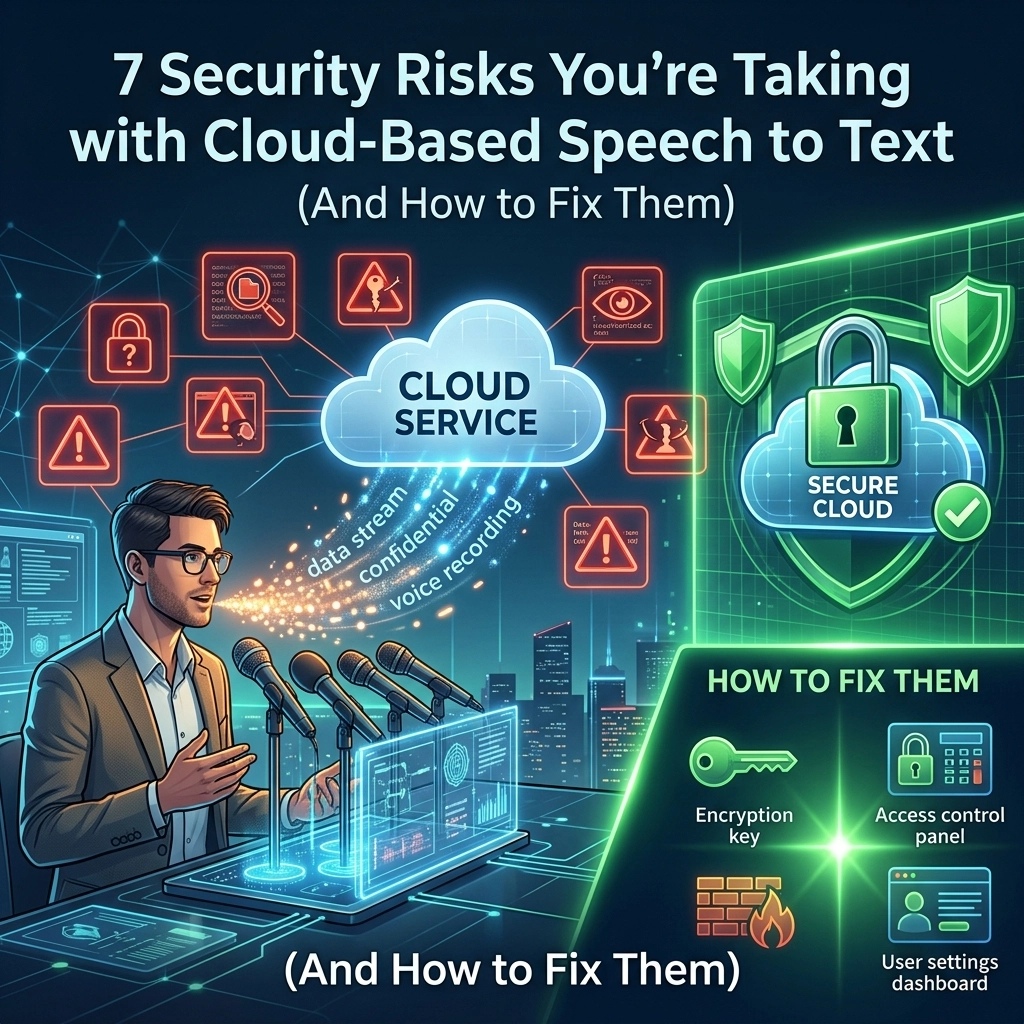
Stop uploading your brain to the cloud.
Every time you hit "record" on a standard dictation app, you are making a choice. You are choosing convenience over privacy. You are sending your most private thoughts, client secrets, and proprietary ideas across the open internet.
The cloud is not a magical safe. It is someone else’s computer.
At VoiceType, we see the aftermath. We see professionals who realize too late that their sensitive data is sitting on a server in a jurisdiction they can’t name, owned by a corporation that doesn't care.
Privacy is not a feature. It is a right. Security is not an option. It is a necessity.
Here are the 7 security risks you are taking right now with cloud-based speech-to-text, and exactly how to fix them.
1. Data Interception: The "Man-in-the-Middle"
Your voice travels. It starts at your microphone. It moves through your Wi-Fi. It hits your ISP. It jumps across multiple servers before it reaches the "AI" in the cloud.
Every jump is a vulnerability.
Hackers look for these gaps. They sit on public Wi-Fi networks. They wait for unencrypted or poorly secured packets. Even with standard encryption, metadata remains visible. A sophisticated attacker can see who you are talking to, when, and for how long.
The Risk: Your raw audio is intercepted before it even gets processed.
The Fix: Eliminate the travel. Use local AI. If the data never leaves your device, there is nothing to intercept. Secure your local network with a robust firewall and ditch the cloud transit entirely.

2. The Centralized Honey Pot
Cloud providers are targets. They store millions of hours of audio. To a hacker, a cloud-based transcription service is a gold mine.
If a provider stores your transcripts on a centralized server, they are creating a "honey pot." One successful breach gives a hacker access to everything. We have seen this before. In 2019, misconfigured cloud buckets exposed thousands of hours of sensitive medical data.
You are trusting a third party to configuration their servers perfectly. Every single day.
The Risk: A single breach at the provider level exposes your entire history of transcripts.
The Fix: Stop storing data in the cloud. Process your audio locally on your hardware. Keep your files on your own encrypted drive. Control the keys. Control the access.
3. Your Secrets Are Their Training Fuel
Read the fine print. Most "free" or cheap cloud dictation services include a clause about "improving the service."
This is code for AI training.
They use your voice. They use your specific industry jargon. They use your private client names to make their models "smarter." Your intellectual property is being harvested to build a product that the provider then sells back to you. You are paying them to take your data.
The Risk: Your proprietary information becomes part of a public AI model's training set.
The Fix: Use a "Zero-Data" solution. Choose software that processes locally and has a strict no-log policy. At VoiceType, we believe your data should stay yours. No training. No harvesting. No exceptions.

4. Personally Identifiable Information (PII) Exposure
Speech-to-text doesn't just capture ideas. It captures names. It captures addresses. It captures credit card numbers and social security numbers mentioned in passing.
Cloud AI often lacks the context to redact this information automatically. It saves it in plain text. If that text is leaked, the PII exposure is catastrophic. For those in legal or medical fields, this isn't just a risk, it's a massive compliance violation.
The Risk: Accidental recording of sensitive PII that stays indexed and searchable on a cloud server.
The Fix: Use on-device processing. When the transcription happens locally, the "searchable" text stays on your machine. You can scrub PII immediately without it ever touching a third-party database.
5. The "Always-On" Microphone Trap
Cloud apps often require "wake word" detection. To hear "Hey Siri" or "Okay Google," the device must always be listening.
False activations happen. All the time. A TV show, a conversation in the next room, or a misheard word can trigger a cloud upload. You might be recording a private meeting without even knowing it. That audio is then sent to the cloud, transcribed, and stored.
The Risk: Unintended recordings of private conversations being sent to the cloud.
The Fix: Disable cloud-based voice assistants. Move to a "Push-to-Talk" or "Manual Start" system that operates locally. Ensure your AI only works when you tell it to work.

6. Lack of Regulatory Compliance (GDPR, HIPAA, SOC2)
Are you a lawyer? A doctor? A financial advisor?
If you use a cloud-based transcription tool that isn't specifically enterprise-grade and heavily audited, you are likely violating your industry's regulations. GDPR requires you to know exactly where data is stored. HIPAA requires strict Business Associate Agreements (BAAs).
Most consumer-grade cloud apps don't offer these. They process data in whatever region is cheapest for them.
The Risk: Massive fines and loss of license due to illegal data handling.
The Fix: Shift to local AI. If the data never leaves your computer, the "storage" location is simply your office. This simplifies compliance instantly. You don't need a BAA for a tool that doesn't see your data.
7. Voice Spoofing and Replay Attacks
When you upload your voice to the cloud, you are providing a biometric sample.
In the age of Deepfakes, your voice is a key. If a cloud provider's audio database is leaked, hackers have a perfect template of your voice. They can use this to bypass voice-activated security on your bank account or to scam your employees with "vishing" (voice phishing) attacks.
The Risk: Your voice architecture is stolen and used to impersonate you.
The Fix: Do not store raw audio files in the cloud. Process the audio into text locally and delete the audio source immediately. Keep your biometric signatures off the internet.
The Ultimate Solution: Local AI with VoiceType
The "old way" of doing things was slow. You had to choose between the speed of the cloud or the security of manual typing.
That era is over.
VoiceType represents the new way. We provide the power of world-class AI without the vulnerability of the cloud.
Why Local AI Wins:
- Zero Latency: No waiting for files to upload or download.
- Offline Capability: Work from a plane, a basement, or a secure bunker. No internet required.
- Total Privacy: Your data stays on your RAM and your hard drive.
- Ownership: You own the tool. You aren't "renting" your privacy on a monthly basis from a provider that can change their terms at any time.
Reclaim Your Privacy
Stop being a data point. Stop letting big tech companies profit off your voice.
You wouldn't leave your physical files on a park bench. Don't leave your digital transcripts on a cloud server.
Direct Action Steps:
- Audit your current tools. Find out where your data is stored.
- Delete old cloud transcripts. Clean out your history today.
- Switch to local processing. Use software that runs on your hardware.
The security risks of the cloud are real. They are documented. They are happening now.
Fix them. Move your workflow to VoiceType.
Work faster. Work safer. Keep your words to yourself.

Leave a Reply