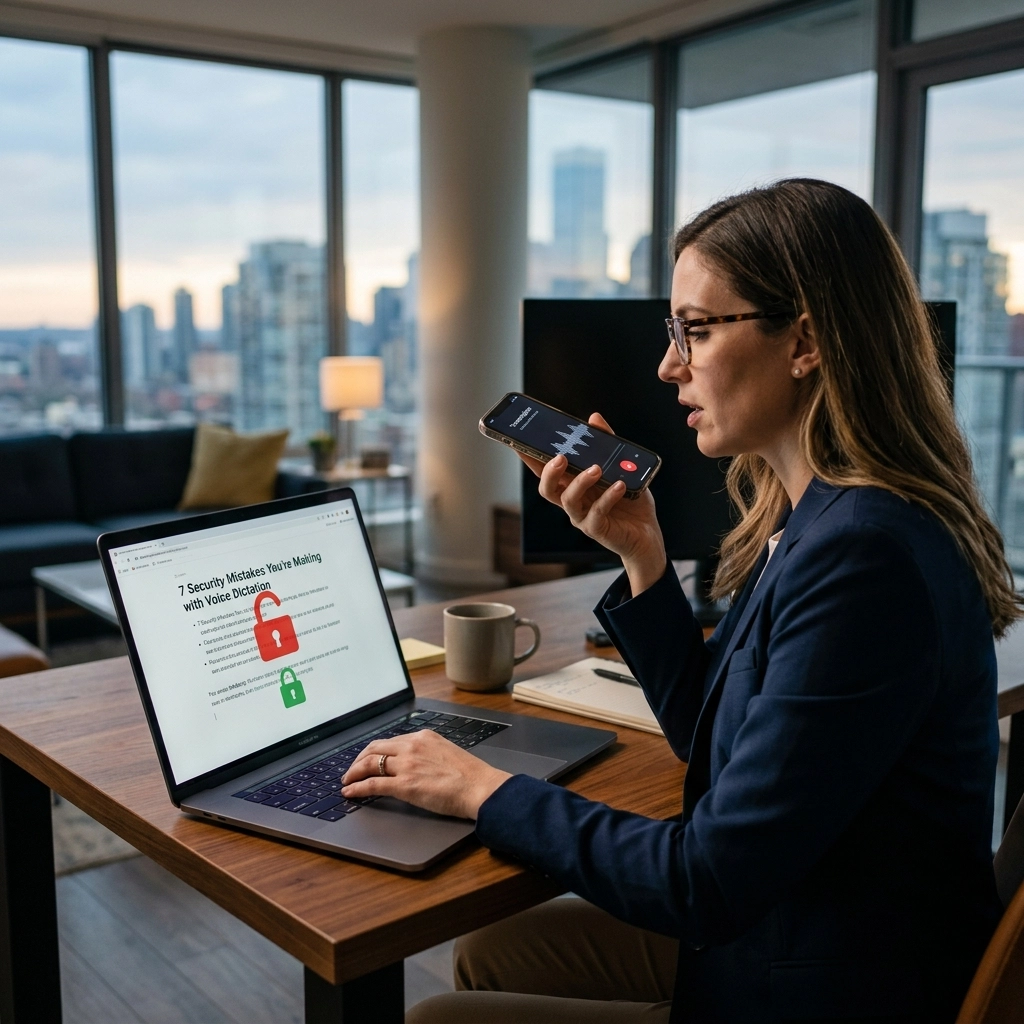
You speak. They listen.
Most people think voice dictation is a harmless convenience. You talk to your computer. Your words appear on the screen. It feels like magic. But behind the curtain, your most sensitive data is traveling across the globe. It is being stored, analyzed, and potentially exposed.
If you are a lawyer, a doctor, or an executive, this isn't just a tech glitch. It is a professional liability. You are handling trade secrets, patient records, and privileged communications. You cannot afford to be reckless.
Stop treating your voice like public property. Here are the seven critical security mistakes you are making with voice dictation and exactly how to fix them.
1. Shipping Your Audio to the Cloud
This is the foundation of every security failure in modern dictation. Most tools use "cloud processing." This is a polite way of saying they take your voice, turn it into a data packet, and send it to a server farm in another country.
You lose control the moment you hit record. Your audio travels through multiple routers and switches. It sits on a third-party server. You don't own that server. You don't control who has access to it. Encryption helps, but it is not a wall. It is a lock that can be picked or bypassed.
The Fix: Go 100% Offline.
Stop sending your data away. Use software that processes your voice locally on your own machine. If the audio never leaves your hard drive, it can never be intercepted. It’s that simple. Local processing turns your computer into a vault. Cloud processing turns it into a sieve.

2. Ignoring the "Permanent Record" Trap
Cloud-based tools love to keep things. They store your audio files. They store your transcripts. They claim it’s for "user experience" or "syncing across devices." In reality, they are building a library of your private thoughts.
Think about your last sensitive meeting. Now imagine that transcript sitting on a server for the next ten years. Hackers don't just target live data; they target archives. A data breach in 2029 could expose a confidential memo you dictated today.
The Fix: Eliminate the Archive.
Demand zero-retention. When you use a local tool like VoiceType, there is no central server to store your data. Your transcripts belong to you. Your audio stays with you. When you delete a file on your computer, it is gone. There is no hidden "backup" in the cloud waiting to be leaked.
3. Relying on Opaque Privacy Settings
"We value your privacy." Every company says it. Few mean it.
Most dictation software hides its most intrusive data collection practices deep inside fifty-page Terms of Service documents. They default to the least secure settings. They count on you being too busy to check the boxes that opt you out of "product improvement programs."
If you haven't manually hardened your settings, you are likely leaking data by default. You are a data point in their quarterly report.
The Fix: Take Ownership.
Stop trusting "default" settings. Switch to a utility that is private by design, not by configuration. Professional-grade software shouldn't require you to hunt through menus to stay safe. It should be incapable of spying on you from the start.

4. Training Their AI on Your Secrets
This is the hidden cost of "free" or subscription-based cloud tools. You aren't just a customer; you are a trainer. These companies use your voice patterns, your vocabulary, and your specific industry jargon to "tune" their AI models.
If you are a patent attorney dictating a new invention, you are feeding that invention into an AI training set. You are giving away your intellectual property to help a tech giant build a better product. You are paying them to let them steal your expertise.
The Fix: Use Private Models.
Use AI that is already trained and runs entirely on your hardware. You want a silent utility, not a social learner. Your dictation tool should be a tool, not a student. It should work for you, and only you.
5. Vulnerability to Interception During Transmission
Data in motion is data at risk. Even with "military-grade" encryption, the act of transmitting audio over the internet creates a surface area for attack. Man-in-the-middle attacks are real. Compromised Wi-Fi networks in hotels or cafes are real.
If you dictate a sensitive email while sitting in an airport lounge using a cloud-based tool, you are practically broadcasting your secrets. You are relying on the security of a public network to protect your most valuable assets.
The Fix: Close the Connection.
The most secure network is no network at all. Local dictation works without an internet connection. You can be in a lead-lined room or an airplane at 30,000 feet. Your dictation will still work, and it will remain 100% private. No transmission means no interception.

6. Overlooking False Activations
We’ve all seen it. You’re having a private conversation, and suddenly your phone or computer chimes in because it thought it heard a "trigger word."
In a cloud-connected environment, that accidental activation sends a recording of your private conversation to a server. These "accidental" recordings happen millions of times a day. They are often reviewed by human contractors to "improve voice recognition." Do you want a random contractor listening to your private office conversations?
The Fix: Physical Control.
Use tools that only listen when you tell them to. More importantly, use tools that stay local. If a local tool accidentally activates, the "mistake" stays on your machine. It doesn't get uploaded. It doesn't get reviewed by a stranger. You maintain the "off" switch.
7. Accepting the Risk of Massive Data Breaches
Every major cloud provider has been breached. It is a matter of "when," not "if." Centralized databases are "honey pots" for hackers. One successful breach can expose the data of millions of users.
When you use a cloud dictation service, you are tying your professional reputation to their security team. If they slip up, you pay the price. Your clients won't care that it was the software provider's fault. They will care that you chose an insecure tool.
The Fix: Decentralize Your Risk.
Don't be part of a honey pot. When your data stays on your machine, you are no longer a target of mass breaches. A hacker would have to target you specifically and breach your physical hardware to get your data. This increases your security by orders of magnitude.

Why Professionals Are Moving to VoiceType
The "old way" of dictation is broken. It is slow, it is intrusive, and it is risky. You shouldn't have to choose between productivity and privacy.
VoiceType is the "new way." It is a professional utility built for people who value their time and their secrets.
- 100% Offline: No audio ever leaves your computer. Ever.
- No Subscriptions: You own the software. You don't rent it.
- Blazing Fast: Local processing means zero lag. No waiting for a server to respond.
- Total Privacy: We don't want your data. We don't see your data. We can't leak what we don't have.
Stop making these security mistakes. Reclaim your privacy. Reclaim your focus.
Your voice is your most personal data. Keep it that way.
Visit voicetype.in to secure your workflow. It’s time to dictate with total confidence. The cloud is for the weather. Your work stays on the ground.

Leave a Reply