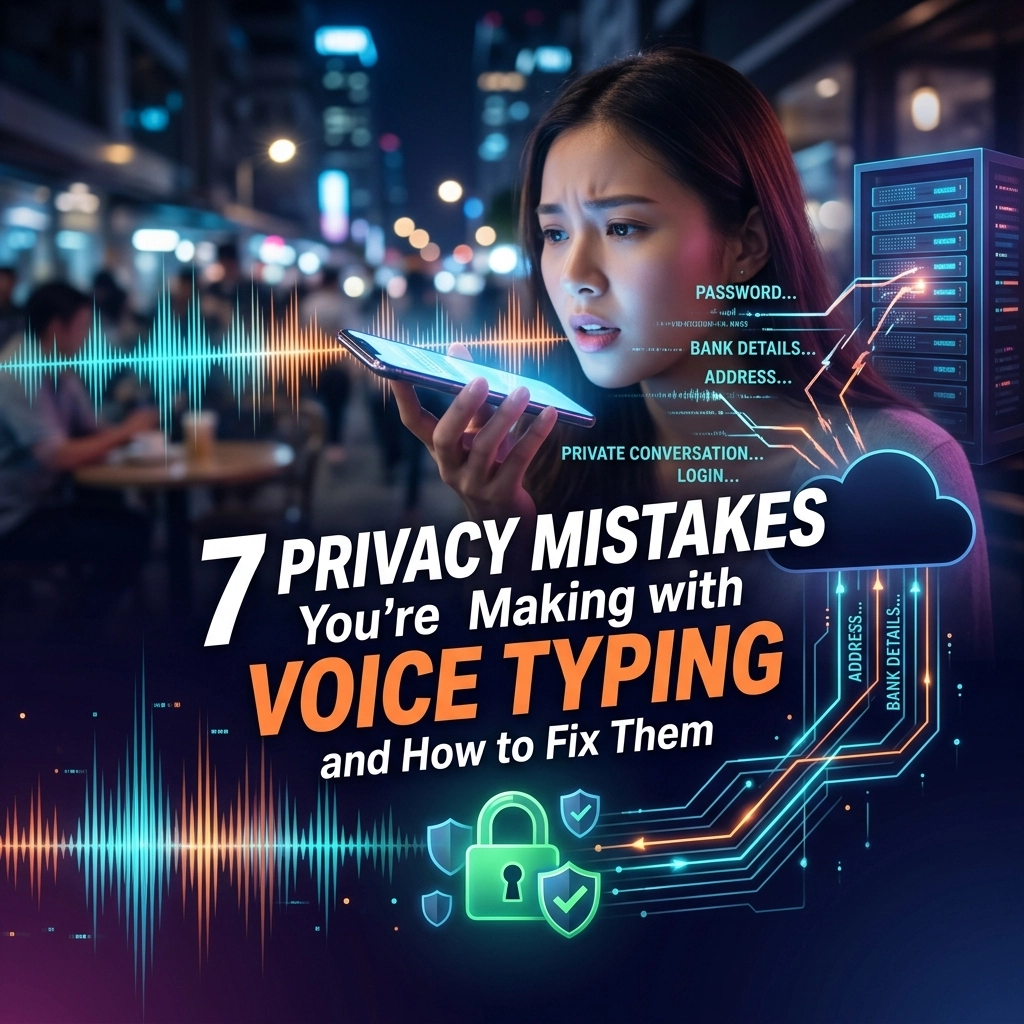
Your voice is a fingerprint. It is unique. It is permanent. It is your most personal data point.
Every time you click that little microphone icon on your keyboard, you are making a choice. Most of the time, it is the wrong one. You are trading your privacy for convenience. You are handing over your intellectual property to Big Tech servers. You are letting your most sensitive ideas float through the cloud, hoping nobody intercepts them.
The "Old Way" of voice typing is a security nightmare. It is slow. It is invasive. It is risky.
The "New Way" is local. It is fast. It is yours. At VoiceType, we believe your words should stay on your machine. Period.
Here are the seven privacy mistakes you are making right now: and how to fix them instantly.
1. You Are Renting Your Own Words
Most voice typing software is a subscription to surveillance. You "rent" the ability to speak to your computer. In exchange, the provider keeps a copy of your audio to "improve their models."
This is a trap. You don't own the output. You don't control the storage. If the company changes its terms, your data is already gone.
The Fix: Switch to Local AI.
Stop sending your thoughts to a remote server. Use tools that process everything on your hardware. When the AI lives on your device, you own the engine. You own the fuel. You own the results. Local AI is the only way to ensure your professional work remains professional.

2. You Ignore the "Cloud Leak"
When you use standard dictation, your audio travels across the internet. It hits a server. It gets transcribed. It comes back. Every step is a point of failure. Hackers want your data. Governments want your data. Advertisers want your data.
Cloud processing is a middleman you don't need. It introduces latency. It introduces risk.
The Fix: Eliminate the Middleman.
Demand offline functionality. If your voice typing software requires an internet connection to work, it is a liability. True productivity tools should work in a bunker. They should work on a plane. They should work without a handshake with a third-party server. VoiceType prioritizes this "Local-First" architecture.
3. You Treat Your Voice Like a Password
Passwords can be changed. If your password is leaked, you reset it. You move on.
Your voice cannot be reset.
Voice patterns are biometric data. Once a recording of your voice is stored in a database, it can be used to synthesize your speech. It can be used to bypass security systems. It is a permanent marker of your identity. Giving this data away to a "free" service is the most expensive mistake you can make.
The Fix: Protect Your Biometrics.
Treat your voice audio like a social security number. Do not upload it. Do not "share" it for better accuracy. High-quality local AI models are already accurate enough. They don't need to "learn" from your specific private recordings in the cloud. They should learn on your terms, on your machine.
4. You Dictate Sensitive Data in Public
Eavesdropping isn't just a digital threat. It's a physical one. Professionals often dictate emails, legal briefs, or medical notes in shared workspaces or cafes.
You think you're being productive. You're actually leaking client secrets to the person at the next table. You are compromising confidentiality with every breath.
The Fix: Use Whisper-Quiet Environments or Targeted Tools.
Only dictate sensitive information in secure, private areas. If you must work in public, use a tool that doesn't require you to shout. Better yet, move to a workflow where your "drafting" happens via voice in private, and your "editing" happens in public. Secure your perimeter.

5. You Trust the "Delete" Button
Big Tech companies love to tell you that you can "delete your voice history."
Don't believe them.
Deletion is often just a "hide" command. The metadata remains. The "learned patterns" from your voice remain in the model. Once data touches the cloud, it is effectively permanent. You cannot un-ring the bell. You cannot un-upload a file.
The Fix: Never Upload in the First Place.
The best way to delete data is to never create it on someone else's server. Local AI systems don't have a "cloud history" because there is no cloud. Your history is a file on your hard drive. When you delete that file, it is actually gone. That is true privacy.
6. You Grant Excess Permissions
Check your settings. How many apps have "Always On" access to your microphone?
Many voice typing tools ask for permissions they don't need. They want access to your contacts. They want your location. They want to "sync" across devices. This isn't for your benefit. It's for their data map. They want to know who you are talking to and where you are when you say it.
The Fix: Audit Your Microphone Access.
Revoke permissions for every app that doesn't need them. Use a dedicated, professional-grade tool like VoiceType that does one thing: turns your speech into text. It doesn't need to know your location. It doesn't need to see your photos. Keep your tools focused and your permissions tight.
7. You Sacrifice Security for "Free"
Free tools are never free. You pay with your data. You pay with your privacy. You pay with your professional integrity.
Professional work requires professional tools. If you are a CEO, a lawyer, or a researcher, using a free consumer-grade voice assistant is a breach of your own standards. It is a shortcut that leads to a dead end.
The Fix: Invest in Privacy.
Pay for software that respects you. Professional AI tools are built with security as a feature, not an afterthought. When you pay for a tool like VoiceType, you are buying a utility. You are not the product. The software is the product.

Why Local AI is the Only Path Forward
The era of "Cloud-First" is ending. It was a transition phase. We sacrificed security because our computers weren't fast enough to handle AI locally.
That time has passed.
Your laptop is now a powerhouse. It can run sophisticated neural networks without breaking a sweat. There is no longer a technical excuse to send your audio to a server farm in another country.
Local AI offers three massive advantages:
- Zero Latency: Your text appears instantly. No waiting for a round-trip to the server.
- Total Privacy: Your data never leaves your sight. You are compliant with GDPR, HIPAA, and every other acronym that matters.
- Complete Ownership: You own the software. You own the output. You are not a "user" in someone else's ecosystem. You are the master of your own.
Stop Leaking. Start Leading.
Privacy is not a luxury. It is a requirement for professional excellence. If you are serious about your work, you must be serious about how that work is created.
Stop making these seven mistakes. Stop feeding the cloud. Stop giving away your biometric identity.
Reclaim your time. Reclaim your privacy. Reclaim your voice.
The future of work is local. The future of work is secure. The future of work sounds like you: and only you.

Take control of your workflow today.
Check out how we are building the most secure, local-first voice typing experience at VoiceType. No clouds. No leaks. Just your words, exactly where they belong.
Leave a Reply