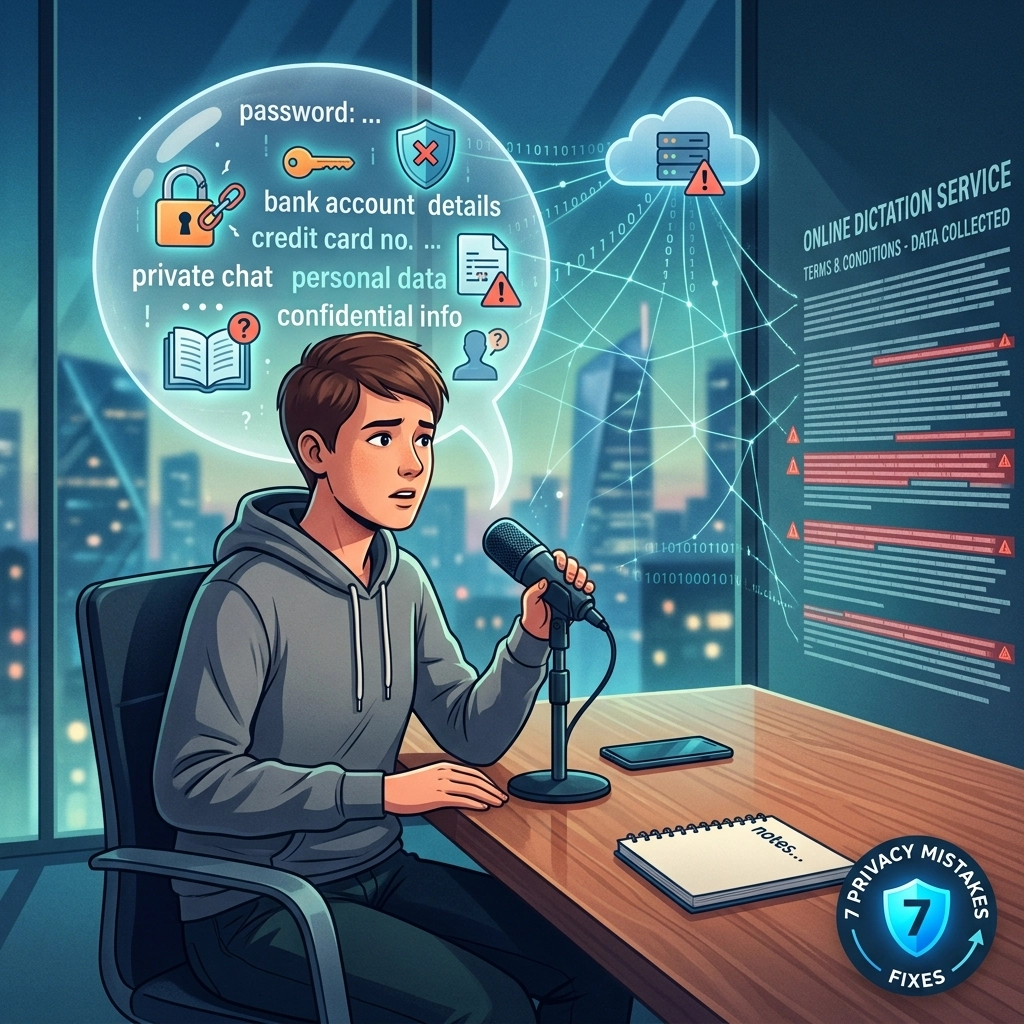
Stop talking to strangers.
Every time you hit the record button on a standard dictation app, you are opening a door. You are inviting a corporation into your office. You are handing over your thoughts, your client secrets, and your unique biometric signature.
Most professionals think they are being productive. In reality, they are being reckless.
Online dictation is a privacy nightmare disguised as a convenience. You are trading your most sensitive data for a few saved minutes. It is a bad trade. It is a dangerous trade.
Here are the seven privacy mistakes you are making right now and exactly how to fix them.
1. Using Cloud-Based Dictation as Your Default
This is the foundation of the problem. If your audio travels through a wire to reach a server, you have lost control.
Cloud dictation services process your voice on hardware they own. They see what you say. They store what you say. They can read what you say. It does not matter if they promise "encryption." If they hold the keys to that encryption, the lock is useless.
A data breach at a major provider means your voice recordings are now public property. Hackers do not care about your productivity. They care about your data.
The Fix: Switch to local-first processing.
Stop sending your voice to the cloud. Use software that lives entirely on your machine. If the AI runs on your laptop, the data stays on your laptop. No servers. No wires. No leaks.

2. Ignoring the Fact That Your Voice Is a Biometric Fingerprint
You can change a compromised password. You can cancel a stolen credit card. You cannot change your voice.
Your voice is a biometric identifier. It is as unique as your fingerprint or your retina. Online dictation services often extract "voiceprints" from your recordings. They use these to identify you across different platforms.
If this biometric data is leaked, it is gone forever. You cannot get a new voice. You are vulnerable to deepfakes, identity theft, and unauthorized access for the rest of your life.
The Fix: Treat your voice like a master key.
Only use tools that promise zero biometric extraction. If an app needs to "learn" your voice on their server, delete it. Your voice belongs to you, not a database.
3. Falling for the "Improvement" Trap
Look at your settings right now. You will likely find a toggle labeled "Help us improve our service" or "Share audio snippets for AI training."
This is corporate speak for "We are using your private thoughts to build our next product."
When you leave this enabled, humans often listen to your "anonymous" clips to check for accuracy. These humans are often low-paid contractors. They hear your legal strategies. They hear your medical diagnoses. They hear your internal company secrets. There is nothing "anonymous" about your specific voice discussing your specific clients.
The Fix: Opt out immediately.
Go into your settings and kill the "improvement" features. Better yet, use a tool like VoiceType that doesn't have a "training" department because it doesn't want your data in the first place.

4. Trusting "Privacy-First" Marketing Without Reading the Fine Print
Marketing is cheap. Privacy is expensive.
Many apps claim to be "secure" or "private." Then you read the privacy policy. You find out they share data with "trusted partners." They share metadata with "advertisers." They store transcripts for "compliance."
A company can call itself "privacy-first" while still selling your metadata to 40 different ad networks. Metadata tells them when you work, where you are, and how often you speak. It is a map of your professional life.
The Fix: Look for the "Offline" test.
Turn off your Wi-Fi. Does the dictation still work? If it stops, it is not private. Real privacy doesn't need an internet connection. If the app requires a login and a constant stream of data, you are the product.
5. Overlooking the Risk of Plaintext Logs
Even if an app processes audio locally, it might store the results poorly.
Some "local" AI tools are built lazily. They store your transcripts in plaintext files on your hard drive. They leave your API keys exposed in simple folders. They keep logs of every window title you had open while you were talking.
If you lose your laptop or get hit by simple malware, your entire dictation history is sitting there in a text file for anyone to read.
The Fix: Use professional-grade architecture.
Demand tools that prioritize local security as much as local processing. Your transcripts should be as secure as your banking information.

6. Mixing Personal and Professional Dictation Tools
You wouldn't use a child's toy to lock your front door. So why are you using consumer-grade voice assistants for professional work?
Siri, Alexa, and Google Assistant are designed for consumers. They are designed to collect data to sell ads and products. Using them to dictate a confidential memo or a patient's notes is a massive compliance risk.
These tools are built for "convenience," which is often a code word for "data harvesting." They are always listening. They are always uploading.
The Fix: Separate your tools.
Use a dedicated, professional AI tool for your work. Keep your work dictation isolated from your personal devices. Professional work requires professional tools.
7. Ignoring Regulatory and HIPAA Requirements
If you are a lawyer, a doctor, or a financial advisor, your privacy mistakes aren't just annoying. They are illegal.
Using a non-compliant cloud dictation tool can lead to massive fines. It can lead to the loss of your license. Many popular tools are not HIPAA compliant. They do not offer Business Associate Agreements (BAAs). They do not meet the "minimum necessary" standard for data access.
The moment that audio leaves your device and hits a third-party server, you are likely in violation of your professional ethics.
The Fix: Eliminate the middleman.
The easiest way to be compliant is to never share the data. Local AI is the ultimate compliance hack. If the data never leaves your sight, you don't have to worry about who else is looking at it.

Why Local AI is the Only Future for Secure Work
The "old way" of doing things is broken.
The old way was renting your tools from a giant corporation. You paid them a subscription, and they took your data as a bonus. It was slow, it was risky, and it was annoying. You were always one server outage away from being unable to work. You were always one data breach away from a career-ending disaster.
The "new way" is local.
Local AI is about reclaiming your power. It is about owning the hardware and the intelligence. When you use VoiceType, you aren't renting a service. You are deploying a silent, powerful utility that works behind the scenes.
It is faster because there is no upload time.
It is safer because there is no server.
It is satisfying because you are in control.
Reclaim Your Privacy Today
You deserve to work without being watched. You deserve to speak without being recorded by a corporation.
The solution isn't to stop dictating. Dictation is the most efficient way to work. It is the fastest way to get thoughts from your head to the screen. The solution is to change where the work happens.
Stop making these mistakes.
Delete the cloud-based apps.
Disable the "improvement" settings.
Switch to a local-first workflow.
Your voice is your own. Keep it that way.

Ready to dictate without the risk?
Experience the power of 100% local, secure AI.
Get started with VoiceType today.
Leave a Reply