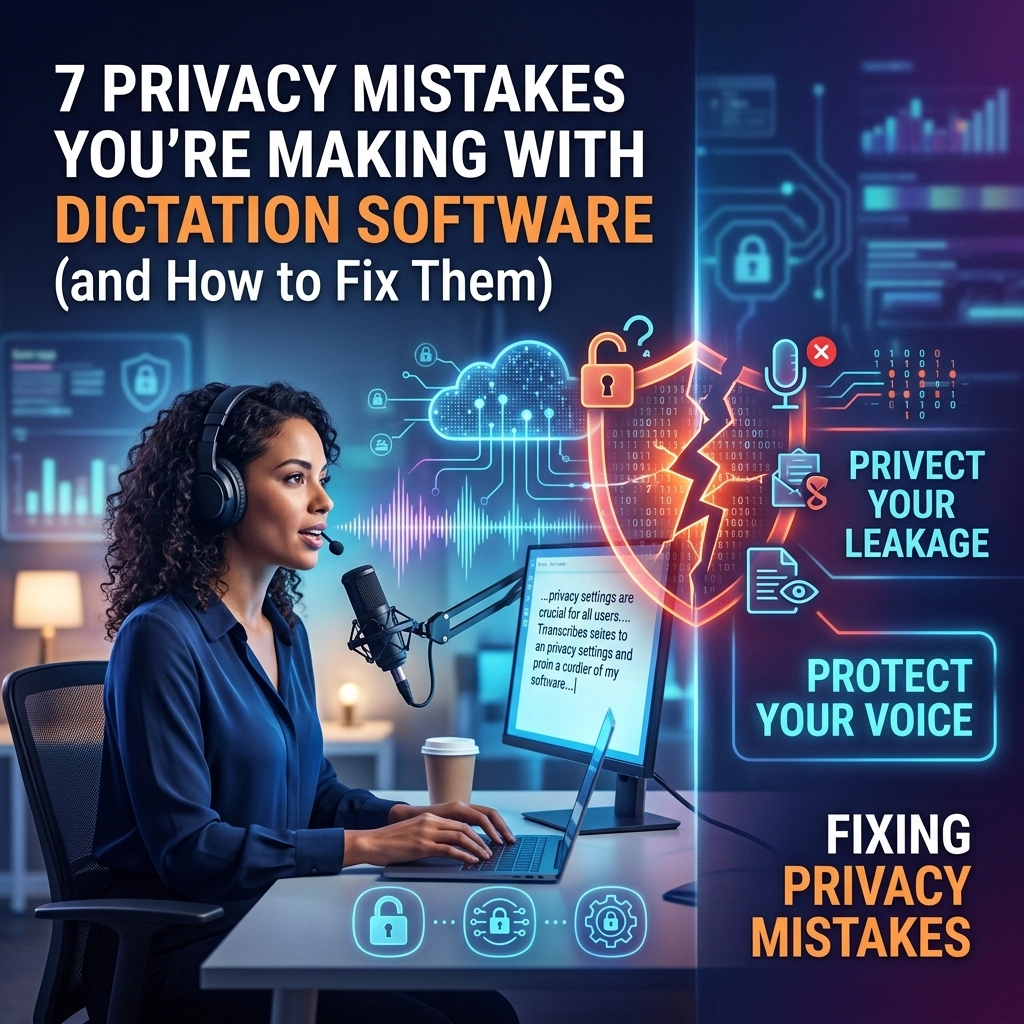
Privacy is not a feature. It is a right.
Every time you speak into a cloud-based dictation tool, you are making a choice. You are choosing to send your thoughts, your business secrets, and your personal life across the internet to a server owned by a billion-dollar corporation.
Most people don't think twice about it. They see the convenience. They see the speed. They ignore the risk.
But the risk is real. Data leaks happen. Servers get hacked. Companies change their terms of service overnight. If your voice data is in the cloud, you don't own it. You are renting access to your own words.
Stop giving your privacy away. Here are the seven biggest mistakes you’re making with dictation software and how to fix them right now.
1. You Are Sending Your Voice to the Cloud
This is the fundamental flaw of modern AI. Most dictation apps are just "shells." They take your audio, package it, and ship it to a remote server for processing.
The Problem: Your data travels thousands of miles. It passes through multiple gateways. It sits on a hard drive in a data center you will never visit. If that connection is intercepted, or if that server is compromised, your voice recordings are gone. You’ve lost control.
The Fix: Go local. Use software that processes your voice on your machine. No internet required. No data transmission. No risk. VoiceType uses local AI to turn your speech into text. Your voice never leaves your computer.

2. You Are "Training" Their AI for Free
Have you ever seen a checkbox that says "Help us improve our services"?
The Problem: This is code for "Let us use your private conversations to train our models." When you agree to this, your sensitive business data or personal reflections become part of a massive dataset. In some cases, human reviewers actually listen to these snippets to verify accuracy. Imagine a stranger in another country listening to your confidential client notes. It happens every day.
The Fix: Opt out of everything. Better yet, use a tool that doesn't have a "training" component. VoiceType is built to work for you, not to learn from you. We don’t need your data to make our AI better. We’ve already done the work.
3. You Are Granting Overkill Permissions
Open your phone settings. Look at your dictation app. Why does it need your location? Why does it need access to your contacts?
The Problem: Many apps use dictation as a Trojan horse. They want to scrape your contact list to map your social graph. They want your GPS coordinates to sell targeted ads. They "scour through contacts" under the guise of improving name recognition. It’s a privacy nightmare.
The Fix: Audit your permissions. If an app asks for anything other than your microphone, delete it. A dictation tool should do one thing: listen and type. It doesn't need to know where you live or who your friends are.
4. You Are Mixing Business Secrets with Personal Tools
The "Bring Your Own Device" (BYOD) trend is a security disaster for dictation.
The Problem: You use the same default assistant: like Siri or Google Assistant: for grocery lists and for dictating legal briefs. These consumer-grade tools are not designed for enterprise security. When you dictate trade secrets into a consumer cloud, you may be violating your company’s compliance policies or even NDAs.
The Fix: Separate your workflows. Use professional, privacy-first tools for work. Treat your voice like any other sensitive document. You wouldn't post a confidential contract on a public forum; don't dictate it into a public cloud.

5. You Are Ignoring Ambient Audio Leaks
Dictation software is a "hot" microphone. It doesn't just hear you.
The Problem: It hears the colleague talking in the background. It hears the sensitive phone call happening in the next cubicle. It hears the environment. If you are using a cloud-based tool, all that "background noise" is recorded and uploaded. You might inadvertently leak someone else’s secrets along with your own.
The Fix: Dictate in private. Use a directional microphone. Most importantly, use a tool that processes audio locally and instantly deletes the buffer after the text is generated.
6. You Are "Dictating but Not Reading"
Accuracy is a privacy issue.
The Problem: If your software misinterprets a word, it can change the entire meaning of a document. In the medical or legal fields, this is a massive liability. Many people use the "dictated but not read" disclaimer. This doesn't protect you; it identifies you as negligent. If a cloud-based error leads to a data breach or a legal error, the responsibility falls on you, not the software provider.
The Fix: Review every word. Local AI like VoiceType is incredibly accurate, but you are the final filter. Speed is nothing without precision. Take the thirty seconds to scan your text. Reclaim your reputation.

7. You Are Trapped in a Subscription Privacy Cycle
When you pay a monthly subscription for a cloud service, you are "renting" your privacy.
The Problem: The company can change its privacy policy at any moment. They can be acquired by a larger, less-ethical company. They can raise prices or shut down, leaving you with no way to access your history or your custom settings. You are at their mercy.
The Fix: Own your tools. Choose software that you buy once and run forever on your own hardware. This isn't just about money; it’s about sovereignty. When the software lives on your machine, you dictate the terms.
The New Way: Local AI Sovereignty
The "Old Way" of dictation is slow, risky, and dependent on the internet. It forces you to choose between productivity and privacy.
The "New Way" is different.
Imagine a tool that works as fast as you think.
Imagine a tool that works on a plane, in a basement, or in a high-security office with no Wi-Fi.
Imagine a tool that never asks for your data because it doesn't want it.
That is VoiceType.
We built VoiceType for the professionals who can’t afford to be wrong. For the CEOs, the lawyers, the doctors, and the creators who value their intellectual property. We stripped away the cloud, the subscriptions, and the data-mining.
What’s left is a silent, powerful utility. It sits on your computer. It waits for your command. It turns your voice into text with surgical precision. And it keeps its mouth shut.
Stop Making Mistakes. Start Reclaiming Your Privacy.
You wouldn't let a stranger stand in your office and take notes on everything you say. So why let a cloud server do it?
The fix is simple.
- Stop using cloud-based assistants for sensitive work.
- Deny unnecessary permissions.
- Switch to a local AI solution.
Your voice is the most personal data you have. It carries your tone, your emotions, and your secrets. Protect it like the asset it is.

The bottom line: If the AI is in the cloud, you are the product. If the AI is on your device, you are the owner.
Choose ownership. Choose VoiceType.
Leave a Reply