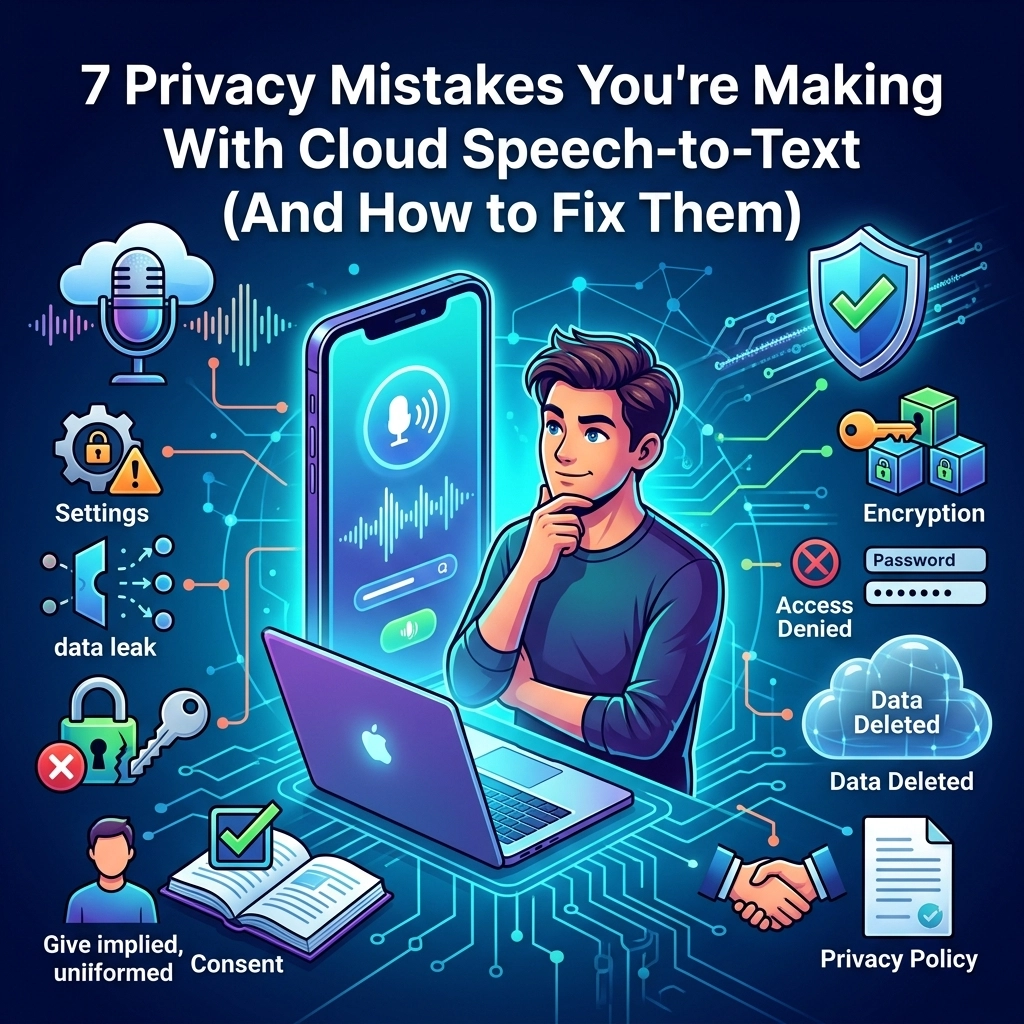
Stop sending your secrets to the cloud.
Every time you hit the record button on a standard dictation app, you aren’t just converting speech to text. You are handing over your intellectual property, your client’s sensitive data, and your own biometric identity to a server you don’t control.
The cloud is convenient. It is also a sieve.
If you think your "private" dictations are safe just because you have a password, you are wrong. Data leaks aren't a possibility; they are an inevitability when you use centralized AI services.
Here are the 7 critical privacy mistakes you are making right now with cloud speech-to-text: and how to fix them before your data becomes public property.
1. You Are Ignoring the "Always Listening" Trap
Most cloud-based voice systems rely on wake words or constant buffering. To respond instantly, these apps keep a small window of audio open at all times. This audio sits in a temporary buffer before it is transmitted to the cloud.
The mistake? False triggers. Background noise, a snippet of a TV show, or a conversation in the next room can trigger an upload. You are recording things you never intended to share. These unencrypted snippets sit on remote servers, waiting for a breach or a manual review by a low-paid contractor.
The Fix: Use local AI. Stop letting apps buffer audio to the cloud. With VoiceType, the processing happens on your device. If you aren’t actively dictating, nothing is being processed. Period.
2. You Are Storing Raw Audio in Unencrypted Cloud Buckets
Cloud providers love "buckets." They store massive amounts of raw audio data in centralized repositories like Amazon S3. The problem? These buckets are often misconfigured.
In 2019, tens of thousands of patient dictations were left publicly accessible because of a single open bucket. This isn't a rare occurrence. Hackers actively scan for these vulnerabilities. If your voice data is in the cloud, it is a target.
The Fix: Reclaim your data. Stop uploading raw audio to third-party servers. Keep your recordings on your own hardware. Use end-to-end encryption if you must move files, but better yet, don't move them at all.

3. You Are "Renting" Your Privacy to Third Parties
When you sign a Terms of Service for a free or subscription-based cloud transcriber, you often give them permission to "improve their models."
This is tech-speak for: "We are going to let our engineers and AI systems listen to your recordings to train our software."
You are paying a subscription fee to become the product. Your confidential business strategies and personal thoughts are being used to build a product that the provider then sells back to you. It is a loop where you lose every time.
The Fix: Demand ownership. Switch to a "Local-First" AI model. When the AI model lives on your machine, it doesn't need to send your data back to the mothership to get smarter. You own the tool; the tool doesn't own your data.
4. You Are Failing to Control Who Listens
Centralized cloud storage lacks granular access control. If a cloud provider has a security breach: or if a rogue employee decides to browse the database: your recordings are vulnerable.
Most companies don't realize that "role-based access" in the cloud is often a suggestion, not a hard rule. Once your audio is on their server, you lose the ability to see who is actually looking at it.
The Fix: Enforce physical boundaries. The best access control is a lack of internet access. If the data never leaves your computer, the only person who can access it is you. VoiceType ensures your words stay within your sight.
5. You Are Leaking Personally Identifiable Information (PII)
Think about what you dictate. Names of clients. Project titles. Home addresses. Credit card numbers. Medical histories.
Cloud speech-to-text engines transcribe these words and store them in plain text alongside the audio. This creates a double risk: a leak of the audio (biometric data) and a leak of the transcript (PII). For anyone in healthcare or finance, this is a HIPAA and GDPR nightmare waiting to happen.
The Fix: Anonymize or Localize. Do not trust a cloud provider to scrub your PII. Use a system that processes the text locally so that sensitive information never touches a public network.

6. You Are Neglecting Your Biometric "Voiceprint"
Your voice is as unique as your fingerprint. Unlike a password, you cannot change your voice if it is compromised.
Criminals use leaked voice data to create "deepfakes." They can clone your voice with just a few minutes of high-quality audio. If a hacker gets hold of your cloud-stored dictations, they can impersonate you to bypass voice-activated security at your bank or to scam your colleagues.
The Fix: Treat your voice like a biometric key. You wouldn't upload your fingerprints to a random cloud server; don't do it with your voice recordings. Keep your biometric data offline.
7. You Are Ignoring Regulatory Compliance
Using cloud-based dictation often puts you in violation of international data laws. If you are in the EU but your cloud provider stores data in the US, you are potentially breaching GDPR. If you are a doctor using a non-compliant cloud app for notes, you are violating HIPAA.
The legal fallout from a data breach is often more expensive than the breach itself. Ignorance is not a legal defense.
The Fix: Conduct an audit. Check where your data is stored. If you can't point to the exact hard drive where your data lives, you aren't in control. Switch to a solution that guarantees data residency by keeping everything on your local device.

The Solution: Stop Renting, Start Owning
The "old way" of doing things is slow, risky, and annoying. It involves waiting for uploads, worrying about privacy, and paying monthly fees for the privilege of being tracked.
The "new way" is Local AI.
VoiceType isn't just another productivity app. It is a silent, powerful utility that runs entirely on your machine. We don't want your data. We don't want your voiceprints. We want to give you your time back without asking for your privacy in exchange.
Why VoiceType is the Security Standard:
- Zero Cloud Latency: No uploading, no waiting. Instant transcription.
- Total Data Sovereignty: Your data stays on your disk. You own it.
- No Subscriptions to Your Privacy: You buy the tool, you keep the tool. No data harvesting for "model training."
- Native Compliance: Because no data is transmitted, you are inherently compliant with the strictest privacy regulations.
Stop making these mistakes. Every day you continue to use cloud-based speech-to-text is another day you are rolling the dice with your security.
Reclaim your privacy. Reclaim your productivity.
Direct your workflow to a safer path. Check out our Sitemap to learn more about how we are building a private future for AI productivity, or visit VoiceType to get started today.
Your voice is yours. Keep it that way.
Leave a Reply