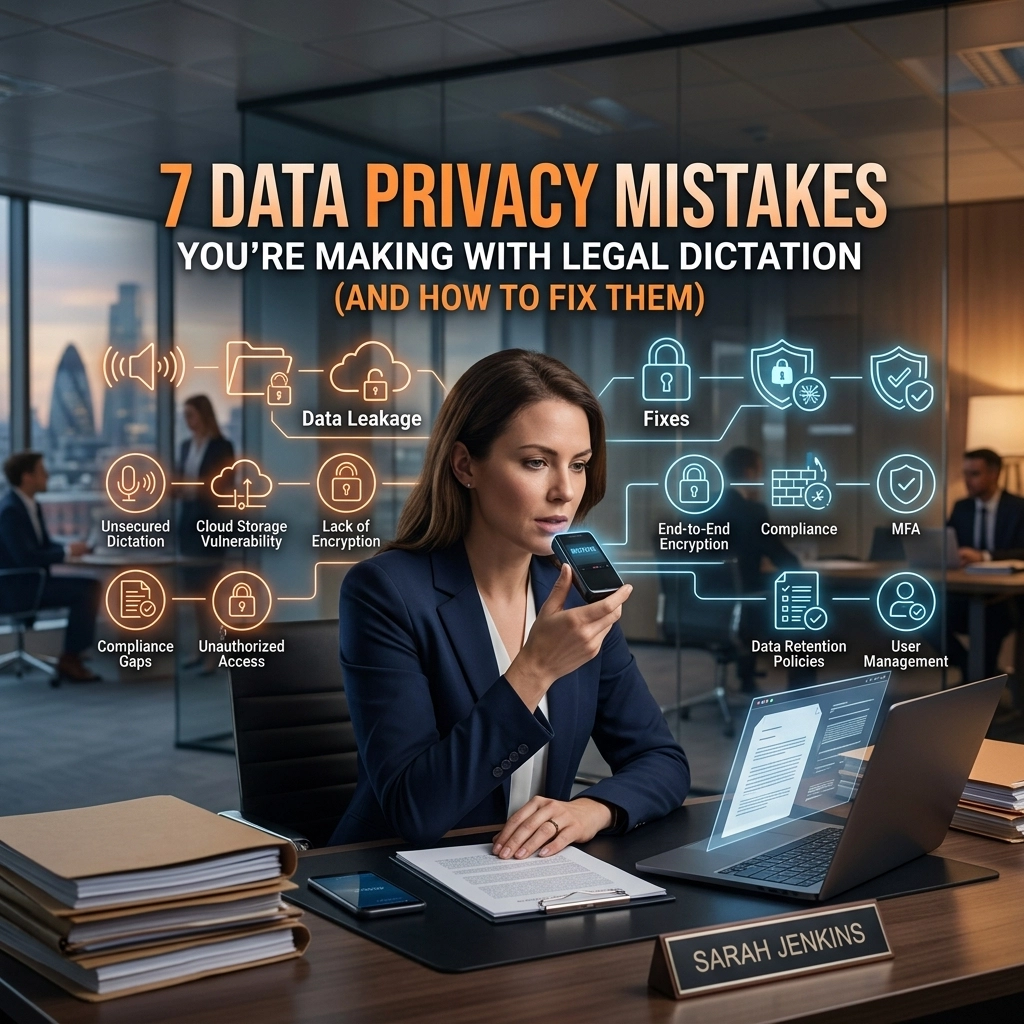
You are a lawyer. Your data is your product. Your reputation is your currency. One leak destroys both.
Most legal dictation tools are a security nightmare. They are open windows in a locked room. You think you are being productive. In reality, you are being reckless. You are sending privileged client information across the open internet. You are trusting third-party servers with secrets that could end your career.
Stop leaving the windows open.
In the legal world, "good enough" security is a liability. You need absolute certainty. You need total control. If you aren't using offline, HIPAA-ready dictation, you are making mistakes.
Here are the seven biggest data privacy mistakes legal professionals make with dictation: and exactly how to fix them.
1. You Trust the "Cloud" With Privileged Data
The cloud is just someone else’s computer.
When you use a standard cloud-based transcription service, your audio files travel from your device to a server. You don't know where that server is. You don't know who has access to it. You don't know how well it is guarded.
Data in transit is data at risk. Even with encryption, the mere act of moving sensitive legal strategy or witness testimony off your local machine creates a vulnerability. Hackers don't break in; they log in. If the cloud provider has a weak point, your client's case is compromised.
The Fix: Go Offline.
Stop sending your data on a round trip. Use a tool like VoiceType that processes dictation locally on your hardware. If the data never leaves your computer, it can never be intercepted in transit. No cloud. No servers. No leaks.
2. You Ignore the HIPAA Cross-Over
You think HIPAA is only for doctors. You are wrong.
Legal professionals handle medical records constantly. Personal injury cases, workers' compensation, and medical malpractice all involve protected health information (PHI). If your dictation software isn't HIPAA-ready, you are in violation of federal law the moment you describe a client’s injury.
Standard AI transcription tools are not built for HIPAA compliance. They don't sign Business Associate Agreements (BAAs). They don't have the necessary audit trails. They are a ticking time bomb for your firm.

The Fix: Demand HIPAA-Ready Standards.
Switch to software designed for high-stakes environments. Ensure your dictation workflow meets medical-grade privacy standards. If the tool can't handle a doctor’s notes, it shouldn't handle your legal briefs.
3. You Are "Training" the Machine With Your Client's Secrets
Most "free" or "cheap" AI tools have a hidden cost. That cost is your data.
Read the fine print. Many popular transcription services use your uploaded audio and text to "improve their models." This means your unique legal arguments, confidential settlements, and private strategies are being fed into a global database. You are literally teaching an AI how to do your job using your client's most sensitive information.
This is a massive breach of attorney-client privilege. You are sharing information with a third party without explicit consent.
The Fix: Use Non-Learning, Local AI.
Choose a professional utility that keeps your data private. You want a tool that works for you, not one that learns from you. Local AI models don't "phone home." They stay on your machine, focused on your tasks, keeping your intellectual property where it belongs.
4. You Have No "Need-to-Know" Access Control
Centralized storage is a trap.
If your firm uses a shared cloud account for all transcriptions, every employee with the password can see every file. A junior clerk shouldn't have access to the partner's strategy notes on a high-profile merger. When data is stored in one big bucket, a single compromised password exposes the entire firm.
Privacy isn't just about keeping outsiders out. It’s about keeping the right people in.
The Fix: Implement Localized, Decentralized Storage.
Store your dictations locally on encrypted drives. Use permissions that reflect your firm's hierarchy. By keeping files on the specific device used for dictation, you create a natural "need-to-know" barrier.

5. You Are Waiving Privilege via Terms of Service
When was the last time you read a 50-page Terms of Service agreement?
Many transcription companies include clauses that grant them broad rights to your content. Some even claim a level of ownership or the right to share "anonymized" data with partners. In the eyes of the court, sharing this information with a third-party vendor: under terms that allow them access: can be interpreted as a waiver of attorney-client privilege.
You wouldn't invite a stranger to sit in on a client meeting. Don't invite a software company into your dictation.
The Fix: Own Your Tools.
Move away from "rented" software. Use a permanent, local solution where you own the software and the output. Eliminate the third party entirely. If there is no service provider in the middle, there is no one to waive privilege to.
6. You Keep "Zombie Data" Forever
Data you don't have is data that can't be stolen.
Many legal professionals dictate a note, get the transcript, and then leave the audio file sitting in a cloud folder or an "Inbox" for years. This is zombie data. It serves no purpose, yet it carries 100% of the risk. If your dictation service keeps backups of every recording you've ever made, you have a massive, unnecessary attack surface.
The Fix: Immediate Deletion Protocols.
Establish a workflow where audio is deleted the moment the transcript is verified. Better yet, use a tool that doesn't store your audio on a secondary server in the first place. High-efficiency dictation should be a flow, not a warehouse.

7. You Sacrifice Security for "Convenience"
The "old way" of dictation involved handheld recorders and manual transcription. It was slow but relatively private. The "new way" is fast but dangerous. Many lawyers choose the easiest app they can find on their phone without checking the security credentials.
Convenience is the enemy of security.
Using a generic voice memo app or a popular consumer AI bot might save you five minutes today, but a data breach will cost you five years of litigation and your professional license. You shouldn't have to choose between speed and safety.
The Fix: Professional-Grade Speed.
Invest in a dedicated productivity tool like VoiceType. Get the speed of modern AI with the security of an offline workflow. It’s faster than typing and safer than the cloud. It’s the "new way" done right.
Reclaim Your Privacy
The legal industry is changing. Privacy is no longer a given; it is something you must actively defend.
Stop using tools that treat your data like a commodity. Your clients trust you to protect them. That protection starts with the tools you use every day.
The Old Way:
- Cloud-based risks.
- Data used for AI training.
- Security "check-boxes" that don't protect you.
- Subscription models that own your data.
- Constant internet dependency.
The VoiceType Way:
- 100% Offline processing.
- HIPAA-ready security.
- Zero data training.
- You own the software and the data.
- Work anywhere, anytime, with total privacy.
Dictation should be a silent, powerful utility that works behind the scenes. It should make you faster without making you vulnerable.

Don't wait for a breach to realize your workflow is broken. Fix it now.
Eliminate the middleman. Secure your privilege. Reclaim your time.
Explore the future of secure legal dictation at voicetype.in.
Leave a Reply