The cloud is just someone else’s computer.
When you use online speech-to-text tools, you are not just "transcribing." You are broadcasting. You are handing over your thoughts, your business secrets, and your personal life to a server farm owned by a multi-billion dollar corporation. They say your data is safe. They say it is encrypted. They also say they use it to "improve their services."
That is a euphemism for training their AI on your voice.
Privacy is not a feature. It is a right. Yet, every day, professionals make critical errors that expose their sensitive data to hackers, corporate eavesdroppers, and AI training bots. If you use voice-to-text to stay productive, you are likely making at least one of these mistakes.
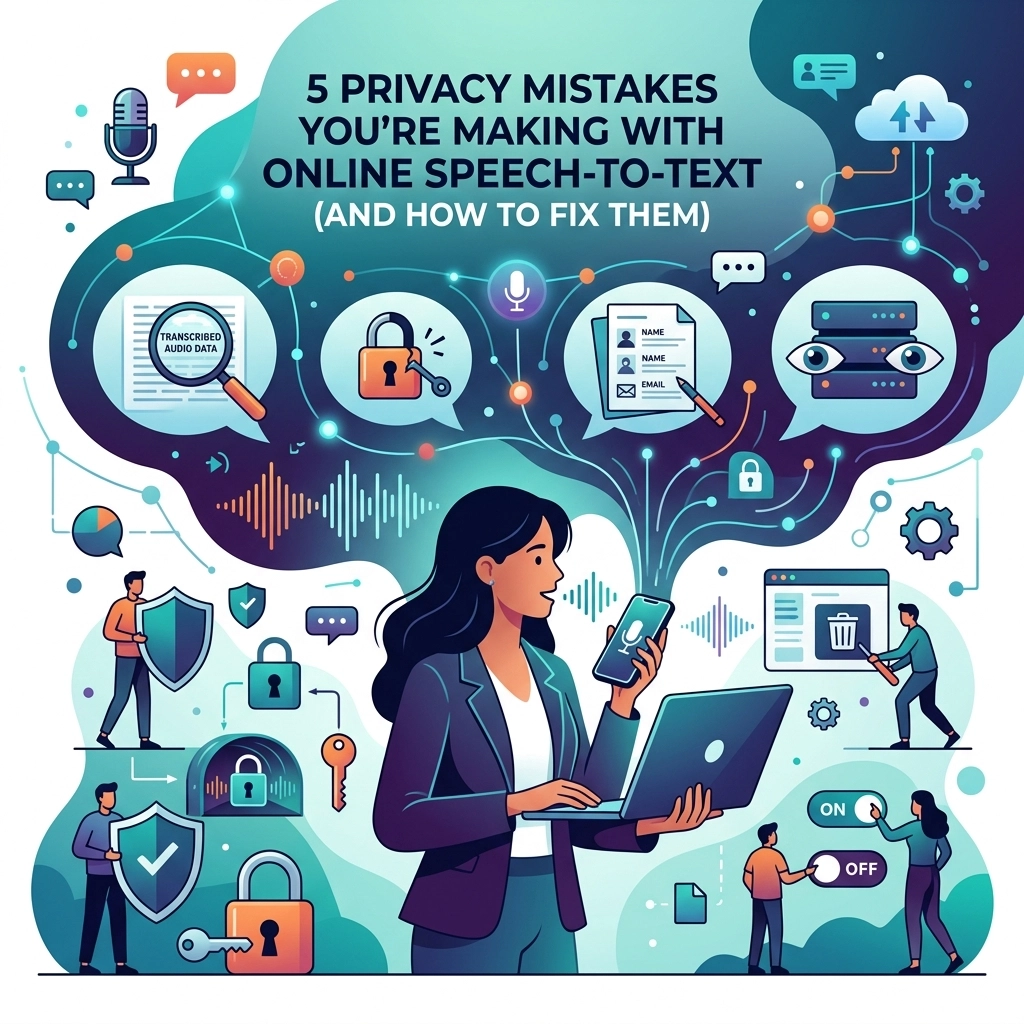
Stop compromising. Start securing. Here are the five privacy mistakes you’re making with online speech-to-text and exactly how to fix them.
1. Dictating Sensitive Personal Information (PII)
You’re in a rush. You dictate a quick note to yourself. You include your social security number, a credit card detail, or a home address. You think it’s just a note. It’s not.
The moment that audio leaves your microphone and hits the internet, it is no longer yours. Online services transmit this data to third-party servers. It is stored. It is logged. In many cases, it is reviewed by human contractors to ensure the "accuracy" of the transcription.
The Risk: Your most private credentials are now sitting in a database. If that company suffers a breach: and they often do: your identity is the first thing on the dark web.
The Fix: Never dictate passwords, financial details, or health data into a cloud-based service. If you must use voice for sensitive data, use a local-first solution like VoiceType. Local AI processes your voice on your device. Your data never hits a server. It stays in your room, on your hardware, under your control.

2. Ignoring the "Service Improvement" Clause
When was the last time you read a privacy policy? Probably never.
Most cloud-based speech-to-text providers include a "Service Improvement" clause. This is a legal green light for them to retain your voice recordings and transcribed text indefinitely. They use your data to train their Large Language Models (LLMs). Your unique professional insights are helping them build their next product, and you aren’t getting a cut.
The Risk: You are paying for a service with your money and your intellectual property. Your data is being shared with third-party contractors who listen to snippets of your audio to "verify" AI performance.
The Fix: Audit your settings immediately. Look for "Data Sharing" or "Improve AI Research" toggles and turn them off. Better yet, switch to software that doesn't have a "cloud" component. If there is no server to send the data to, there is no data to steal.
3. Trusting "Free" and Unverified Apps
The App Store is a minefield. You search for "Free Speech to Text" and find hundreds of options. They look legitimate. They have four-star reviews. But who built them?
Cybercriminals frequently create fraudulent applications that mimic productivity tools. These apps perform the basic task: transcribing your voice: while silently scraping your contacts, location, and background audio. They are not tools; they are spyware.
The Risk: A "free" app is a data-harvesting machine. It captures your professional conversations and sells the metadata to advertisers or, worse, uses it for phishing attacks.
The Fix: Verify every developer. Use recognized, enterprise-grade software. If a tool doesn’t have a clear business model, you are the product. Look for tools that prioritize local processing. Professional work requires professional tools.

4. Transmitting Confidential Professional Information
If you are a lawyer, a doctor, or an executive, this is your biggest liability.
Using a public cloud-based speech-to-text service to transcribe client testimonies, medical histories, or trade secrets is a violation of trust. It may also be a violation of the law. Regulations like GDPR and HIPAA require strict data handling. Most consumer-grade voice tools are not compliant. They do not offer the security measures needed to protect privileged information.
The Risk: One accidental leak of a confidential transcript can lead to lawsuits, loss of license, and irreparable brand damage. You are gambling your career on the security protocols of a third-party startup.
The Fix: Use local AI. Local AI is the only way to guarantee 100% compliance because the data never leaves your sight. When the transcription happens on your laptop, the "chain of custody" for that data is exactly one person long: you.
5. Failing to Manage Your Voice History
Every time you talk to a cloud AI, a log is created. Google, Apple, and specialized transcription services keep a history of your "activity."
Users rarely delete this history. It sits there for years. It becomes a goldmine for anyone who gains access to your account. If your email is hacked, your entire history of dictated thoughts, meetings, and personal notes is exposed.
The Risk: Your digital footprint is massive and permanent. Your voice recordings can be used to create "deepfakes" or simply to reconstruct your private life.
The Fix: Go to your account settings right now. Find your "Voice & Audio Activity." Clear it. Set it to auto-delete every 24 hours. Or, stop creating a history altogether. Local AI tools don't keep a cloud log. They don't have a "history" that exists outside of your own files.

The Future is Local: Why Local AI Wins
The era of "Cloud Everything" is ending. We are entering the era of Local AI.
For years, we sacrificed privacy for convenience. We thought we needed massive server farms to process speech. That is no longer true. Modern processors are powerful enough to run high-end AI models right on your desk.
Local AI is faster. There is no "uploading" time. There is no latency. Your words appear on the screen as you speak them because they aren't traveling to a server in Virginia and back.
Local AI is safer. It is physically impossible to hack a server that doesn't exist. Your data stays on your silicon. You own the model, you own the output, and you own the privacy.
Local AI is yours. No subscriptions that track your usage. No "credits" that expire. No dependence on an internet connection. It is a silent, powerful utility that works behind the scenes.
Reclaim Your Privacy with VoiceType
Stop renting your productivity. Start owning it.
VoiceType was built for the professional who refuses to compromise. We don't want your data. We don't want your voice recordings. We want you to work faster and safer.
Our software brings the power of elite-level speech recognition directly to your device. It is direct. It is fast. It is secure.
- Zero Data Logging: We don't see what you write.
- On-Device Processing: Your CPU does the work, not our servers.
- Professional Speed: Built for the staccato rhythm of a high-pressure workday.

Stop Making Mistakes. Start Making Moves.
The "old way" of doing things was risky. It was slow. It was invasive. You dictated your notes and hoped for the best. You trusted corporations that didn't know your name.
The "new way" is local. It is fast, safe, and satisfying.
Check your workflow. If your voice is leaving your device, you are making a mistake. Fix it today. Reclaim your time. Reclaim your privacy. Reclaim your peace of mind.
Get the power of local AI. Get VoiceType.
Leave a Reply