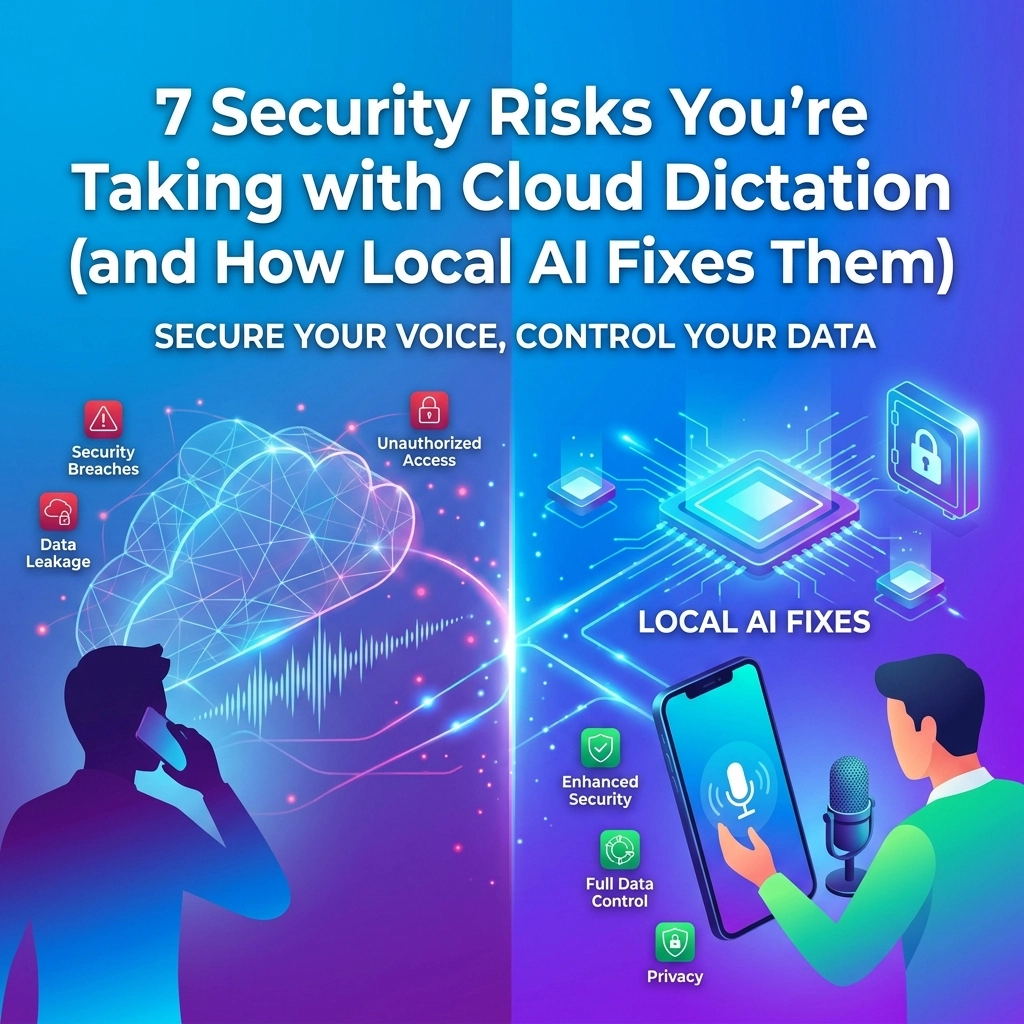
You speak. They listen.
Not just the AI, but the server, the administrator, and potentially the hacker. Every time you use a cloud-based dictation tool, you gamble with your company’s most sensitive data. You think you’re just "taking notes." In reality, you are broadcasting proprietary secrets across the open internet.
It is a bad bet. It is an unnecessary risk.
At VoiceType, we see the aftermath of "convenience-first" security. We see businesses losing control of their intellectual property because they chose a tool that lives in the cloud instead of one that lives on their machine.
Stop renting your security. Start owning it. Here are the seven massive risks you take with cloud dictation and how local AI shuts the door on them forever.
1. The Mass Data Breach: Your Secrets in a Pile
Cloud dictation services are honey pots. They store massive amounts of transcriptions from thousands of companies in central databases. When an attacker hits a cloud provider, they don’t just get one person’s notes; they get everyone’s notes.
In 2023, at least 80% of data breaches involved data stored in the cloud. Think about that. Eight out of ten leaks happened because companies trusted a third party to hold their information. When your legal briefs, medical records, or trade secrets are sitting on a remote server, you are no longer in control of your destiny.
The Local Fix:
Local AI processes data on your device. There is no central database to hack. If an attacker wants your data, they have to target you specifically: not a vulnerable cloud provider. With VoiceType, your data never leaves your hardware. No transit. No pile. No breach.
2. Misconfiguration: The Unlocked Digital Cabinet
Security is only as strong as the person clicking the "Save" button. Unfortunately, humans make mistakes. Approximately 15% of all cybersecurity breaches result from cloud misconfigurations.
Cloud dictation platforms often suffer from overly permissive policies. A storage bucket gets left on "public" by accident. An API endpoint is left unsecured. Suddenly, your private dictations are indexed by Google or harvested by bots. You wouldn’t leave your office door wide open at night. Why do it with your data?

The Local Fix:
Eliminate the variable of the "remote admin." When the processing is local, there are no cloud buckets to misconfigure. You rely on your own internal OS security: the same security that protects your local files. You control the permissions. You hold the keys.
3. Account Hijacking: One Password Away from Ruin
Phishing is getting smarter. Credential stuffing is more common. If an attacker steals your login for a cloud dictation service, they have immediate, unfettered access to every transcript you’ve ever made.
Cloud account hijacking threats jumped 16-fold in 2023. Sixteen times. This isn't a theoretical problem; it’s an epidemic. A single weak password or a compromised email address turns your entire dictation history into an open book for an adversary. They can exfiltrate months of sensitive data in seconds.
The Local Fix:
VoiceType doesn't store your history in a "cloud account" that can be logged into from a browser in another country. Your transcripts stay where you put them. To get your data, a thief needs your physical laptop and your system password. That is a significantly higher bar to clear.
4. The "Naked" Stream: Weak Encryption in Transit
Many cloud services claim to be secure, but their encryption is often "best effort" or non-existent for data at rest. Even if they encrypt the file, they often hold the master key. This means they: or anyone who gains access to their system: can decrypt your audio and text at will.
If your dictation service lacks strong end-to-end encryption, your sensitive data is essentially a postcard sent through the mail. Anyone in the middle can read it. For industries like law and finance, this isn't just a risk; it's a compliance disaster.

The Local Fix:
The best encryption is no transmission at all. By keeping the audio processing on your local CPU or GPU, there is no "transit" to intercept. You don't have to worry about the strength of a vendor's SSL certificate because you aren't sending them anything.
5. API Key Leaks: The Automated Thief
This is a modern nightmare. Developers often use API keys to connect different cloud services. Sometimes, those keys are accidentally committed to public code repositories like GitHub.
Automated bots crawl these repositories 24/7. They find a key for a cloud transcription service and immediately use it to drain data. If your company uses a "cloud-connected" AI notetaker, your data is one developer's mistake away from being public property.
The Local Fix:
Local AI doesn't rely on fragile API keys for core functionality. It’s a self-contained utility. It works behind the scenes without needing to "call home" to a third-party server. It removes the "human error" of the developer from your security equation.
6. Vendor Maturity: The "Move Fast and Break Things" Problem
The market is flooded with new AI notetakers and dictation startups. Most of them prioritize features over security. Many lack basic standards like SOC 2 certification or GDPR alignment. They don't have a dedicated security team; they have a "growth" team.
Trusting your corporate secrets to a startup with zero security infrastructure is a recipe for a PR nightmare. When they inevitably fail, it’s your data that pays the price.

The Local Fix:
Stop trusting strangers. When you use VoiceType, you aren't relying on a startup's server security. You are relying on your own infrastructure. We provide the tool; you provide the secure environment. It is the only way to ensure 100% privacy.
7. Voice Replay Attacks and Digital Fraud
This is the newest frontier of risk. Cloud-based systems are vulnerable to replay attacks. An attacker who captures your voice recordings from a cloud server can use that audio to train a voice-cloning AI.
Once they have your "voice," they can bypass voice-based authentication systems or commit fraud by impersonating you in phone calls to your employees or bank. By storing your raw audio in the cloud, you are giving hackers the blueprint to your digital identity.
The Local Fix:
Process locally. Delete the audio after transcription. Keep the "blueprint" of your voice on your own device. Local AI ensures that your biometric data stays private and unreachable for those looking to build deepfakes.

Reclaim Your Privacy with VoiceType
The "old way" of dictation was slow and risky. You spoke into a cloud-connected microphone, hoped the internet didn't drop, and prayed that the company on the other end was actually protecting your data.
The "new way" is local.
VoiceType is built for professionals who value their time and their privacy. We don't want your data. We don't want your transcripts. We want to give you a powerful, silent utility that works on your machine, using your power, for your benefit.
Why VoiceType?
- Zero Latency: No waiting for a server to "think."
- Total Privacy: Data never leaves your device.
- Absolute Ownership: You aren't renting a service; you are using a tool.
- No Subscriptions to Privacy: Security shouldn't be an "add-on" feature. It should be the foundation.
Direct. Fast. Secure.
Stop broadcasting your business to the world. Switch to local AI and take back control of your information. Your secrets are yours. Keep them that way.
Visit voicetype.in to learn how to secure your workflow today.
Leave a Reply