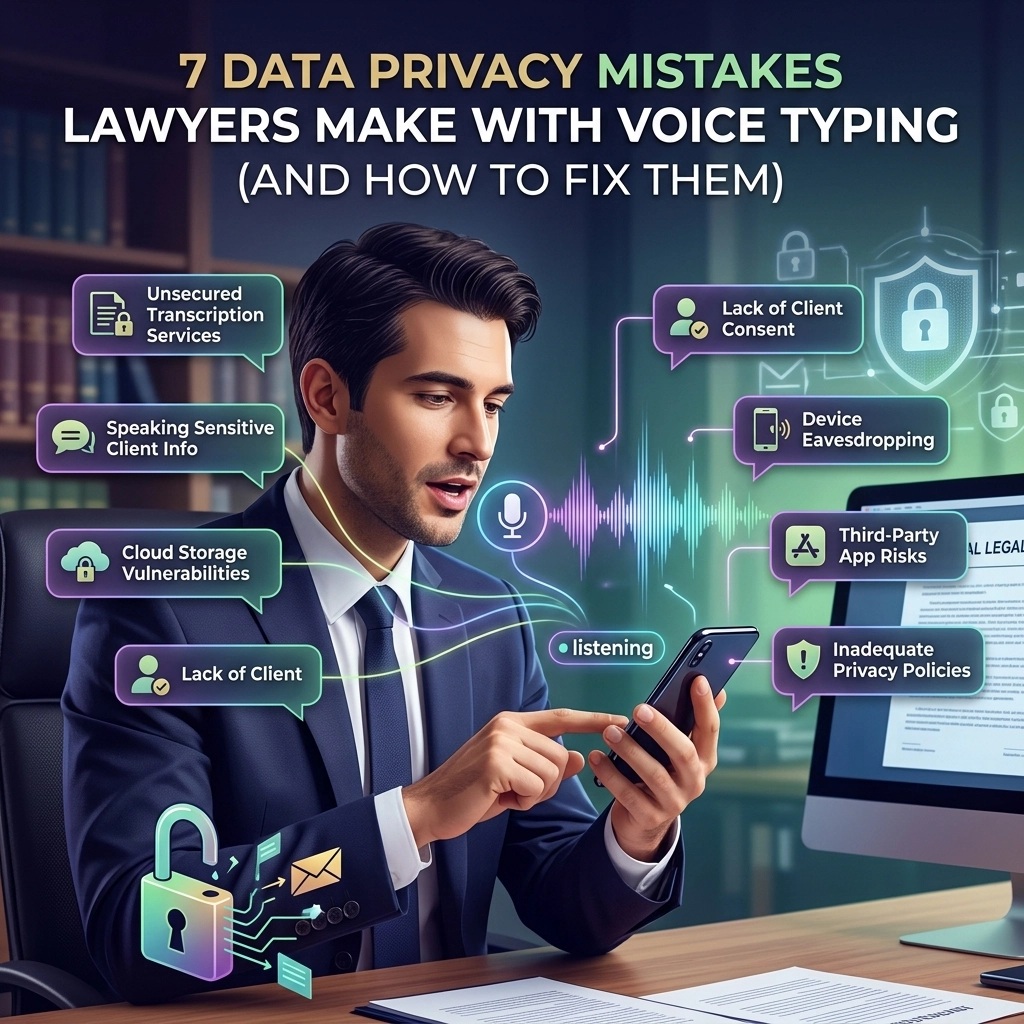
You are a lawyer. Your words are your currency. Every syllable you utter in a client meeting, every note you dictate for a brief, and every strategy you whisper into a recorder is a piece of highly sensitive intellectual property. It is protected by attorney-client privilege. It is the bedrock of your practice.
Yet, you are likely leaking this data every single day.
You use "free" apps. You trust big-tech cloud services. You assume that because a tool is convenient, it is safe. It isn't. Most voice typing tools are designed for consumers, not legal professionals. They trade your privacy for their "free" service. They turn your confidential dictation into their training data.
Stop compromising your career. Stop risking your clients’ trust.
Here are the seven critical data privacy mistakes lawyers make with voice typing, and the immediate steps you must take to fix them.
1. Trusting the "Cloud" with Client Secrets
The cloud is just someone else’s computer. When you use a standard voice-to-text app on your phone or computer, your voice data travels across the internet to a server owned by a third party. You lose control the moment you hit record.
The Problem: Once your data leaves your device, it is vulnerable. It can be intercepted. It can be subpoenaed from the provider. It can be leaked in a server breach. For a lawyer, "reasonable care" to protect client data means knowing exactly where that data lives. If it’s in a generic cloud, you don’t know.
The Solution: Switch to offline dictation. Process your voice locally. Your data should never leave your physical machine. If there is no internet connection required for the transcription to happen, there is no path for a leak.

2. Allowing AI Models to "Learn" from Your Dictation
Most modern AI transcription services are "hungry." They need data to get better. When you use these services, you are often implicitly agreeing to let the provider use your recordings to train their language models.
The Problem: Think about that. You are feeding confidential client details, names, and case strategies into a global AI model. This isn't just a privacy risk; it’s a potential ethical violation. If an AI model "learns" from your privileged communications, those communications are no longer truly private.
The Solution: Demand a "Zero-Training" guarantee. Or better yet, use software that doesn't have a server to send data to in the first place. You need a tool that treats your data as a temporary asset to be processed, not a permanent resource to be harvested.
3. Ignoring HIPAA-Ready Standards
Many lawyers handle medical records, personal injury cases, or insurance litigation. If you deal with Protected Health Information (PHI), you are likely a "covered entity" or a "business associate" under HIPAA.
The Problem: Using a standard transcription tool for a PI case is a HIPAA violation waiting to happen. Most consumer apps do not offer Business Associate Agreements (BAAs). They do not meet the technical safeguards required by law. One data breach could result in six-figure fines and a destroyed reputation.
The Solution: Use HIPAA-ready software. Ensure your workflow involves end-to-end encryption and, ideally, total local processing. If the data never reaches a server, the risk of a HIPAA-regulated breach drops to near zero.
4. Failing to Secure the "Discovery" Trail
In the age of digital litigation, your transcripts are discoverable. If you use a third-party service to generate and store transcripts, those records exist on their servers.
The Problem: If you are hit with a discovery request, those third-party records are a liability. You may not even know they exist until they are used against you. Furthermore, many AI "notetakers" join meetings and record everything, even the casual "off the record" comments that happen before a deposition officially starts.
The Solution: Maintain total ownership of your transcripts. Delete what you don't need. Store what you do need in your own encrypted document management system. Use a tool like VoiceType that puts you in the driver’s seat. Don't let a third-party bot archive your "off the record" moments.

5. Dictating over Public Wi-Fi
Lawyers are mobile. You dictate in coffee shops, airports, and courthouse hallways. You rely on public Wi-Fi to sync your notes to the cloud.
The Problem: Public Wi-Fi is an open door for "Man-in-the-Middle" attacks. Hackers can intercept the data packets traveling from your laptop to the transcription server. Your "encrypted" connection is only as strong as the certificate verification, which can be spoofed.
The Solution: Stop syncing. Start dictating locally. When your transcription happens offline, the Wi-Fi signal is irrelevant. You can work in a lead-lined basement or 30,000 feet in the air without a single byte of client data touching the public web.
6. Overlooking Biometric Privacy (Voiceprints)
Your voice is a biometric identifier. In many jurisdictions, including states like Illinois with BIPA (Biometric Information Privacy Act), collecting a "voiceprint" without explicit, written consent is illegal.
The Problem: Many AI transcription companies create a unique digital profile of your voice to improve accuracy. They may also do this for your clients or opposing counsel if their voices are recorded. If you haven't obtained written biometric consent from everyone in the room, you are walking into a legal minefield.
The Solution: Use tools that do not store or profile biometric data. Pure speech-to-text engines that interpret sounds into words without "tagging" or "profiling" the speaker are the only safe bet. Keep the process mechanical, not personal.
7. Choosing "Rented" Privacy over Ownership
Subscription-based AI tools are the norm. You pay a monthly fee to access their "secure" portal.
The Problem: You are renting your privacy. If the company changes its Terms of Service, your data is at their mercy. If the company goes bankrupt, your data could be sold as an asset. If you stop paying, you lose access to your own records. You are building your practice on a foundation you don't own.
The Solution: Invest in software you own. Look for solutions that run locally on your hardware. Ownership means control. Control means security.
The Reality: Efficiency Shouldn't Cost Your License
You need voice typing. It saves you 10+ hours a week. It clears the backlog of memos. It lets you capture brilliant ideas while they are fresh. You cannot go back to the "old way" of manual typing. It’s too slow. It’s too expensive.
But the "old way" was private. Your yellow legal pad didn't upload its contents to a server in Silicon Valley.
You need the speed of AI with the privacy of the legal pad.

How to Fix Everything: The Offline Dictation Framework
Fixing these mistakes doesn't require a degree in computer science. It requires a shift in your tech stack. Follow this three-step framework to reclaim your privacy:
- Audit Your Tools: Look at every app you use for voice memos, dictation, or meeting transcription. Does it require an internet connection to work? If yes, it is a risk.
- Go Local: Switch to software that performs AI processing on your device's CPU or GPU. Modern laptops are powerful enough to handle high-accuracy transcription without the cloud.
- Formalize Consent: Update your engagement letters. Disclose that you use AI-assisted tools for efficiency and explain the safeguards you have in place (like offline processing).
Why Offline is the Only Way Forward
At VoiceType, we believe that productivity should never come at the cost of privilege. We built a solution specifically for the high-stakes environment of the legal industry.
Our system is HIPAA-ready because it is 100% offline.
- No Servers: Your voice never leaves your computer.
- No Training: We don't use your data to train models. We don't even see your data.
- No Subscriptions: You own the tool. You own the results.
- Total Speed: Experience the fastest transcription on the market without the lag of an internet upload.
Reclaim Your Time. Protect Your Practice.
The legal industry is changing. Clients are becoming more tech-savvy, and they are starting to ask hard questions about how their data is handled. "I used a popular app" is no longer an acceptable answer for a data breach.
Be the lawyer who can look a client in the eye and say, "My notes never leave this room."

Stop making these seven mistakes. Stop treating your dictation like a casual text message. Treat it like the privileged communication it is.
Switch to offline. Switch to VoiceType.
Ready to see the difference that total privacy makes?
Eliminate the cloud. Secure your firm. Start dictating with absolute confidence today.
Leave a Reply