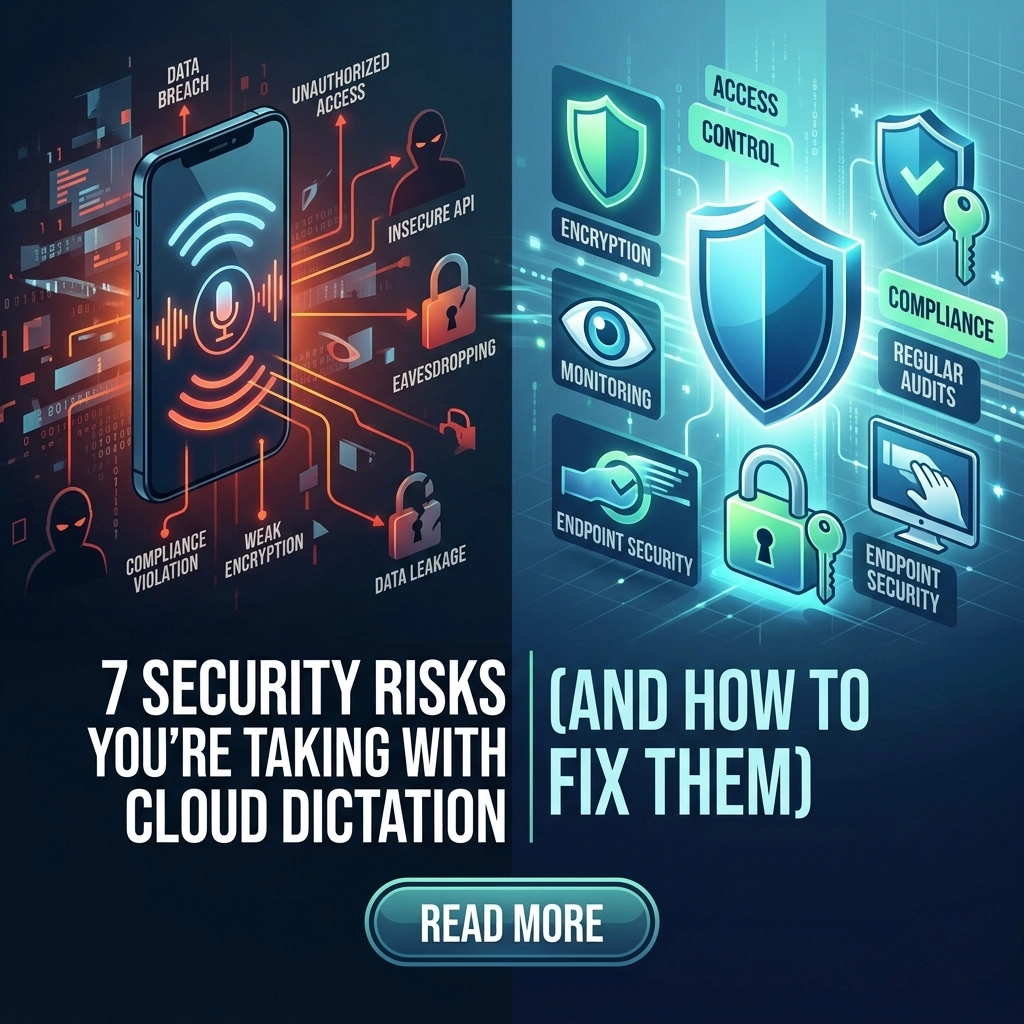
Cloud dictation is a trap. You think you are buying efficiency. You are actually buying a liability. For every sentence your team speaks into a cloud-based AI, a packet of sensitive data leaves your perimeter. It travels through public infrastructure. It sits on a server you do not control. It is handled by a company whose primary goal is growth, not your absolute privacy.
As an IT or Security professional, you know the truth. The "cloud" is just someone else's computer. When that computer processes your legal briefs, medical notes, or proprietary internal strategies, your attack surface explodes.
Stop compromising. Own your data. Here are the seven critical security risks you are taking with cloud dictation and the only way to fix them.
1. The Centralized Honeypot Risk
Cloud dictation providers are massive targets. They aggregate data from thousands of companies. This makes them a primary objective for sophisticated threat actors. One successful breach at the provider level grants access to the "voice" of entire industries.
Think about your most sensitive conversations. Financial forecasts. Mergers and acquisitions. Employee grievances. If it is dictated into a cloud tool, it is sitting in a honeypot. You are relying on a third party's security posture to protect your most valuable intellectual property.
The Fix: Air-Gapped Local Processing.
Eliminate the honeypot. Move the AI model to the local machine. If the data never leaves the device, it cannot be swept up in a mass provider breach. Use VoiceType to keep your audio internal. Lock your data behind your own existing, proven firewalls.

2. The "Listening Ear" (Insider Threats)
Who is actually training these cloud models? Often, it is human reviewers. Cloud providers frequently use contractors to "validate" transcriptions. This means a stranger could be listening to your CEO’s private notes to "improve the algorithm."
You have no visibility into who these people are. You have no control over their environments. A single disgruntled contractor with a smartphone can record your audio and leak it. This is not a theoretical risk. It is a documented industry practice.
The Fix: Private Local Models.
Remove the human element. Local AI dictation works in isolation. No contractors. No reviewers. No "quality assurance" teams in distant time zones. The model sits on your hardware. It processes in silence. It forgets the audio the moment the text is generated.
3. Data Sovereignty and Jurisdictional Chaos
Where is your data right now? If you use a cloud dictation tool, the answer is "everywhere." Data centers are scattered across the globe. Your audio might be processed in one country and stored in another.
This creates a compliance nightmare. GDPR, HIPAA, and CCPA require strict control over data residency. Most cloud providers reserve the right to move data to optimize their own costs. You are left holding the bag when an auditor asks for the exact physical location of your processed voice data.
The Fix: On-Premise Execution.
Define your borders. When you use local AI, your data residency is your office floor or your encrypted laptop. You don't need a complex legal framework to explain where the data is. It is right there. In your hands.
4. Model Training: Your IP as "Fuel"
Most cloud-based AI tools are "rented." You pay a subscription fee. In exchange, they often use your data to train their future models. You are essentially paying to give away your intellectual property.
Your unique terminology, your client names, and your strategic phrasing are all sucked into the collective brain of the cloud provider. This data is then used to benefit their next customer: who might be your direct competitor.
The Fix: Non-Participatory AI.
Stop feeding the machine. Use an AI tool that does not phone home. Local dictation software doesn't "learn" from you to help others. It serves you and only you. Reclaim ownership of your linguistic patterns.

5. The Vulnerability of APIs and Transit
Data is most vulnerable when it is moving. Cloud dictation requires a constant stream of audio data from your microphone to the server. Even with TLS encryption, you are opening ports. You are trusting the integrity of the API.
Man-in-the-middle attacks are real. DNS hijacking is real. Every "hop" between your computer and the cloud is a potential point of failure. Why take the risk?
The Fix: Zero-Transit Architecture.
Close the ports. Local dictation requires zero outbound traffic. If there is no transit, there is no interception. It is the ultimate "Zero Trust" approach to voice-to-text.
6. Shadow IT: The Silent Breach
When you don't provide a secure, local alternative, employees find their own solutions. They use free web-based recorders. They use mobile apps with dubious privacy policies. They do this because they need to be productive.
This is Shadow IT. It is the silent killer of enterprise security. You cannot secure what you cannot see. If your team is uploading sensitive audio to "free" cloud converters, your security perimeter is already gone.
The Fix: Standardize on Local Productivity.
Give them a tool that is faster and better than the "free" cloud options. When you deploy a high-performance local AI like VoiceType, the incentive to use insecure cloud tools disappears. You regain control by providing a superior experience.
7. The Internet Dependency Trap
Cloud dictation is fragile. If the internet goes down, your productivity stops. If the provider's server has a "hiccup," your legal team cannot file their briefs. You are paying for a service that requires a 100% uptime connection just to function.
In high-security environments: like specialized research labs or remote field offices: internet access is either restricted or unreliable. Cloud tools are useless here. They are a bottleneck, not a benefit.
The Fix: Hardware-Accelerated Independence.
Work anywhere. Work in a bunker. Work on a plane. Local AI dictation uses the power of your modern CPU and GPU. It is faster because there is no latency. It is more reliable because there is no dependency.

The Strategic Shift: Local is the New Secure
The era of "Cloud-First" is maturing into the era of "Privacy-First."
For IT and Security professionals, the mandate is clear: Reduce the footprint. Minimize the data export. Secure the endpoint.
Cloud dictation is a legacy approach built on the limitations of old hardware. Today, your laptops are powerful enough to run world-class AI locally. There is no longer a technical reason to send your voice to the cloud. There is only a security risk in doing so.
Why VoiceType?
We built VoiceType for the professionals who cannot afford a "whoops" moment. We don't want your data. We don't want your audio. We don't even want your metadata.
- No Servers: Your voice stays on your machine.
- No Subscriptions to Privacy: You own the tool; you own the output.
- No Latency: Real-time transcription that keeps up with your thoughts.
Stop renting your productivity and risking your security. It is time to bring your AI home.
Visit voicetype.in to see how air-gapped dictation can transform your security posture. Explore our sitemap for more industry deep dives into the future of local AI.
The choice is simple.
You can trust the cloud. Or you can trust your own iron.
Choose the iron.
Leave a Reply