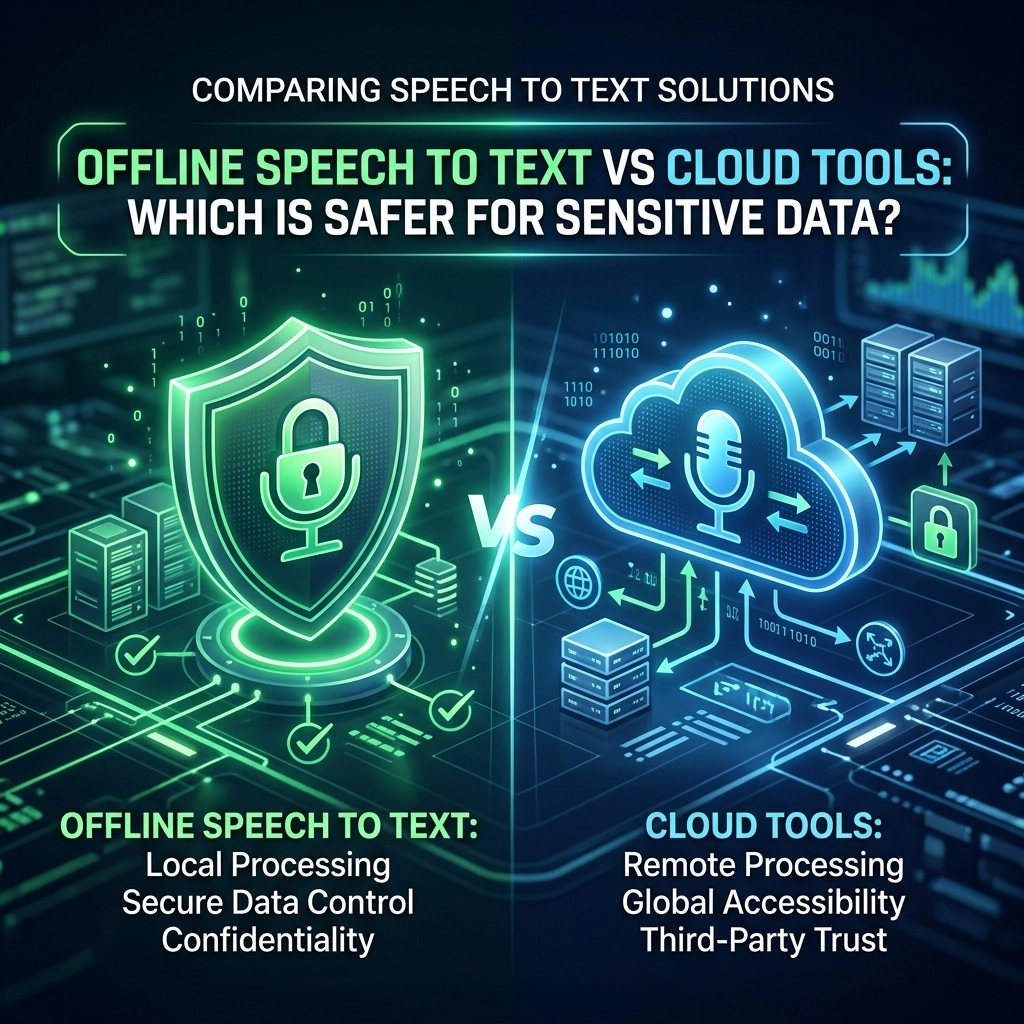
Stop sending your secrets to the cloud. It is that simple.
If you are an IT professional or a security officer, you know the stakes. Every byte of data that leaves your firewall is a liability. Every packet sent to a third-party server is a gamble. For years, we traded privacy for performance. We let cloud-based speech-to-text (STT) tools listen to our board meetings, our legal depositions, and our patient records because we thought local machines couldn't handle the load.
Those days are over.
Local AI has caught up. The gap is closed. Now, the choice between offline STT and cloud tools isn't about accuracy. It is about control. It is about who owns your voice.
The Cloud is Just Someone Else’s Computer
Don't let the marketing fool you. "The Cloud" is not a magical, safe ether. It is a physical server owned by a corporation that has its own interests. When you use cloud-based dictation, your audio files travel across the public internet.
Think about that journey. Your voice is captured. It is compressed. It is sent through multiple routers and switches. It eventually lands on a server you don't manage, in a data center you can't visit.
Encryption helps. It prevents casual eavesdropping. But it doesn't change the fundamental reality: You have handed over the keys. You are trusting a third party to handle your most sensitive information. You are trusting their admins, their security protocols, and their legal team.
In the world of high-stakes security, trust is a vulnerability.

The Hidden Risks of Subscriptions
Cloud tools are rented. You pay a monthly fee for the privilege of using their processing power. But the true cost isn't on the invoice. The true cost is the data trail.
Most cloud providers use "de-identified" data to train their models. They claim your specific identity is scrubbed. But for a security professional, "de-identified" is a red flag. Patterns remain. Context remains. If a system processes enough of your data, the anonymity evaporates.
When you use VoiceType, you aren't renting a service. You are deploying a utility. Offline STT means the AI lives on your hardware. It works for you. It listens to you. And it tells no one.
Air-Gapped AI: The Only Real Security
Look at the hardware. Look at the air gap.
An air-gapped system is physically isolated from unsecured networks. It cannot be hacked remotely. It cannot leak data to a command-and-control server. It is the gold standard for sensitive data.
Cloud tools cannot work in an air-gapped environment. They are tethered to the internet. If the connection drops, the productivity stops. If the connection exists, the risk exists.
Offline STT turns your laptop into a secure vault. You can dictate a classified report in a lead-lined room with zero bars of signal, and the AI will still produce a perfect transcript. No pings to a central server. No logs stored in a data center in a foreign jurisdiction.
This isn't just a feature. It is a paradigm shift.
Stop Managing Risks. Eliminate Them.
IT departments spend thousands of hours on compliance. They fill out SOC2 forms. They audit vendors. They worry about GDPR, HIPAA, and CCPA.
Why? Because they are moving data.
If you don't move the data, you don't have to secure the movement. Offline speech-to-text eliminates the most dangerous part of the workflow. You don't need a Business Associate Agreement (BAA) for a piece of software that never connects to the internet. You don't need to worry about a vendor's data breach if the vendor never sees your data.
Reduce your attack surface. It is the most effective security strategy there is. By keeping audio processing local, you shrink your vulnerability from "the entire internet" down to "this specific device."

Accuracy Without the Tether
The old argument for the cloud was "The models are too big for a laptop."
That argument is dead.
Modern local AI models, like those powering VoiceType, are optimized for efficiency. They run on standard professional hardware. They deliver 99% accuracy without needing a fiber-optic connection.
You get the speed. You get the precision. You keep the privacy.
Compare that to the cloud "old way."
- Record audio.
- Wait for upload.
- Wait for server-side processing.
- Wait for download.
- Pray the connection doesn't flicker.
The offline way is faster. Press a key. Speak. The text appears. It feels like magic because it isn't fighting the friction of the internet. It is raw, local power.
The Cost of the "Free" and "Cheap"
There is no such thing as a free lunch in AI. If a cloud tool is free or suspiciously cheap, you are the product. Your data is the fuel for their next model.
For a legal firm, this is a nightmare. Attorney-client privilege is not a suggestion. It is a legal requirement. Sending a client's confession or a high-stakes strategy to a cloud-based AI tool is a breach of ethics. It is a liability that can end a career.
For a doctor, it is a HIPAA violation waiting to happen. Voice data is biometric. It is PII (Personally Identifiable Information). Treating it with anything less than total local isolation is a massive risk.

Ownership vs. Access
Ask yourself: If your internet goes out today, can you still work?
Most "modern" productivity tools turn into bricks without a 5G signal. You have access to the tool, but you don't own it. You are a tenant.
Offline STT gives you ownership. It is your tool. It stays on your machine. It works when you are on a plane, in a secure basement, or in a remote field office. This is true productivity. It is reliable. It is consistent. It is yours.
The Hard Numbers: Performance and Latency
Let’s talk specs.
Cloud STT introduces latency. There is the round-trip time (RTT) for every packet. There is server queueing. There is the overhead of API calls. In a fast-paced environment, those milliseconds add up. They break the flow of thought.
Local STT has zero network latency. The bottleneck is the CPU/GPU, and modern chips are incredibly fast. When you speak, the AI processes the audio in real-time. The feedback loop is tight. You see your words as you say them.
- Cloud Latency: 500ms to 2.0s (depending on connection).
- Local Latency: <50ms.
In the world of productivity, speed is a feature. In the world of security, local is the only option.
Direct Comparison: A Summary
| Feature | Cloud-Based Tools | Offline / Local AI |
|---|---|---|
| Data Privacy | Third-party exposure | 100% Local |
| Security | Internet-dependent | Air-gapped capable |
| Reliability | Fails without signal | Always available |
| Ownership | Subscription / Rented | Owned Asset |
| Latency | Network dependent | Instantaneous |
| Compliance | Complex / Risky | Simplified |
Reclaim Your Privacy
You have spent years building a secure perimeter around your organization. Don't let a "productivity tool" be the hole in the fence.
Your voice is personal. Your data is valuable. Your secrets are yours to keep.
Choose the solution that respects your boundaries. Choose the solution that works behind the scenes without demanding an internet connection. Choose the solution that puts you in the driver's seat.
Explore how VoiceType can secure your workflow. Check out our sitemap to see our deep dives into local AI.
The decision is yours. Keep it local. Keep it safe.
Stop sending your data to the cloud. Start working with total confidence. The era of private, high-performance dictation is here. Use it.
Leave a Reply