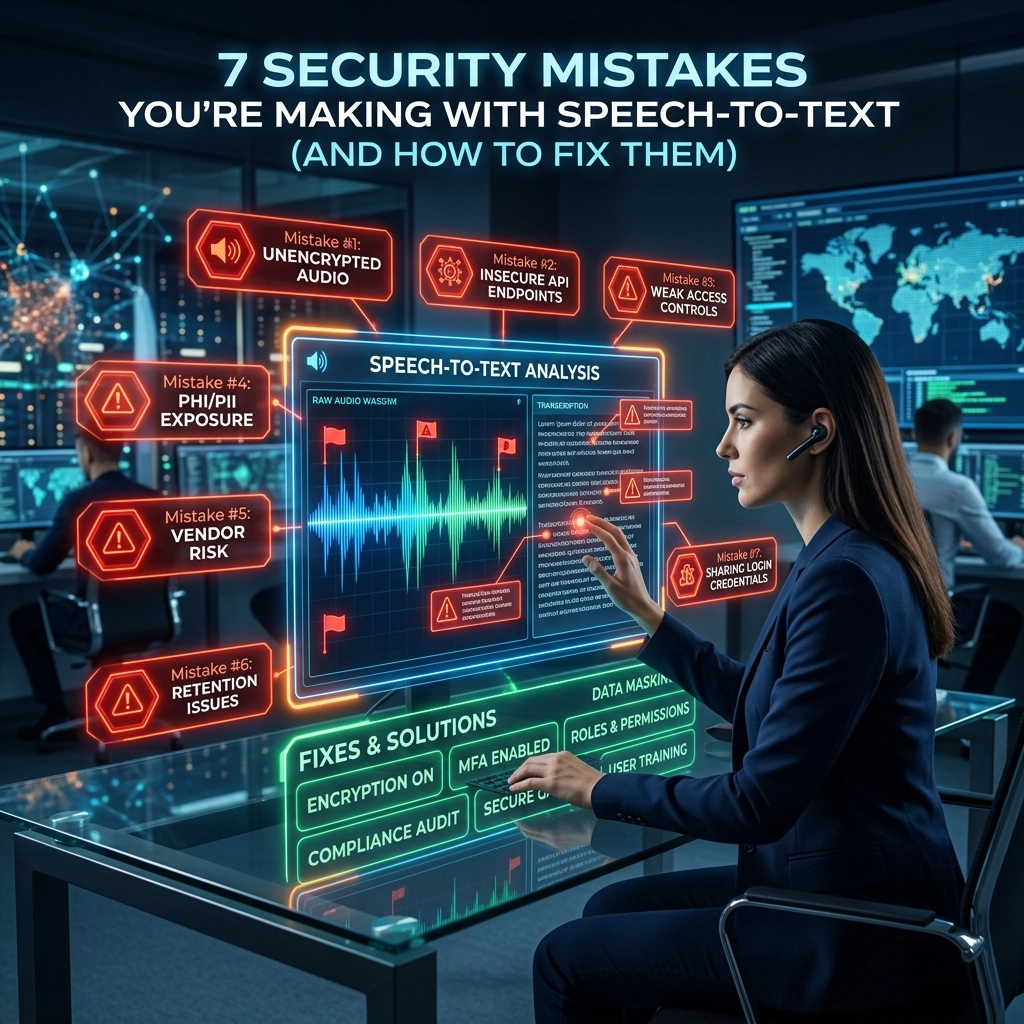
Your voice is your most personal data. When you speak, you aren't just conveying words. You’re sharing tone, emotion, and often, the deepest secrets of your business. If you are a lawyer, a doctor, or a CEO, your dictation contains sensitive intellectual property, client privileges, and strategic roadmaps.
Yet, most professionals treat their speech-to-text tools like a public park. They walk in, throw their data on the grass, and hope nobody picks it up.
The reality? The "Cloud" is just someone else’s computer. Every time you hit that microphone icon on a standard app, your voice travels through miles of fiber optic cables to a server farm you don't control. This is a massive security failure.
Stop being reckless with your data. Here are the 7 security mistakes you are making right now and exactly how to fix them.
1. You Think the "Cloud" is a Safe Box
The biggest mistake is the most fundamental one. You assume that because a company is a multi-billion dollar giant, your data is locked in a digital vault. It isn’t.
When you use cloud-based speech-to-text, your audio is transmitted to a remote server. It is processed there. It is stored there. This creates a "moving target" for hackers. Data in transit is data at risk. Even with encryption, the mere act of sending your voice across the internet exposes you to man-in-the-middle attacks and server-side breaches.
The Fix: Go 100% Offline.
Stop sending your voice to the internet. Use tools that process every single syllable locally on your device. If the data never leaves your laptop, it can’t be intercepted. It’s that simple. VoiceType lives on your machine, not on a server in another country.

2. You’re Helping "Train" Their AI Without Permission
Read the fine print. Most free or subscription-based cloud tools have a sneaky clause. They use your "anonymous" data to improve their machine-learning models.
This means a transcript of your confidential board meeting or a sensitive legal brief is being fed into an algorithm. Even if they strip your name, the context remains. If you’re dictating unique trade secrets, you are literally teaching a global AI how to understand your proprietary business logic. You are paying them to steal your edge.
The Fix: Demand Zero Data Retention.
Switch to a solution that guarantees your data is never used for training. Better yet, use an offline tool that doesn't have a "home" to send the data back to. You want a tool that works for you, not a tool that learns from you.
3. You Dictate over Public Wi-Fi
You’re at a coffee shop. You’ve got a deadline. You start dictating a sensitive email using a cloud-based app. You think you’re being productive. You’re actually being a liability.
Public Wi-Fi is a playground for data interception. Even if the app claims to be secure, vulnerabilities in the Wi-Fi protocol can allow bad actors to sniff the packets of data leaving your device. Your voice is essentially being broadcast to anyone with the right software and a seat nearby.
The Fix: Kill the Connection.
The most secure network is no network. When you use offline speech-to-text, it doesn't matter if you’re on public Wi-Fi or on a plane at 30,000 feet. Your dictation happens in a vacuum. No connection required. No data leaked.
4. You Leave a "Digital Paper Trail" of Logs
Every time you use a cloud service, a log is created. The time you logged in. The duration of the recording. The IP address you used. Often, a copy of the transcript is cached in the cloud for "convenience" so you can access it across devices.
This digital trail is a goldmine for discovery in legal battles or for hackers looking to piece together your daily routine. You are leaving breadcrumbs all over the internet.
The Fix: Local Storage Only.
Your transcripts should stay where you created them. Use a system that saves files directly to your hard drive and nowhere else. If you want to delete it, it’s gone. No ghost copies living on a server in Virginia. No logs for a third party to subpoena.

5. You Assume Encryption is Enough
"We use AES-256 encryption!"
That sounds great in a marketing brochure. But encryption only protects data while it’s sitting still or moving. It doesn't protect you from the company holding the keys. If a cloud provider has the "key" to decrypt your data so their AI can process it, they can also decrypt it for any other reason: be it a government request or a rogue employee.
The Fix: Own the Keys and the Lock.
When you process speech-to-text locally, you are the only one with the "keys." There is no third party standing between your voice and your transcript. You are the sole gatekeeper of your information.
6. You Dictate PII Without a Filter
Personally Identifiable Information (PII) is a magnet for trouble. Names, social security numbers, medical diagnoses, and financial figures are frequently spoken during professional dictation.
In a cloud environment, this PII is now out of your hands. If that provider suffers a breach, your clients’ most private details are on the dark web. You aren't just risking your own security; you’re risking your professional reputation and facing potential HIPAA or GDPR fines.
The Fix: Process Privileged Info Privately.
Treat PII like toxic waste. Keep it contained. By using 100% offline software, you ensure that sensitive client data stays within your regulated environment. You maintain compliance because the data never enters the "wild" of the public internet.

7. You’re Renting Your Privacy
Most speech-to-text tools are "Software as a Service" (SaaS). You pay a monthly fee to rent their "brain." The moment you stop paying, you lose access. But more importantly, as long as you are renting, you are subject to their changing privacy policies. They can change the rules of the game whenever they want.
They can decide tomorrow that they want to share data with "partners." What are you going to do then? You’re already locked into their ecosystem.
The Fix: Buy, Don't Rent.
Invest in tools that you own and control. Offline software like VoiceType gives you the power back. It’s a silent, powerful utility that sits on your machine. It doesn't ask for permission to work. It doesn't report back to a headquarters. It just works.
The Physicality of Privacy
Privacy isn't a vague concept. It’s a physical reality. It’s the difference between talking to a friend in a soundproof room and shouting your secrets into a megaphone in the middle of a crowded terminal.
The "Old Way" of speech-to-text is loud, risky, and dependent on the internet. It’s a constant tether to a server that doesn't care about your business. It’s slow when the Wi-Fi is bad and dangerous when the Wi-Fi is "good."
The "New Way" is fast, silent, and entirely yours.
Why Offline is the Only Way Forward:
- Instant Speed: No waiting for data to travel to a server and back. Dictation happens at the speed of your processor.
- Total Ownership: Your voice, your files, your drive. No one else has a copy.
- Work Anywhere: In the basement, in the courtroom, or in the woods. Privacy doesn't need an LTE signal.
- Absolute Certainty: You don't have to "trust" a privacy policy when there is no data transmission to begin with.

Reclaim Your Voice
You have spent years building your career and your reputation. Don't let a "convenient" cloud app flush it all away. Security isn't about being paranoid; it’s about being smart. It’s about recognizing that the most efficient way to handle data is to never let it go in the first place.
Stop making these mistakes. Close the loop. Pull the plug on cloud-based dictation and move your workflow to a place where hackers and data miners can’t reach.
Your productivity shouldn't come at the cost of your privacy. With the right tools, you can have both. You can dictate your most sensitive thoughts with the confidence that they stay exactly where they belong: with you.
Ready to fix your security? It’s time to go offline.
Explore how to secure your workflow at voicetype.in. Check out our sitemap for more guides on professional productivity.
Leave a Reply