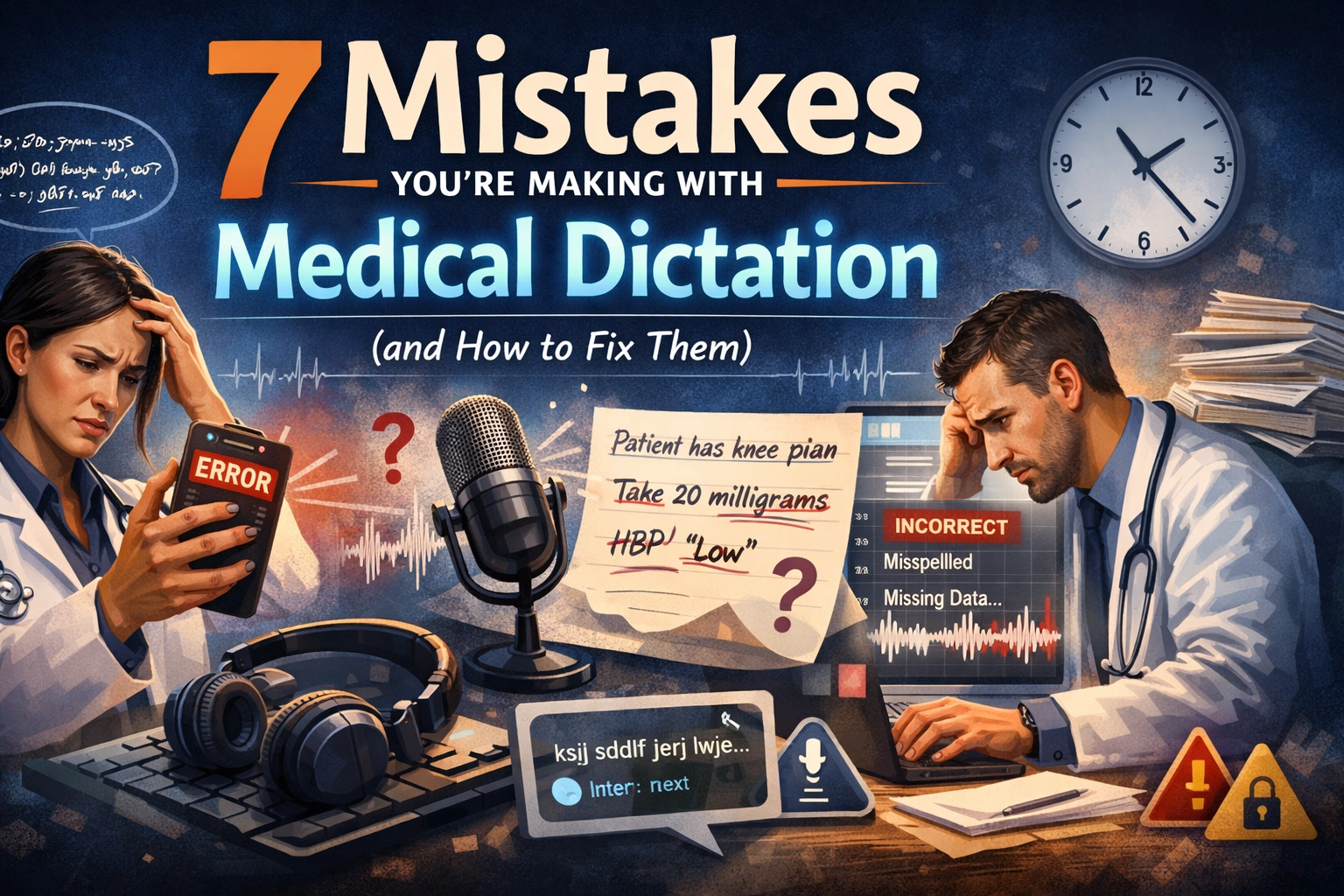
Medical documentation is a grind. You spend hours every day tethered to a keyboard. You lose time with your family. You lose focus on your patients. Dictation was supposed to be the escape hatch. You expected to talk, finish your charts, and go home.
Instead, you’re spending your evening correcting typos. You’re fixing "15mg" that became "50mg." You’re chasing errors that could cost you your license or your patient’s life. Dictation is a tool, but most clinicians are using it wrong.
Stop settling for "good enough" documentation. Your notes are your legal shield and your clinical legacy. If they are sloppy, you are vulnerable. Here are the seven deadly mistakes you’re making with medical dictation and exactly how to fix them today.
1. The Negation Flip: A Clinical Disaster
Small words carry the heaviest weight. In medical dictation, the word "no" is the most dangerous syllable in your vocabulary. AI and traditional transcription often miss it. "No history of diabetes" becomes "History of diabetes." "Denies chest pain" becomes "Chest pain."
This isn't just a typo. It is a clinical catastrophe. It flips the entire medical story. If a consultant reads that flip, they treat the wrong condition. If a lawyer reads it, they see negligence.
How to fix it:
Stop using "no" as a standalone modifier. Switch to "negative for" or "denies." These phrases are multi-syllabic and harder for AI to misinterpret. Physically scan every finished note for negations. If you see "history of," verify the "no" didn't vanish into thin air. Be robotic. Be repetitive. Consistency saves lives.
2. The Dose Mangle
Numbers are the enemy of voice recognition. "Fifteen" and "Fifty" sound nearly identical in a busy clinic. "Point five" is easily heard as "five." When you dictate "0.5mg of Xanax" and it appears as "5mg," you have created a lethal order.
The risk is even higher with look-alike, sound-alike (LASA) medications. Your software might be smart, but it isn't a pharmacist. It doesn't know the context of the dosage versus the drug name.
How to fix it:
Dictate digits individually. Say "one-five milligrams" instead of "fifteen." Always lead with a zero for decimals: say "zero point five." Pronounce both the brand name and the generic name for high-alert medications. "Warfarin, brand name Coumadin." It takes three extra seconds. It prevents a lifetime of litigation.

3. Dictating in the Chaos
You are busy. You try to dictate while walking down a hallway. You dictate while a nurse is asking you a question. You dictate while the HVAC system is humming in the background. This is a recipe for garbage data.
Background noise is the primary cause of transcription "hallucinations." When the AI can’t find a clear signal, it fills the gaps with what it thinks you said. These hallucinations are often grammatically correct but clinically nonsensical.
How to fix it:
Find a quiet zone. Stop multitasking. Dictation requires the same focus as surgery. If you can hear a conversation three feet away, your microphone can too. Use a high-quality, directional microphone that cancels ambient noise. If you are using a mobile device, hold it properly. Don’t treat your phone like a walkie-talkie; speak directly into the primary mic.
4. The Omission Gap
More than 60% of medical errors originate from documentation failures. The most common failure? Leaving things out. You focus so hard on the Chief Complaint that you forget the Family History. You skip the "negative" findings because you’re in a rush.
A thin note is a weak note. If it isn't documented, it didn't happen. If you didn't document that you checked the patient's gait, a jury will assume you didn't check it.
How to fix it:
Use templates. Don't rely on your memory to guide the narrative. Follow a strict SOAP or H&P structure every single time. Before you stop the recording, run a mental checklist: History, Physical, Assessment, Plan. If you find yourself skipping sections, your system is failing you. Rebuild it.
5. The Security Breach: Trusting the Cloud
Most dictation software is a privacy nightmare. You speak, and your voice is sent to a server in another state: or another country. You are "renting" your productivity from a company that owns your data. If their server goes down, your clinic stops. If they get hacked, your patient's most intimate details are on the dark web.
Cloud-based dictation is a tether. It requires a constant internet connection. It introduces lag. It introduces risk.
How to fix it:
Go offline. Use local processing. Your data should never leave your device. At VoiceType, we believe in privacy by design. Offline dictation means no data leaks, no latency, and total ownership of your clinical notes. It works in the basement of a hospital where Wi-Fi dies. It works when the grid goes down. It is the only way to ensure 100% HIPAA compliance.

6. Vague Terminology and Fluff
"Patient is doing better." This sentence is useless. "Better" is subjective. "Doing" is a filler word. Vague language is the hallmark of a rushed clinician. It forces the next reader to guess your meaning.
Ambiguity leads to "copy-paste" syndrome, where notes look identical day after day. This is a red flag for auditors. If every patient "feels better," you aren't practicing medicine; you’re filling out forms.
How to fix it:
Use visceral, objective language. Instead of "better," say "pain decreased from 8/10 to 3/10." Instead of "appears well," say "ambulating without assistance, respiratory rate normal." Use standardized medical terminology. Avoid non-standard abbreviations that only your local office understands. Speak with the precision of a textbook.
7. The "Normal" Trap (Documentation Inflation)
You dictate "Normal" for a 10-point Review of Systems when you only asked two questions. You do this to hit a billing code. This is documentation inflation, and it is a massive liability.
If you document a "normal" neurological exam but the patient has a stroke two hours later, your "normal" note is the rope the plaintiff’s attorney will use. Dictating "normal" by default is not a shortcut; it is a trap.
How to fix it:
Only document what you actually performed. Use "Medical Decision Making" (MDM) to justify your billing, not "bullet counting." At the end of your dictation, state: "Complexity is moderate due to chronic conditions and medication management." This is more powerful for coding than a dozen "normal" checkboxes. Be honest. Be accurate.

Reclaiming Your Time
Medical dictation should be a silent, powerful utility. It should work behind the scenes to make your life easier. If you are struggling with your current setup, you are likely making one of these seven mistakes.
Stop fighting with your software. Stop sending your patient data into the cloud. You deserve a workflow that respects your time and your privacy.
The old way of dictating is slow, risky, and annoying. The new way is fast, offline, and secure. Fix your habits. Upgrade your tools. Take back your evenings.
For more information on how to streamline your clinical workflow, visit our sitemap or explore the VoiceType homepage. Your notes belong to you. Keep them that way.
Leave a Reply