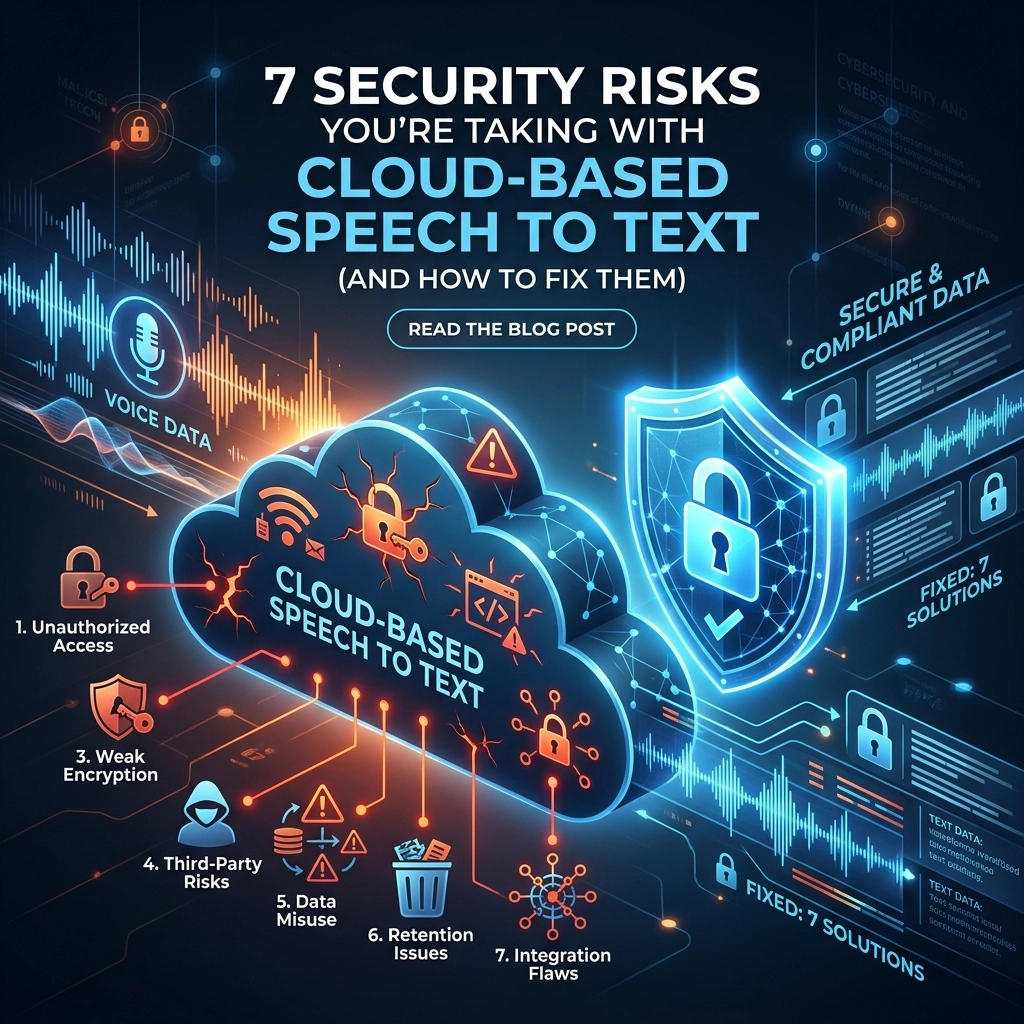
Your voice is your most private asset. When you speak, you reveal secrets, strategies, and sensitive client data. But the moment you use a cloud-based speech-to-text tool, you stop owning those words. You rent them back from a server located thousands of miles away.
Cloud convenience is a trap. It offers speed at the cost of sovereignty. It offers "free" services at the cost of your professional integrity. For doctors, lawyers, and executives, this isn't just a tech choice. It is a massive security liability.
Stop gambling with your data. Recognize the risks. Reclaim your privacy.
Here are the seven security risks you are taking right now with cloud-based speech-to-text, and the only way to fix them.
1. The Invisible Wiretap: Data Interception
Every time you dictate into a cloud-connected app, your audio travels. It leaves your device. It moves through your router. It bounces across public infrastructure. It lands on a third-party server.
Encryption exists, but it is not a silver bullet. Sophisticated attackers target data in transit. They look for vulnerabilities in the "pipes" of the internet. If your data is moving, it is at risk.
The Risk: A bad actor intercepts your audio stream. They now have a digital recording of your private meeting, your patient’s diagnosis, or your company’s trade secrets.
The Fix: Stop sending data. Use tools that process audio locally on your hardware. If the data never leaves your computer, it cannot be intercepted in transit. Use VoiceType to keep your voice within your walls.

2. The Honeypot: Centralized Storage
Cloud companies love data. They store your transcripts on massive, centralized servers. These servers are "honeypots": giant targets for every hacker on the planet.
You are trusting a third party to be perfect forever. History proves they aren't. Misconfigured buckets, leaked credentials, and insider threats happen every single day. When a cloud provider gets breached, they don't just lose their data. They lose yours.
The Risk: A single breach at a cloud provider exposes years of your dictated notes and confidential records to the dark web.
The Fix: Delete the honeypot. Choose an offline-first workflow. When you store your data locally on your encrypted drive, you control the perimeter. You are no longer a target in someone else’s database.
3. The Silent Listener: Unintended Recording
"Wake words" are a marketing fiction. For a device to hear a wake word, it must be listening to everything else. Cloud-based systems are designed to be "always on." They capture snippets of conversation you never intended to record.
These "false activations" are more common than you think. Private family moments, legal strategy sessions, and confidential phone calls end up on cloud servers because a machine thought it heard its name.
The Risk: Private conversations are uploaded and transcribed without your explicit consent, creating a permanent record of things that were meant to be off-the-record.
The Fix: Cut the cord. Use software that only activates when you tell it to, and never communicates with an external server. True privacy requires a "hard off" switch that only offline software provides.

4. The Human Element: Manual Reviews
Most users assume "AI" means "only machines." This is a lie. To improve accuracy, cloud companies often employ human reviewers. These contractors sit in cubicles and listen to your "anonymous" audio clips to check if the machine got the words right.
Your "anonymous" data isn't always anonymous. Accents, names, and context clues make it easy to identify the speaker. You are essentially inviting a stranger into your private office to proofread your thoughts.
The Risk: A random contractor listens to your sensitive business discussions or personal reflections.
The Fix: Demand 100% machine-local processing. Ensure that no human: and no other computer: ever sees or hears your data. VoiceType ensures that the only person who hears your voice is you.
5. The Compliance Nightmare: Regulatory Failure
If you work in healthcare, law, or finance, you are bound by strict regulations like HIPAA, GDPR, or CCPA. Cloud tools often claim to be compliant, but the fine print says otherwise.
When data leaves your device, you lose the "Chain of Custody." You cannot prove who has seen the data, where it is stored, or how it is being used. A single audit can turn your "convenient" cloud tool into a multi-million dollar fine.
The Risk: You violate federal privacy laws because your speech-to-text provider moved data across international borders or failed to secure it to regulatory standards.
The Fix: Maintain absolute custody. The simplest way to be compliant is to never let the data leave your sight. Local processing is the ultimate compliance shortcut. It removes the need for complex Business Associate Agreements (BAAs) because there is no third party involved.

6. The Identity Goldmine: PII Exposure
Your voice contains Personally Identifiable Information (PII). You dictate names, addresses, credit card numbers, and social security digits. Cloud systems ingest this data and store it in plain text or easily decodable formats.
This data is a goldmine for identity thieves. Unlike a password, you cannot change your voice. You cannot change your social security number easily. Once this data is leaked from a cloud server, the damage is permanent.
The Risk: Your dictated notes become a manual for identity theft, providing hackers with everything they need to impersonate you or your clients.
The Fix: Treat your voice like a biometric password. You wouldn't upload your fingerprints to a random cloud server; don't do it with your voice. Keep PII local. Process it locally. Store it locally.
7. The Subscription Trap: The Kill Switch
When you rely on cloud speech-to-text, you don't own your tools. You rent them. If the provider changes their terms, hikes their prices, or goes out of business, your workflow disappears.
Even worse, if the provider decides they don't like your "content," they can flip a switch and lock you out of your own data. You are a tenant on their platform, subject to their whims and their security failures.
The Risk: You lose access to your productivity tools and your historical data because of a server outage or a corporate policy change.
The Fix: Move to ownership. Buy software that lives on your machine. No subscriptions. No "kill switches." No internet required. Own your tools. Own your data. Own your time.
The Ultimate Fix: Go Offline
The solution to these seven risks isn't better cloud security. It is no cloud security.
The only way to guarantee 100% privacy is to use a 100% offline speech-to-text solution. You need a tool that leverages the power of your own computer's processor to turn speech into text.
VoiceType is that tool.
We built VoiceType for professionals who cannot afford a single leak. It is direct. It is powerful. It is silent.
- No Internet Required: Transcribe anywhere, from a plane to a basement.
- Zero Data Logging: We don't want your data. We never see it.
- Local Power: High-speed AI that runs on your laptop, not a server farm.
- One-Time Ownership: Stop renting your productivity.

Stop Renting Your Privacy
The "old way" of doing things was slow and risky. You spoke, the cloud listened, and you hoped for the best. That era is over. The "new way" is fast, safe, and satisfying.
Reclaim your privacy. Protect your clients. Secure your future.
Stop sending your voice into the void. Start using a tool that respects your boundaries.
Direct. Private. Productive.
That is the VoiceType promise.
Leave a Reply