Security is not a checkbox. It is a posture. For IT and Security professionals, the perimeter is your life. You lock the doors. You encrypt the drives. You vet the vendors. Then, you hit "Record" on a cloud dictation app.
In that moment, your security posture collapses.
Your voice is data. It is sensitive data. It contains client names, trade secrets, and internal strategies. When you use cloud-based tools, you are effectively shouting your secrets across the internet and hoping the person on the other end is listening, and that they are honest.
Stop hoping. Start securing.
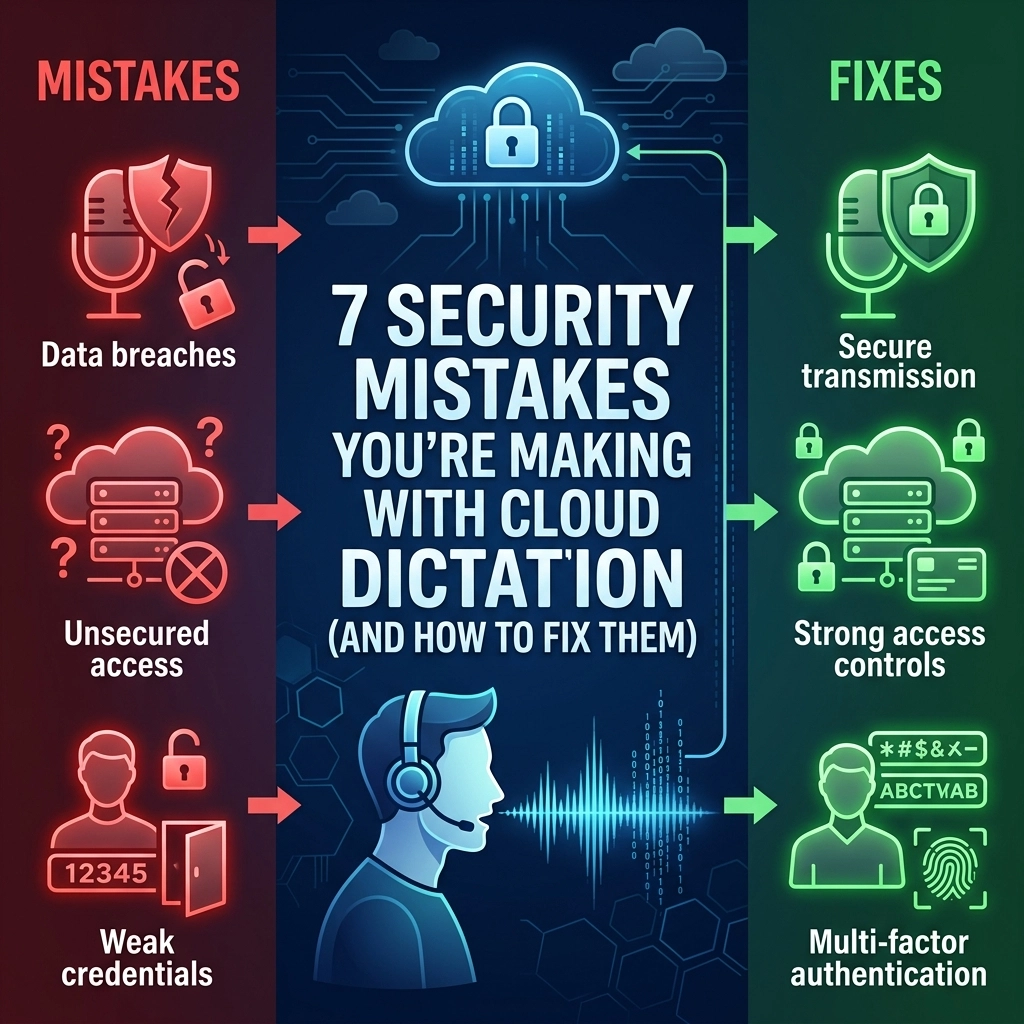
Here are the 7 security mistakes you are making with cloud dictation right now, and the one way to fix them forever.
1. The Server Leap: Trusting Someone Else’s Metal
Every time you speak into a cloud-connected microphone, your voice makes a leap. It leaves your device. It travels through the air. It lands on a server in a data center you have never visited.
This is the "Rental" risk. You are renting your productivity at the cost of your privacy. You don't know who has physical access to those servers. You don't know if the provider’s internal admins are snooping on high-value accounts. You don't know if their storage buckets are misconfigured.
The Fix: Go Local.
The only way to guarantee server security is to remove the server from the equation. Use tools that process your voice on your own hardware. If the data never leaves the laptop, the data can’t be stolen from a third-party cloud. 
2. The Transit Trap: Over-Reliance on Encryption
Most cloud dictation providers brag about "Encryption in Transit." They tell you your data is safe because it uses TLS 1.3.
They are lying by omission.
Encryption in transit only protects the data while it is moving. Once it hits the provider's server, they have to decrypt it to process the AI model. At that moment, your data is "hot." It is readable. If a bad actor gains access to that processing environment, your encryption meant nothing. You are relying on a middleman to keep a secret they have to read to understand.
The Fix: Air-Gapped AI.
True security means the decryption key never leaves your hands. By using air-gapped, local AI, the processing happens in a "black box" on your device. There is no transit. There is no trap.
3. The Training Tax: Feeding the Public Model
Cloud AI companies are hungry. They need data to get smarter. When you use their "free" or "pro" cloud tiers, you are often agreeing to let them use your dictation to train their future models.
Think about that. Your confidential legal strategy or your company's Q3 roadmap becomes a training point for a public AI. A competitor could potentially prompt that AI in six months and receive a suggestion based on your intellectual property. You are paying a "Training Tax" with your own secrets.
The Fix: Sovereign Intelligence.
Own your AI. When you run dictation locally through VoiceType, the model is static and private. It doesn't learn from you to teach others. Your IP stays yours. Period.

4. The Residency Riddle: Where is Your Voice?
Compliance is a headache. GDPR, HIPAA, and local data residency laws demand you know exactly where data is stored. Cloud providers often shuffle data between regions to save on costs. One day your dictation is in Virginia; the next, it’s in a jurisdiction with zero privacy protections.
If you can’t point to the physical disk where your data lives, you are failing your compliance audit. It is that simple.
The Fix: Data Residency by Default.
When your AI lives on your hard drive, your data residency is wherever you are standing. There is no riddle to solve. You are the data center.
5. The Dependency Drift: Connectivity as a Vulnerability
Security isn't just about privacy; it’s about availability. Cloud dictation makes your productivity a slave to your ISP. If the Wi-Fi drops, your dictation stops. If the provider’s API goes down, your workflow dies.
For a security professional, this is an unacceptable "single point of failure." You wouldn't rely on a cloud-based firewall that stops working when the internet flickers. Why would you rely on a cloud-based dictation tool?
The Fix: Offline Resilience.
Local AI doesn't need a handshake with a server. It works in a basement. It works on a plane. It works in a SCIF (Sensitive Compartmented Information Facility). It is always on because it is always there.

6. The Metadata Leak: More Than Just Words
It’s not just what you say. It’s when you say it, where you say it from, and what device you use. Cloud providers track metadata to "improve user experience." They know your IP address. They know your typing speed. They know your location.
This metadata creates a footprint. To a sophisticated attacker, that footprint is a map of your habits and your vulnerabilities.
The Fix: Minimalist Footprint.
Local software doesn't need to phone home. It doesn't need to report your coordinates. It just works. By cutting the cord, you erase the footprint.
7. The Subscription Squeeze: Renting Your Own Safety
Many IT departments fall for the subscription trap. You pay every month for "Enterprise Security" features. You are essentially paying a protection fee to access your own data safely. If you stop paying, you lose access to your history and your security protocols.
This is "Rented Security." It is fragile. It is expensive. And it is unnecessary.
The Fix: Ownership.
Buy the tool. Own the tech. Run it on your hardware. VoiceType represents a shift back to ownership. You don't rent your keyboard. You shouldn't rent the brain that turns your voice into text.
The Deep Dive: Why Local AI is the Only Path Forward
For years, we were told that AI was too "heavy" for local machines. We were told we needed the cloud’s massive GPU clusters to handle speech-to-text.
That was the old way. The "New Way" is here.
Modern laptops have dedicated hardware for AI tasks. Your device is more than capable of running world-class transcription without ever pinging a server. This isn't just a convenience; it is a fundamental shift in the security landscape.
When you move to local AI, you eliminate the biggest attack surface in your organization: the internet. You cannot hack what you cannot reach. An air-gapped AI dictation tool is a fortress. It provides:
- Zero Latency: No more waiting for the "processing" spinner.
- Total Control: You decide when to update. You decide where to save.
- Absolute Privacy: Your voice never leaves the room.

Reclaiming Your Voice
You spend your career protecting your organization’s data. Stop leaving a back door open through your microphone.
Cloud dictation is a legacy habit from an era of weak hardware. That era is over. It is time to bring your dictation back behind the firewall. It is time to stop trusting "The Cloud" and start trusting your own metal.
At VoiceType, we believe that productivity should never come at the expense of privacy. We build tools for people who understand that the most secure data is the data that never leaves your sight.
Direct. Fast. Local.
Stop leaking. Start dictating.

Summary Checklist for IT Professionals
- Audit your current tools: Does the dictation software function without an internet connection? If no, it is a security risk.
- Check the TOS: Does your provider use your data for "model improvement"? If yes, your IP is leaking.
- Verify residency: Can you pinpoint the physical location of your stored voice files? If no, you are out of compliance.
- Evaluate the "New Way": Test local AI solutions. Compare the speed. Notice the lack of lag. Feel the peace of mind.
The transition to local AI is inevitable. The only question is whether you will make the switch now, or after your first data breach. Choose now.
Leave a Reply