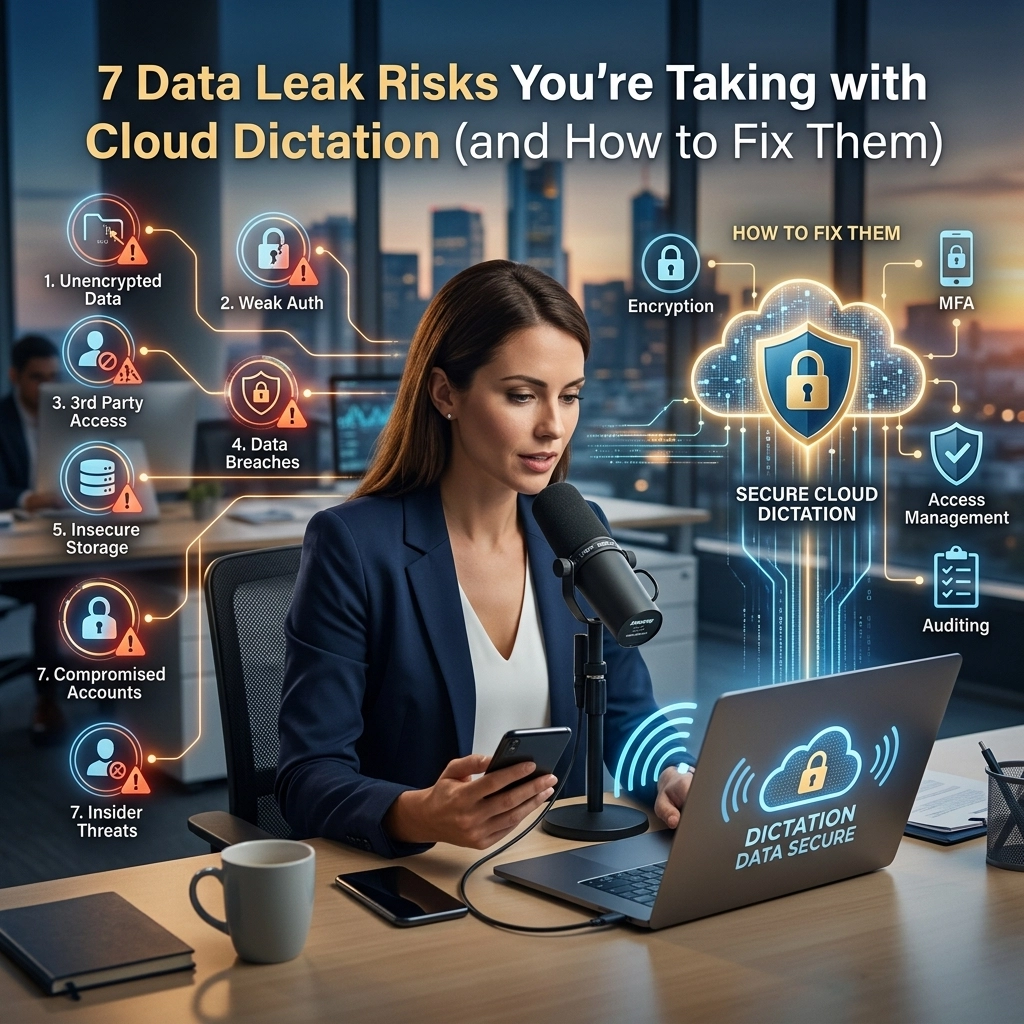
Convenience is a trap. You think you are being productive. You think you are saving time. In reality, you are handing over the keys to your kingdom.
Every time you click "record" on a cloud-based dictation tool, your voice leaves your building. It travels across miles of public infrastructure. It lands on a server you do not own. It is processed by an entity you cannot truly audit.
For IT and security professionals, this is a nightmare disguised as a utility. Your intellectual property is floating in the ether. Your legal strategies, patient records, and trade secrets are now data points on someone else's spreadsheet.
Stop pretending "encrypted at rest" is enough. It isn't. If you want to protect your data, you need to understand the risks of the old way and embrace the power of the new way.
Here are the seven data leak risks you are taking right now: and the only way to fix them.
1. The Transit Vulnerability: Your Voice in the Wild
The moment you speak, the clock starts. In a cloud environment, your audio must be digitized, packaged, and sent. Even with modern encryption, "data in transit" is a point of failure.
You are relying on the strength of a connection you don't control. You are relying on certificates that can expire or be spoofed. If the handshake fails, or if a sophisticated actor intercepts the stream, your raw audio is exposed.
Think about what you dictate. Corporate strategy. Sensitive HR disputes. Financial forecasts. This isn't just "data." It is the DNA of your company. Sending it over the open web is like shouting your bank password across a crowded room and hoping nobody is listening.

2. The Third-Party Honeypot
Cloud providers are massive targets. They centralize data from thousands of companies into single, juicy "honeypots." Hackers don't want to breach your small office. They want to breach the provider holding the data of ten thousand offices.
When you use cloud dictation, you inherit the risk profile of the provider. If they have a bad day, you have a catastrophic year. You are betting your reputation on their security team's ability to be perfect every single second of every single day.
History shows that even the biggest players fail. Misconfigured buckets, compromised employee credentials, and zero-day exploits are constant threats. Why put your data in a pile with everyone else’s?
3. The Parasitic Training Model
Here is the dirty secret of the AI industry: your data is the fuel.
Most cloud-based tools use your dictations to "improve their models." They call it a feature. It is actually a leak. Your unique vocabulary, your industry-specific jargon, and your proprietary concepts are being fed into a machine.
That machine then gets smarter for the next person. Sometimes, that next person is your competitor. While the provider might claim the data is anonymized, "un-learning" information from a large language model is nearly impossible. You are paying a subscription fee to let a third party mine your brain. It’s time to stop being the product.
4. The Sub-Processor Shadow Chain
You signed a contract with Vendor A. But Vendor A uses Vendor B for storage. Vendor B uses Vendor C for specialized AI processing.
This is the "shadow chain." Every new link in the chain is a new opportunity for a leak. Do you know where Vendor C's data centers are located? Do you know who has physical access to their servers?
In a cloud dictation setup, your voice data often touches three or four different companies before it returns to your screen as text. You have zero visibility into this ecosystem. You have zero control. You have a massive compliance headache waiting to explode.

5. The Misconfiguration Trap
Human error is the leading cause of data breaches. Cloud interfaces are complex. They are designed for flexibility, not for lockdown. One developer forgets to toggle a "private" switch, and suddenly your entire transcription history is indexed by Google.
This isn't a theory. It happens every day. When the tools are local, the perimeter is simple. When the tools are in the cloud, the perimeter is a labyrinth of permissions, roles, and API keys. You are one click away from a public disclosure. Why take the chance?
6. Compliance Friction and Legal Gray Zones
If you work in healthcare, law, or finance, you know the weight of compliance. HIPAA, GDPR, and SOC2 aren't just acronyms; they are legal obligations.
Cloud dictation makes compliance a marathon. You need Business Associate Agreements (BAAs). You need data residency guarantees. You need to prove where the data went and who saw it.
The "Old Way" forces you to trust a third party's audit report. The "New Way": local, air-gapped AI: removes the problem entirely. If the data never leaves your device, the data never enters the scope of "external transmission" risks. You reclaim your time and your sanity.
7. The Account Takeover (ATO) Risk
If your dictation history is stored in a cloud account, it is protected by a password. Maybe you have MFA. But hackers are experts at social engineering, SIM swapping, and session hijacking.
Once an attacker gains access to a user's cloud account, they don't just see one transcript. They see every transcript that user has ever made. They see a library of corporate secrets.
Local AI dictation doesn't have an "account" in the cloud. There is no central login to steal. The data lives on the machine. If you have the machine, you have the data. If you don't, you don't. It is physical security for a digital age.

The Fix: Local, Air-Gapped AI
The solution isn't to stop dictating. Dictation is a productivity powerhouse. The solution is to change where the work happens.
You need to move from the cloud to the edge. You need VoiceType.
VoiceType isn't another subscription service that rents you access to a server. It is professional-grade AI that lives on your hardware. It is air-gapped. It is private. It is absolute.
Reclaim Your Privacy
With VoiceType, the audio never leaves your computer. The processing happens on your CPU and GPU. The transcription is generated locally. No internet connection is required. No data is sent to a "mother ship." No third party gets to peek at your notes.
Zero Latency, Zero Risk
Cloud tools lag. They wait for the upload. They wait for the server. They wait for the download. VoiceType is instant. Because the data doesn't travel, there is no transit time. You get high-speed results without the high-stakes risk.
Ownership Over Rental
Stop "renting" your productivity. When you use cloud tools, you are at the mercy of their uptime and their pricing whims. VoiceType gives you ownership. It is a silent utility that works in the background, serving you and only you.

How to Fix Your Workflow Today:
- Audit your current tools. Find every app that "calls home" to process voice.
- Identify the high-risk users. Your executives, legal team, and R&D department should be the first to move.
- Deploy local AI. Install VoiceType on your local machines.
- Kill the connection. Turn off the internet. Watch the transcription happen anyway. That is what true security feels like.
The "Cloud-First" era was a mistake for sensitive data. It traded security for a false sense of ease. The "Local-First" era is here. It is faster. It is safer. It is the only way to ensure that what you say stays within your four walls.
Your voice is your most valuable asset. Stop giving it away.
Reclaim your data. Reclaim your privacy. Use VoiceType.
For more insights on securing your professional workflow, visit voicetype.in.
Leave a Reply