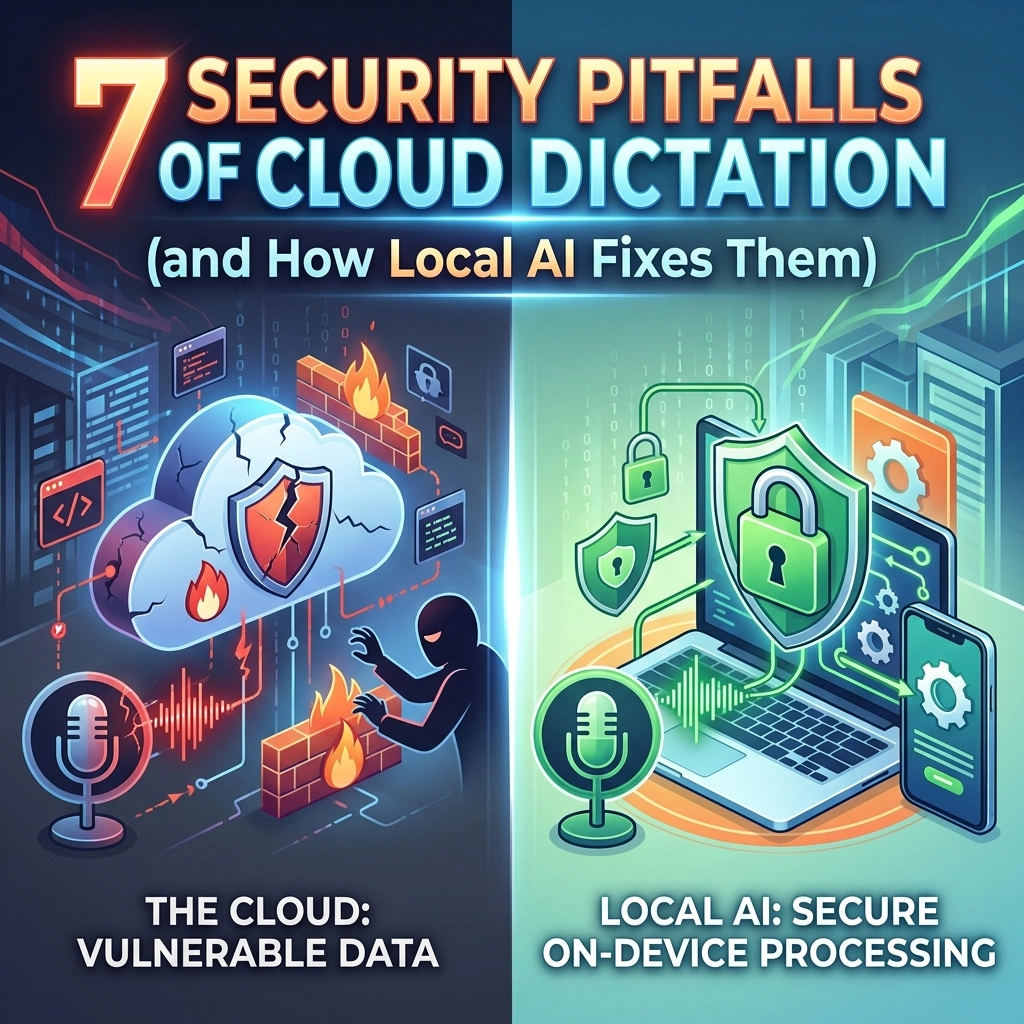
Stop sending your voice to the cloud. It is a security risk you cannot afford.
In the race for productivity, IT leaders have made a dangerous trade. They swapped privacy for convenience. They handed over sensitive corporate strategy, legal briefs, and patient data to distant servers. They trusted the "cloud" to keep secrets.
The cloud does not keep secrets. The cloud is someone else’s computer.
If you are an IT or Security professional, you know the stakes. A single leaked transcript can derail a merger. A compromised voice profile can fuel deepfake attacks. The status quo is broken.
Here are the 7 security pitfalls of cloud-based dictation and how local, air-gapped AI reclaims your perimeter.
1. The Leaky Pipeline: Data in Transit
Every time a user clicks "record" on a cloud dictation tool, a data packet starts a journey. It travels through local networks, ISP gateways, and public backbones. It eventually lands in a data center thousands of miles away.
Encryption protects this data, but encryption is not a guarantee. It is a lock. Locks can be picked. Man-in-the-middle (MITM) attacks target this journey. Side-channel leaks happen. Metadata is harvested at every hop.
The Fix: Eliminate the Journey
Local AI keeps the data on the device. There is no pipeline to leak. The audio never leaves the RAM of the local machine. You cannot intercept what isn't sent.

2. The Black Box: Unseen Training Models
Cloud providers have a secret. They are hungry for your data. They don't just transcribe your words; they use them to "improve their models." This is a polite way of saying they are harvesting your intellectual property.
Your proprietary code, your confidential client lists, and your internal strategies become training fodder. Once your data enters a training set, it is gone. You cannot delete it. You cannot "un-train" a model.
The Fix: Absolute Ownership
Local AI models are static. They work for you, not for a provider. With VoiceType, the intelligence is contained. It does not phone home to report what it learned. You own the input. You own the output. You own the model.
3. Compliance Chaos: The Residency Nightmare
GDPR. HIPAA. SOC2. These aren't just acronyms. They are legal minefields.
Cloud dictation makes compliance a moving target. Do you know exactly where your data is stored? Is it in a jurisdiction with weak privacy laws? When a cloud provider updates their Terms of Service, do you lose your compliance status overnight?
Tracking data residency in the cloud is a full-time job. It is a job you shouldn't have to do.
The Fix: Physical Sovereignty
If the data never leaves the building, compliance becomes simple. You don't need to audit a distant data center. You audit your own hardware. Local AI provides a hard boundary that satisfies even the strictest regulators.
4. The Connectivity Trap: Security vs. Availability
Cloud tools require a heartbeat. No internet means no dictation. This forces employees to use insecure public Wi-Fi or tethered hotspots just to get their work done.
When a user is desperate to finish a report, they will bypass your VPN. They will connect to the "Airport_Free_WiFi." They will prioritize availability over security. This creates a massive hole in your defensive posture.
The Fix: Air-Gapped Productivity
Local AI works in a lead-lined room. It works on a plane. It works in a basement. Because it doesn't need a connection, your team never feels the urge to hunt for a risky signal. Security and availability finally work together.

5. Identity Hijacking: The SaaS Login Problem
Cloud tools are accessed via accounts. Accounts are protected by passwords. Passwords are stolen every day.
If a bad actor gains access to a user’s cloud dictation account, they don't just get one transcript. They get the history. They get months of recorded thoughts, meetings, and notes. Centralizing sensitive voice data in a SaaS account creates a single point of failure for your entire organization.
The Fix: Decentralized Intelligence
Local AI ties the data to the machine. To steal the data, an attacker needs physical access to the encrypted drive. There is no central honey pot. You turn a massive target into thousands of tiny, hardened ones.
6. The "Rented" Future: API Fragility and Lock-in
Relying on cloud AI means renting your productivity. If the provider raises prices, you pay. If they change their API, your workflow breaks. If they decide to deprecate a feature you rely on, you lose.
More importantly, you are vulnerable to "vulnerability drift." A cloud provider might introduce a new feature that inadvertently creates a security hole. You have no control over their codebase, yet you suffer the consequences.
The Fix: Perpetual Stability
Local AI is a utility you own. It is a silent, powerful tool that lives on your hardware. It doesn't update without your permission. It doesn't change the rules of the game mid-match. It provides a stable, predictable environment for your users.

7. The Speed Tax: Latency is a Security Risk
In the cloud, speed depends on the "distance" to the server. High latency leads to user frustration. Frustrated users find workarounds.
They record their voice on a personal phone and email the file to themselves. They use unapproved third-party transcription sites. Latency kills your "Shadow IT" prevention efforts. Every millisecond of delay is an invitation for a user to break protocol.
The Fix: Instant Execution
Local AI is fast. It is limited only by the local CPU/GPU. There is no "buffering." There is no "uploading." The text appears as the user speaks. When the official tool is the fastest tool, users stop looking for dangerous alternatives.
Reclaiming the Perimeter
The era of "Cloud-First" is ending. We are entering the era of "Private-First."
As an IT professional, your job is to build a fortress. You cannot build a fortress if the walls have thousands of tiny holes for data to leak out. Cloud dictation is one of those holes.
Local AI is the patch.
At VoiceType, we believe that your voice is your most private asset. We built a system that respects that. Our software runs locally. It processes locally. It stays local.
Hard Numbers for the C-Suite
If you need to justify the move to local AI, look at the quantifiable outcomes:
- 0% Data transit risk.
- 100% Data residency compliance.
- 0ms Server-side latency.
- $0 In recurring API "usage" fees for training their models on your data.
Stop renting. Start owning.

The Bottom Line
Security is not about checking boxes. It is about reducing the attack surface.
Cloud dictation expands your attack surface. It introduces third-party risk, transit risk, and residency risk. It turns your private conversations into public liabilities.
Local AI shrinks the attack surface to zero. It gives your team the power of modern speech-to-text without the compromise of the cloud. It is fast. It is private. It is inevitable.
Direct your team to a safer way of working. Move your dictation off the cloud and back where it belongs: under your control.
Check our sitemap for more industry deep dives or visit VoiceType to secure your organization’s voice today.
The choice is simple. Protect the data or lose it. Choose local.
Leave a Reply