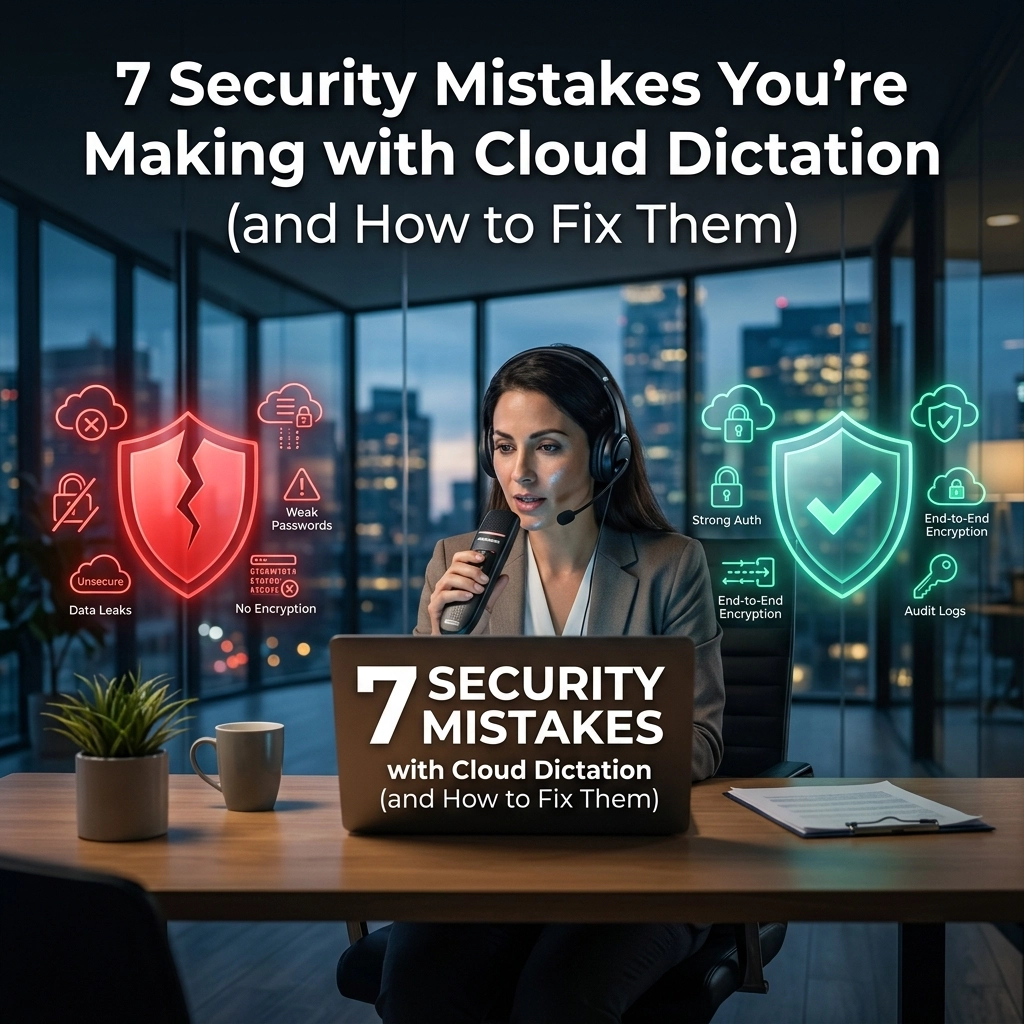
Your voice is your most personal data. It carries your thoughts, your trade secrets, and your identity. Every time you use a cloud-based dictation tool, you are handing that data over to a stranger. You are betting your career on their security.
Most professionals are losing that bet.
Cloud dictation is the old way. It is slow. It is risky. It is a privacy nightmare disguised as a convenience. You think you are being productive. In reality, you are leaking confidential information every single day.
Stop settling for "good enough" security. Start protecting your work.
Here are the seven biggest security mistakes you are making with cloud dictation and the definitive way to fix them using local AI.
1. Shipping Your Brain to the Cloud
Every word you speak into a cloud-based app is bundled and sent to a remote server. You lose control the second you hit "record." This data travels across the open internet. It sits on servers you don't own. It is managed by people you don't know.
This is the "Cloud Trap."
Stop treating your intellectual property like junk mail. When you use cloud services, you are essentially "renting" your own productivity. If their servers go down, you stop working. If their servers get hacked, your data is gone.
The Fix: Move to Local AI.
Process everything on your machine. Keep your data where it belongs: with you. Local AI means your voice never leaves your hardware. No transit. No external servers. No risk.

2. Trusting the "Privacy Policy" Illusion
You clicked "Agree." You didn't read it. Nobody does.
Most cloud dictation providers include clauses that allow them to "analyze" your data to "improve the service." This is corporate speak for: "We are listening to your private memos to train our algorithms." You are paying them to use your data for their profit.
This isn't privacy. It's a data harvest.
Your legal briefs, medical notes, and strategic plans are being fed into a machine. You are literally building your competitor's tools with your own secrets.
The Fix: Eliminate the Middleman.
Use software that doesn't have a "backdoor" to a central server. When the AI lives locally on your computer, there is no one to report back to. You don't need to trust a privacy policy when there is no data being transmitted in the first place.
3. Ignoring the API Trail
Many "modern" productivity apps aren't actually AI companies. They are shells. They take your audio and send it to a third-party API like OpenAI or Google.
Now, your data isn't just in one cloud. It’s in two.
Every hop your data makes increases the attack surface. A breach at the API provider is a breach for you. You have no visibility into how these third parties store, process, or delete your audio files. You are operating in a total blind spot.
The Fix: Hardware-Native Processing.
Demand tools that run natively. VoiceType leverages the power of your own processor. It doesn't call a third-party API. It doesn't "hop" across the web. It stays silent, powerful, and local.
4. The "Delete" Button That Doesn't Work
You deleted the transcript. You think it's gone. It isn't.
Cloud providers keep backups. They keep logs. They keep metadata. Even if the text is gone, the record of when, where, and how long you spoke remains. In a world of sophisticated cyber-attacks, metadata is a goldmine. It tells a story about your habits and your business that you never intended to share.
Deleted should mean destroyed. In the cloud, "deleted" usually just means "hidden from view."
The Fix: Physical Ownership.
When you store data on your own encrypted drive, "delete" actually means something. You control the disk. You control the encryption keys. You control the destruction of data. Reclaim the right to be forgotten.

5. Training Models on Your Expertise
This is the most dangerous mistake of all. Large Language Models (LLMs) need data to grow. When you use cloud-based AI, you are the data.
Your unique insights, your specialized vocabulary, and your proprietary workflows are being absorbed by the model. Eventually, the AI will be able to mimic your expertise for someone else. You are effectively training your own replacement.
Professional work requires exclusivity. If everyone has access to the intelligence you helped build, your value diminishes.
The Fix: Non-Generative, Fixed Local Models.
Local AI models stay static unless you choose to update them. They don't "learn" from your sensitive input to update a global database. They serve you, and only you. Your expertise remains your competitive advantage.
6. The Latency Leak
Cloud dictation is slow. You speak. You wait. The text appears.
This delay isn't just annoying; it's a security signal. Latency exists because your data is traveling. That "lag" is the physical manifestation of your privacy leaving the building.
Furthermore, cloud-based tools often require a constant, stable internet connection. If you are working on a public Wi-Fi at an airport or a coffee shop, you are practically begging for a "Man-in-the-Middle" attack. Hackers can intercept your audio packets before they even reach the cloud.
The Fix: Offline-First Workflow.
Real speed comes from local execution. Local AI is near-instant. There is no "round-trip" to a server in Virginia or Ireland. You can dictate in a basement, on a plane, or in a high-security bunker. If you don't need the internet to work, you can't be hacked over the internet.

7. The Subscription Vulnerability
Cloud dictation is almost always a "Software as a Service" (SaaS) model. You pay every month. If you stop paying, you lose access to your history and your tools.
This creates a dependency. The provider owns the keys to your productivity. They can raise prices, change features, or shut down entirely. If they go bankrupt, your workflow dies with them.
Beyond the cost, a subscription requires a constant "handshake" with a license server. This is another point of failure and another data point being tracked.
The Fix: Buy, Don't Rent.
Local AI tools are moving back to a "buy it once, own it forever" model. This is about more than just money. It’s about sovereignty. When the software lives on your machine, it is a utility that works for you, not a service you are beholden to.
Why Local AI is the Only Path Forward
The "Old Way" of cloud dictation is a relic of a time when our computers were too weak to handle AI. That time is over.
Your laptop is now a powerhouse. It is capable of running sophisticated neural networks without breaking a sweat. There is no longer a technical reason to send your voice to the cloud. The only reason companies want you in the cloud is to control your data.
Local AI is the future because it is:
- Invisible: It works in the background without needing a login or a connection.
- Invincible: It doesn't care if the internet is down or if a server is hacked.
- Private: It treats your voice like the confidential asset it is.
Stop making these seven mistakes. Stop compromising. Your work is too important to be processed on a shared server.
Reclaim Your Privacy Today
You wouldn't let a stranger sit in your office and record every meeting. So why let a cloud provider do it?
The shift to local AI isn't just a tech trend. It is a return to common sense. It is about building a professional environment where security is the default, not an "optional feature" hidden behind a premium tier.
Start moving your workflow to the edge. Use tools that respect your boundaries. Choose software that empowers you without monitoring you.
The most secure way to work is the way that stays on your desk.

Take control of your data.
Visit voicetype.in and discover how local AI can transform your productivity without sacrificing your privacy. It is time to stop dictated by the cloud and start dictating on your own terms.
Direct. Fast. Secure.
That is the VoiceType way.
Leave a Reply