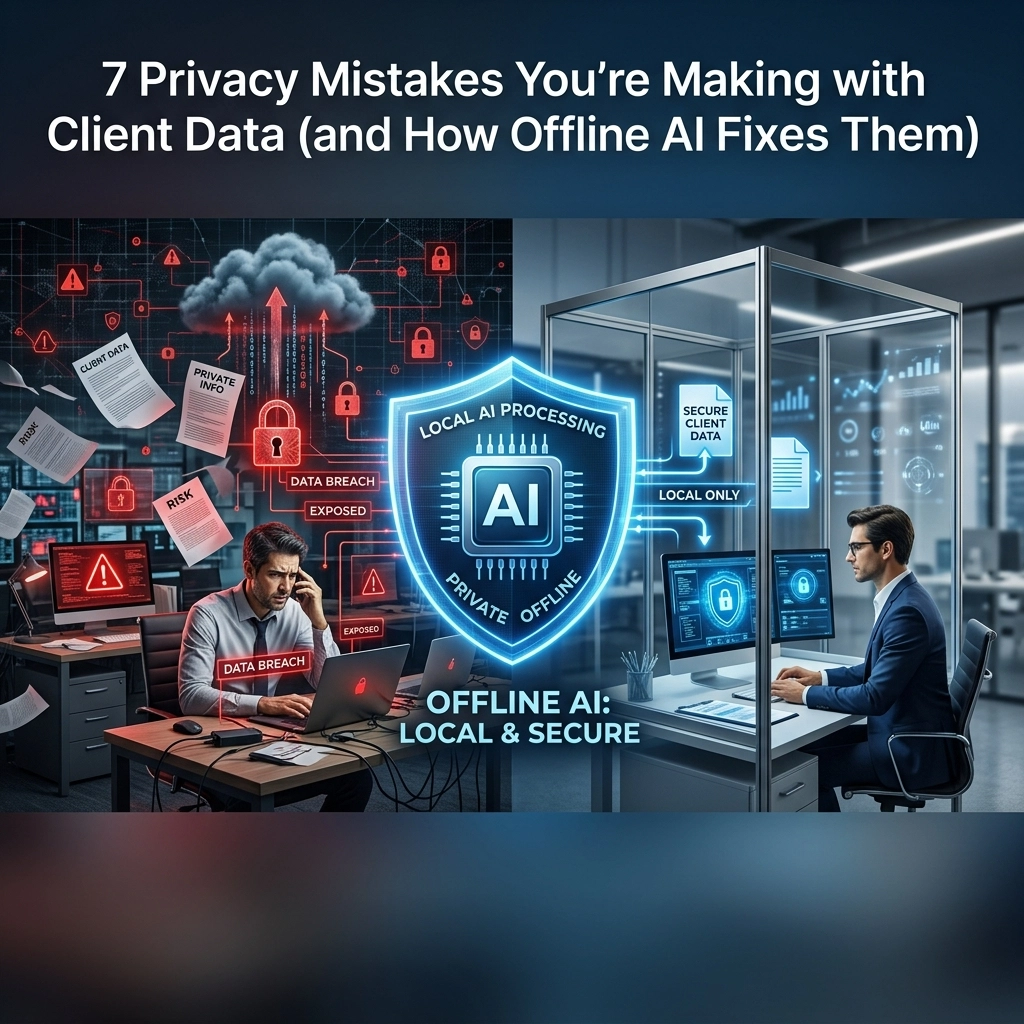
You are a legal professional. Your reputation is built on trust. Your license depends on confidentiality. You handle sensitive depositions, strategic litigation plans, and private client disclosures every single day.
Stop treating your data like it's public property.
Most lawyers think they are secure because they use a password. They are wrong. Most believe that "Cloud AI" is a productivity miracle. It is actually a liability. If your data leaves your device to be processed by a server in another state, you have already lost control.
Privacy isn't a checkbox. It is a physical reality. In 2026, the stakes have never been higher. Hackers are faster. Regulations are stricter. Your clients are smarter.
Here are the 7 privacy mistakes you are making right now: and why offline AI is the only way to fix them.
1. You Are Renting Your Privacy
You use subscription-based AI tools. You pay every month for the privilege of sending your audio files to someone else's server. This is "rented" privacy. You rely on a third-party's promise that they won't look at your data.
Promises break. Servers get hacked. Terms of service change overnight.
When you use cloud-based dictation, your voice: and your client’s secrets: travel through the open internet. It sits on a database managed by a company that might not even exist in three years. If their security fails, your firm takes the hit.
The Fix: Own the Process.
Offline AI, like VoiceType, lives on your machine. It doesn't ask for permission to use a server. It doesn't send packets of data across the globe. You own the software. You own the data. You own the privacy.

2. You Are Training Your Competitor’s AI
Every time you "feed" a cloud AI your legal briefs or case notes to summarize them, you are likely training their model. Most free and many paid AI services use your input to "improve" their algorithms.
You are literally giving away your proprietary work product. You are handing over your unique legal strategies to a machine that will eventually use that logic to help someone else. This isn't just a privacy leak; it's a competitive disaster.
The Fix: Zero-Data Training.
Offline AI does not "learn" from you and share it with the world. It processes. It executes. It forgets. Your strategy remains yours. The model stays static or updates only when you choose. No data exfiltration. No accidental sharing of your intellectual property.
3. The Public Wi-Fi Trap
Legal work doesn't just happen in the office. It happens in courtrooms, airports, and coffee shops. When you use cloud-based transcription tools on public Wi-Fi, you are inviting disaster.
Unsecured networks are playgrounds for man-in-the-middle attacks. Even with a VPN, you are adding unnecessary layers of risk. If the connection drops, your work is lost. If the connection is intercepted, your client's deposition is compromised.
The Fix: Cut the Cord.
Offline AI works in airplane mode. It works in a basement. It works in a high-security courtroom with no signal. By removing the need for an internet connection, you eliminate the single largest attack vector in modern computing.
4. HIPAA Compliance Theater
Many legal professionals believe that a "HIPAA-compliant" badge on a website is enough. It isn't. HIPAA requires strict data handling, encryption, and Business Associate Agreements (BAAs).
Most cloud tools offer "compliance" but still store logs of your activity. They keep metadata. They store "snippets" for quality control. In a legal setting, "mostly compliant" is the same as "non-compliant." If a HIPAA-protected medical record is mentioned in your dictation and that audio is stored on an unencrypted server, you are in breach.
The Fix: HIPAA-Ready by Design.
Offline AI is HIPAA-ready because the data never leaves the "covered entity's" device. There is no transmission to a third party. There is no "Business Associate" because there is no third party handling the data. It is the gold standard of compliance: total isolation.

5. The Infinite Data Log
Cloud providers love logs. They log when you log in. They log how long you speak. They log your IP address. They log the file names you upload.
Even if they delete your audio file, the metadata remains. This creates a digital paper trail that can be subpoenaed. In high-stakes litigation, this metadata can be weaponized against you. It proves who you were talking about, when, and for how long.
The Fix: Immediate Data Destruction.
When you use a tool like VoiceType offline, there is no central server keeping a log of your work habits. Your computer processes the audio and outputs the text. Once you close the app, the RAM is cleared. There is no "history" stored in a cloud dashboard for a hacker to find.
6. Sending Data to the Wrong Recipient
One of the most common data breaches is human error. You meant to upload the file to your secure internal drive, but you accidentally dragged it into a public AI chat window. Or you emailed a transcript to a "reply all" thread.
Cloud-based workflows often involve moving files between multiple tabs, windows, and platforms. Every move is an opportunity for a mistake.
The Fix: Integrated Offline Workflows.
Offline AI integrates directly into your existing secure environment. You don't "upload" files. You speak directly into your document. The text appears where you need it. By reducing the number of steps and the number of platforms involved, you drastically reduce the chance of a manual error.

7. Vague Privacy Policies
Have you read the 50-page privacy policy of your current dictation software? Probably not. Most legal professionals haven't. Hidden in those documents are clauses that allow "limited review by humans" or "sharing with trusted partners."
If a human at a tech company is listening to your audio to "improve accuracy," you have committed a massive breach of attorney-client privilege.
The Fix: Transparent Tech.
Offline AI doesn't need a 50-page privacy policy because it doesn't collect your data. The policy is simple: What happens on your computer stays on your computer. It is a silent, powerful utility. It works behind the scenes. It doesn't report back to headquarters.
Why Legal Professionals are Switching to VoiceType
The "Old Way" of legal tech was about convenience at the cost of security. It was slow. It was risky. It was annoying. It forced you to trust companies that don't understand the legal industry's unique burdens.
The "New Way" is about power and autonomy.
VoiceType provides AI-powered dictation that runs locally. No cloud. No servers. No leaks.
- Speed: Instant transcription without waiting for "uploading" or "processing" bars.
- Accuracy: High-performance AI models tuned for professional language.
- Security: Total isolation from the internet.
- Cost: One-time ownership or simple, transparent pricing. No "data tax."
Reclaim Your Peace of Mind
Stop worrying about where your data goes. Stop checking your Wi-Fi signal before you start a sensitive memo. Stop trusting third-party servers with your career.
Direct your energy where it belongs: on your clients and your cases. Let your software be a tool, not a liability.
Action Plan:
- Audit your current AI tools.
- Check if they require an internet connection to work.
- If they do, they are a risk.
- Replace them with offline alternatives.
- Download VoiceType.
The future of legal tech isn't in the cloud. It’s on your desk. It’s in your hands. It’s offline.
Be bold. Be secure. Keep your data where it belongs.
Leave a Reply