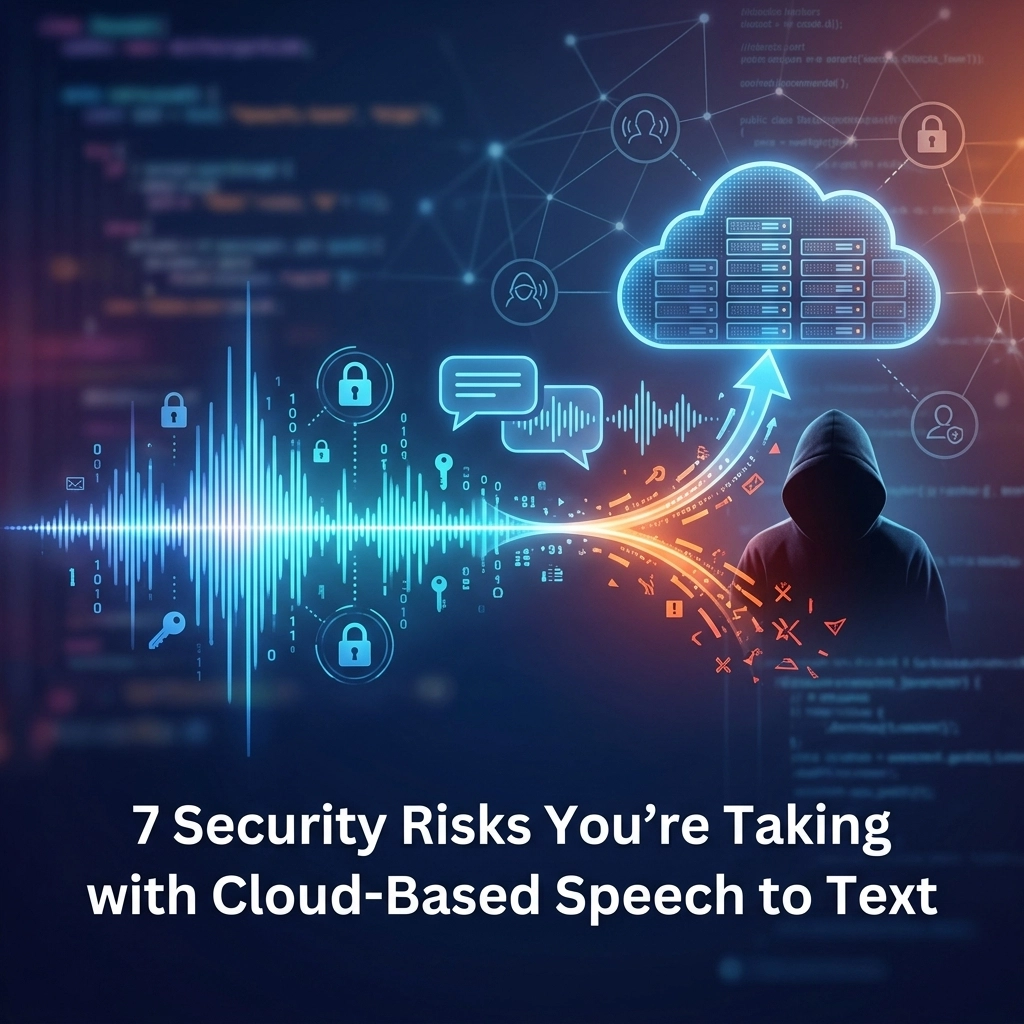
You talk. Your computer listens. Your words appear on the screen. It feels like magic. But behind that magic is a dangerous journey.
Most speech-to-text tools today are built on the cloud. That means every word you say: every confidential strategy, every medical diagnosis, every legal secret: is bundled up and shipped across the internet to a server you don’t own.
You are trading your privacy for convenience. You are renting your productivity. You are taking risks you don’t even see.
Here are the 7 security risks you take every time you hit "record" on a cloud-based transcription service.
1. Data Interception: The Journey is the Trap
When you use a cloud service, your audio doesn't stay on your device. It travels. It moves from your microphone, through your Wi-Fi, across the public internet, and finally into a data center.
Hackers love the journey.
Even with encryption, transmission is a vulnerability. Public Wi-Fi at a coffee shop is a playground for packet sniffing. Older devices with outdated security protocols are easy targets. If a hacker intercepts that data, they don’t just get a file. They get your voice. They get your ideas. They get your identity.
Stop sending your thoughts into the void. Keep them on your machine.
2. Centralized Storage: The Massive Honey Pot
Cloud providers store your data in centralized servers. These servers are massive targets. They are the ultimate "Honey Pot" for cybercriminals.
Think about it. Why would a hacker try to break into your laptop when they can break into a server containing the data of ten million users?
In 2019, researchers found over 7,000 hours of sensitive medical transcriptions exposed on a misconfigured AWS bucket. These weren't just random words. These were private patient details. Names. Histories. Vulnerabilities.
When you use the cloud, you bet your business on someone else’s configuration. One wrong click by a cloud admin and your entire history is public.

3. Continuous Listening: The Uninvited Guest
Many cloud-based systems rely on "wake words." They are always on. They are always listening.
This passive listening leads to the unintentional collection of private conversations. You think you’re having a private chat with a colleague about a sensitive merger. Your device thinks you said its name. Suddenly, your conversation is recorded, uploaded, and stored in the cloud.
You didn’t consent to that. You didn’t intend for that data to leave the room. But once it hits the cloud, you lose control. It’s no longer your conversation. It’s a data point on a server.
4. False Activations: The Ghost in the Machine
Voice recognition isn't perfect. It makes mistakes. It triggers when it shouldn't.
These "false activations" happen more often than you think. A sneeze, a television in the background, or a similar-sounding word can trigger a cloud upload.
Cloud services process this unintended voice data just like any other. They store it. They analyze it. They use it to "improve" their models. This means your most private moments: the things you never intended to dictate: are now part of a corporate database.
5. The Shadow Supply Chain: Who Else is Watching?
When you sign a Terms of Service agreement for a cloud AI, you aren't just trusting one company. You are trusting their entire supply chain.
Most corporations integrate their speech-to-text with third-party services. Your audio might be outsourced to a secondary AI model for "quality assurance." It might be sent to human contractors for "manual review."
Do you know who these people are? Do you know where they are?
Without explicit consent, your voice data is being passed around a marketplace of providers. Every hand that touches your data is a new risk. Every integration is a new hole in your security fence.

6. PII Exposure: The Compliance Nightmare
Personally Identifiable Information (PII) is a liability. If you handle credit card numbers, home addresses, or biometric details, the cloud is a danger zone.
Speech recognition systems often fail to filter out PII during the transcription process. If you dictate a client's banking details and that file isn't properly encrypted on the server, you are one breach away from a lawsuit.
Regulations like HIPAA and GDPR aren't suggestions. They are laws. Many cloud AI services have vague data-handling practices that make compliance impossible. You are responsible for your data. If the cloud provider fails, you pay the price.
7. Unauthorized Access via API Hacks
Cloud-based speech-to-text tools rely on APIs. These are the doors that allow different software programs to talk to each other.
Hackers focus on these doors. If a cloud provider’s API is vulnerable, an attacker can gain unauthorized access to thousands of accounts. They don’t need your password. They just need to exploit the system’s architecture.
Once they’re in, they can siphon off confidential transcripts, identity details, and proprietary business logic. It’s fast. It’s quiet. And by the time you realize it happened, your data is already being sold on the dark web.
The Solution: Go Local or Go Risk
The risks of cloud-based AI are not "bugs." They are features of the architecture. If the data leaves your device, the risk is real.
But there is a better way.
The future of secure professional work isn't in the cloud. It’s local. Local AI is the only way to guarantee 100% privacy.
At VoiceType, we believe your data belongs to you. Not us. Not a cloud provider. You.
Reclaim Your Privacy
Local AI processes everything on your own hardware. Your voice never leaves your laptop. Your words never travel across the internet. There is no transmission risk because there is no transmission.
Own Your Tools
Stop renting your productivity. When you use local software, you own the process. You aren't subject to a cloud provider's downtime, price hikes, or changing privacy policies. It works when you work.
Experience True Speed
Cloud AI is fast, but it’s limited by your internet connection. Local AI is instant. No lag. No "processing" bars. Just pure, immediate productivity.

Why VoiceType?
We built VoiceType for professionals who can’t afford to be careless.
- Zero Cloud Dependency: We don't have servers that store your audio. We don't want them.
- Total Security: Your data stays on your device. Period.
- Professional Grade: Designed for doctors, lawyers, and executives who handle sensitive information daily.
Stop gambling with your intellectual property. Stop letting "big tech" listen in on your brainstorming sessions.
The "Old Way" was slow, risky, and exposed.
The "New Way" is local, secure, and private.
Choose the new way. Reclaim your time. Protect your secrets. Focus on the work, not the risks.
Experience the power of Local AI today.
Visit voicetype.in and take control of your data.
Leave a Reply