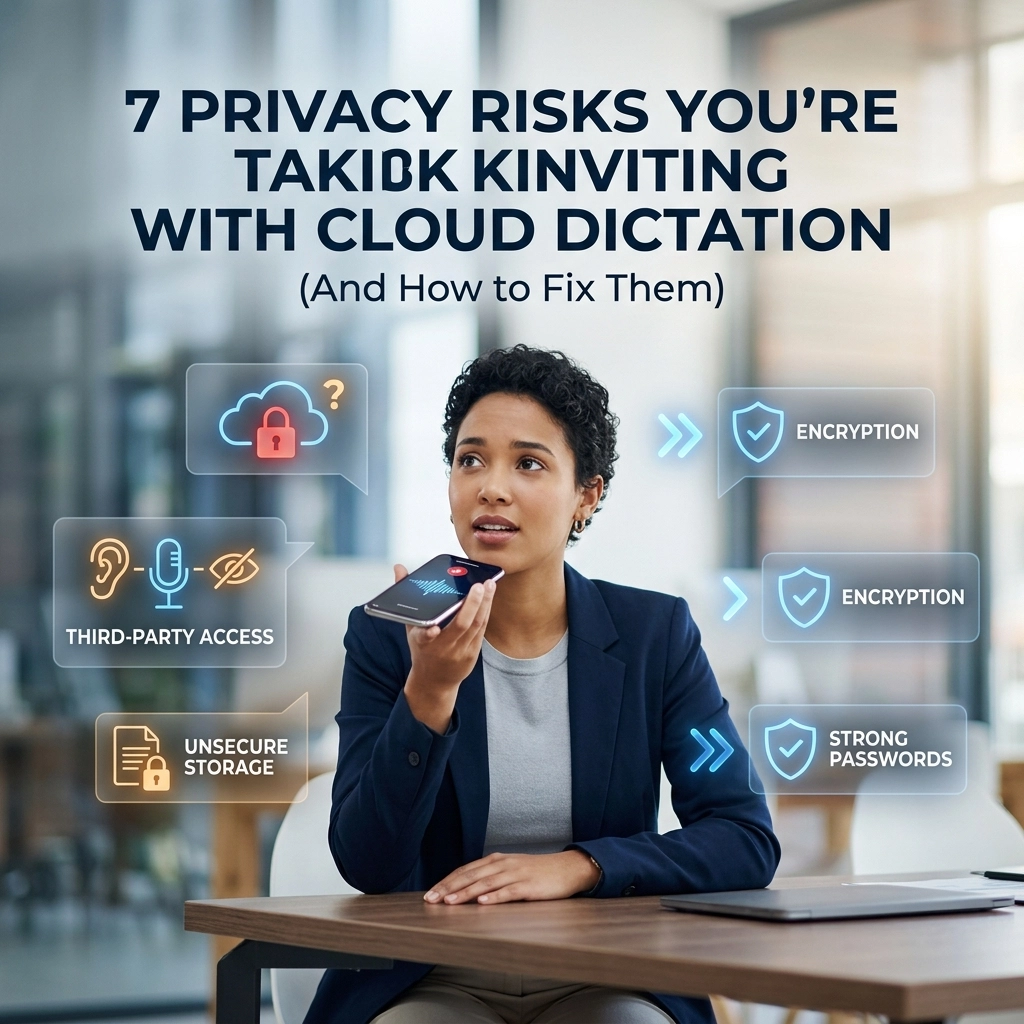
Your voice is a fingerprint. It is unique. It is personal. It is you.
Every time you hit the microphone icon on a standard cloud-based dictation app, you are giving that fingerprint away. You are handing over your thoughts, your business secrets, and your personal life to a server owned by a billion-dollar corporation.
You think it’s convenient. You think it’s "free." It isn't. You are paying with your privacy.
Cloud dictation is a security hole. It is a slow leak in the hull of your digital ship. If you don't plug it, you will sink.
Here are the 7 privacy risks you are taking right now and exactly how to fix them.
1. The Interception Point
When you speak into a cloud-based app, your audio doesn't stay on your phone. It turns into a data packet. It travels through your router. It bounces through your ISP. It lands on a server miles away.
This is the "In-Transit" danger.
Public WiFi is a playground for hackers. They use man-in-the-middle attacks to snatch those data packets out of the air. Even with basic encryption, sophisticated attackers can scrape your audio before it’s secured or right after it’s decrypted for processing.
The Fix: Stop sending audio over the internet. Use local AI. When your speech is processed on your own hardware, there is nothing to intercept. There is no wire to tap.
2. Indefinite Data Storage
Big Tech loves your data. They want to keep it forever.
By default, most cloud services store your voice recordings indefinitely. Google, for example, lets you set auto-delete for 3, 18, or 36 months. But think about that. Even at the minimum, your private conversations are sitting on a server for 90 days.
That is a 90-day window for a data breach to occur. That is a 90-day window for a rogue employee to listen. That is a 90-day window where you do not own your words.
The Fix: Audit your settings immediately. Go to your activity controls and set the shortest possible retention period. Better yet, switch to a tool that never stores your data in the first place because it never sees it.

3. The "Silent" Transmission
You think you know when you’re being recorded. You hit a button. You see a glowing light.
Research suggests otherwise. Studies on Siri revealed that messages dictated for WhatsApp or iMessage are often sent to servers even when it isn't necessary for the task. You have zero control over what is transmitted or when.
You are talking to your spouse. You are discussing a sensitive legal matter. You are venting about a boss. If that microphone is "primed," your data is moving.
The Fix: Revoke "Always Listening" permissions. Don't let your device wait for a "Hey" or a "Wake" word. It’s a constant drain on your privacy.
4. Metadata Leakage
It’s not just what you say. It’s the context around it.
When you dictate to the cloud, the system sends a mountain of metadata along with your audio. They know which apps you have installed. They know your device name. They know your contact info. They even know the names of other people in your household.
This metadata builds a profile. It turns a simple text message into a deep map of your life.
The Fix: Use a minimalist utility. You don't need a "smart assistant." You need a tool that does one thing: turns speech into text. Nothing more. No metadata. No profiling.
5. The Single Point of Failure: Your Account
Your voice data is tied to your account. Your account is tied to your password.
If your password is breached: and 24% of users experienced some form of account compromise in 2023: your entire history of voice recordings is wide open. A hacker doesn't just get your emails; they get the sound of your voice.
They can hear your tone. They can learn your patterns. They can use that audio to fuel AI-generated voice clones for social engineering attacks.
The Fix: Enable Two-Factor Authentication (2FA) on everything. If you don't have 2FA, you don't have security. But more importantly, stop storing voice data in the cloud. If there is no data to steal, a breached account is less of a catastrophe.

6. The Leaky Bucket of Third-Party Apps
You download a productivity app. You give it permission to use "Voice Recognition."
You just opened a back door.
Research shows that 43% of apps with voice features have at least one high-risk security vulnerability. These apps often use third-party libraries that funnel your audio to unknown servers. You think you’re talking to "NoteApp," but you’re actually talking to a data broker in a country with zero privacy laws.
The Fix: Audit your app permissions today. If an app doesn't need your voice to function, kill the permission. Be ruthless.
7. The Compliance Nightmare
Are you a doctor? A lawyer? A financial advisor?
If you use consumer-grade cloud dictation, you are likely violating HIPAA, GDPR, or SOC 2 regulations. Most standard voice services are not compliant. Dictating sensitive patient info or client secrets into a standard smartphone is professional malpractice.
One leak can end a career. One breach can lead to a multi-million dollar fine.
The Fix: Use professional-grade, local-first software. Ensure your tools are designed for privacy, not just "convenience."

The Old Way vs. The New Way
The "Old Way" is the Cloud Way. It is slow. It is risky. It relies on a "rented" AI that lives in a data center. When the internet goes down, your productivity stops. When the server gets hacked, your privacy dies.
The "New Way" is Local AI.
At VoiceType, we believe your data belongs to you. Not us. Not Big Tech.
We built VoiceType to be a silent, powerful utility. It lives on your device. It processes your speech using your hardware.
Why Local AI is the Only Fix
- Zero Latency: You don't have to wait for a signal to travel to a server and back. It is instant.
- Total Privacy: Your audio never leaves your machine. It is never stored on a server. It is never sold to advertisers.
- Works Offline: You can dictate in a basement, on a plane, or in a remote cabin. You don't need a connection to be productive.
- No Subscriptions to Privacy: You own the tool. You own the results.
Take Back Your Privacy
Stop being a product. Start being a user.
The risks of cloud dictation are real, documented, and dangerous. But the solution is simple. You don't have to stop dictating; you just have to stop sending your voice to the cloud.
Reclaim your time. Reclaim your privacy. Reclaim your workflow.

Immediate Action Plan:
- Delete your voice history from Google and Apple accounts.
- Turn off "Always Listening" features on your smartphone.
- Switch to a local AI dictation tool like VoiceType.
- Encrypt your local storage to ensure that even if your device is stolen, your data remains yours.
The cloud is a choice. Today, choose better.
Direct. Fast. Private. That is the VoiceType promise.
Stop talking to the cloud. Start talking to your computer.
Get started with local AI at voicetype.in.
Leave a Reply