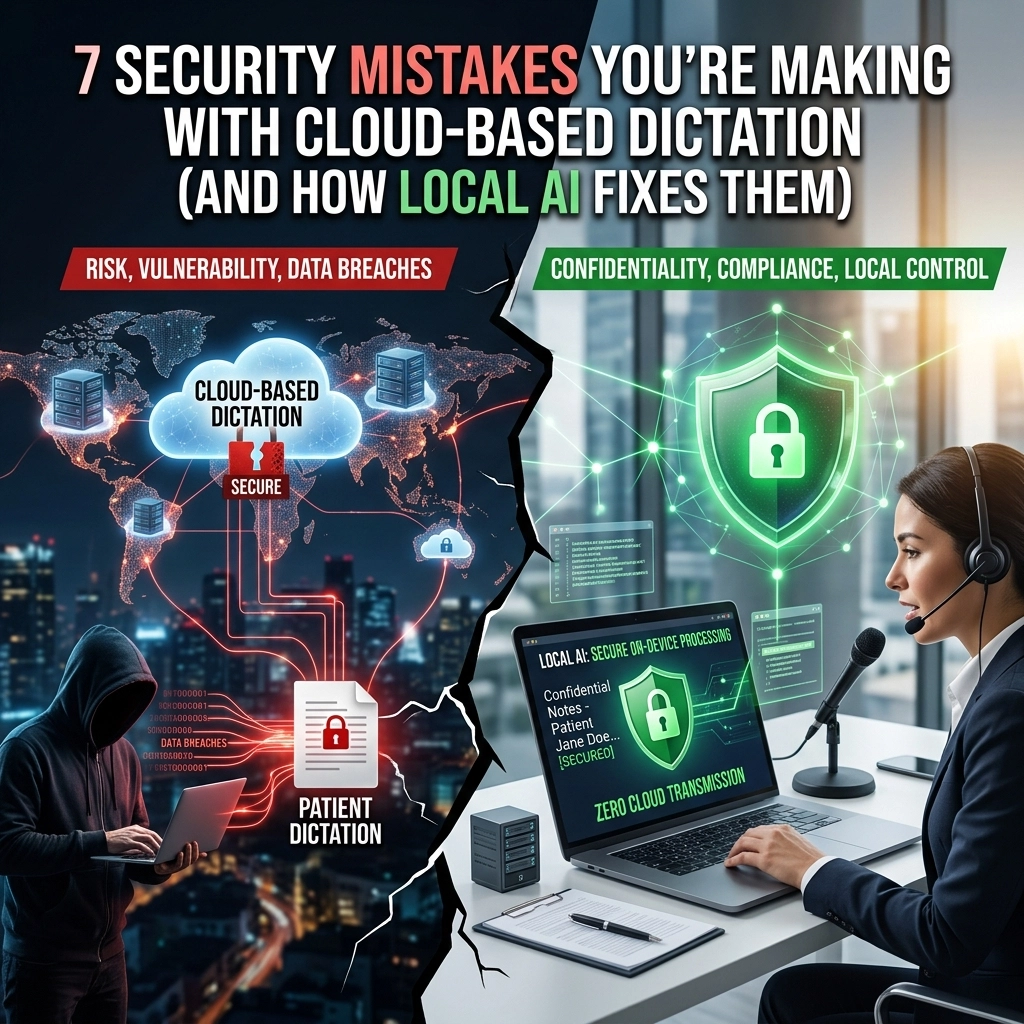
Security is not an afterthought. It is the foundation. In the world of IT and security, you know that every connection is a vulnerability. Every byte sent over the wire is a risk. Yet, every day, your organization leaks sensitive data through a tool you likely overlook: cloud-based dictation.
You think it is harmless. You think it is just "speech-to-text." You are wrong. Cloud dictation is a massive, gaping hole in your security posture. You are streaming raw, unencrypted thoughts, trade secrets, and PII directly to servers you do not control.
Stop the leak. Reclaim your privacy.
Here are the 7 security mistakes you are making with cloud-based dictation: and why moving to local AI is the only professional choice.
1. The "In-Flight" Fallacy
You trust TLS. You trust SSL. You believe that because the data is encrypted during transit, it is safe. This is a dangerous mistake.
Encryption in transit only protects data from the person sitting next to you at the coffee shop. It does not protect it from the provider on the other end. When you use a cloud tool, you hand over the keys to the kingdom. The provider decrypts your audio to process it. For a split second, your most confidential data exists in plain text on a third-party server.
If that provider is compromised, you are compromised. If their API has a leak, your data is gone.
The Local Fix: Eliminate the "flight." Data that never leaves the machine cannot be intercepted. Local AI, like VoiceType, processes audio on the device's silicon. No transit. No middleman. No risk.

2. Relinquishing the Chain of Custody
Security professionals live and die by the chain of custody. You need to know where data lives, who accessed it, and when it was destroyed.
Cloud dictation shatters this chain. Once the audio hits the cloud, you lose visibility. You do not know which data center is hosting it. You do not know which sub-processor has access to it. You cannot verify that the data was actually deleted when you clicked "trash."
You are renting security on someone else’s terms. That is not security. That is a leap of faith.
The Local Fix: Maintain absolute ownership. With local AI, your audio files and transcripts stay in your specified directories. Your existing EDR and DLP tools can monitor them. You own the infrastructure. You own the data.
3. The Silent Training Leak
This is the biggest threat you haven't considered. Most cloud-based AI providers use your data to "improve their models."
Every time your CEO dictates a strategy memo, or your developers dictate code comments, you are training someone else's AI. Your proprietary IP is being ingested, tokenized, and potentially spit back out to a competitor through a generative AI prompt.
You are paying a subscription fee to give away your intellectual property. It is the worst trade-off in corporate history.
The Local Fix: Air-gapped intelligence. Local AI models are static. They work for you, not for the provider. They do not "learn" from your sensitive data. They perform the task and forget the input. Your secrets remain yours.
4. Compliance Nightmares and "Audit Ghosting"
Try passing a HIPAA, SOC2, or GDPR audit when your employees are using browser-based dictation tools.
Auditors ask for logs. They ask for physical data location. Cloud providers give you generic white papers and "trust centers." They won't give you the granular logs you need for a specific user at a specific time. You are left holding a bag of "we think it's secure."
This "audit ghosting" leaves your organization vulnerable to massive fines and legal liability.
The Local Fix: Full auditability. Because the AI runs locally, every action is logged within your controlled environment. You can prove compliance because you have the logs on your own servers. You don't need to ask permission to see your own data.

5. Dependency as a Security Risk
Uptime is a security metric. If your team relies on dictation for documentation and the cloud provider goes down, your workflow breaks.
But there is a deeper risk: The "Phone Home" vulnerability. Many cloud tools require a constant heartbeat to a central server. If that server is hijacked, your local application could be instructed to download a malicious update or exfiltrate data.
You are tethered to a remote entity that you cannot vet in real-time.
The Local Fix: True autonomy. Local AI works in airplane mode. It works in a basement. It works in a high-security SCIF. No heartbeat required. By cutting the cord, you remove an entire class of remote execution vulnerabilities.
6. The Shadow IT Proliferation
When IT doesn't provide a secure, powerful tool, employees find their own.
Your staff is already using dictation. They are using free browser extensions. They are using built-in mobile tools. They are using unvetted web apps. This is Shadow IT in its most invisible form. You cannot block what you cannot see, and you cannot see the audio streams leaving your network.
Every employee with a microphone is a potential data egress point.
The Local Fix: Provide a superior local alternative. Employees use cloud tools because they are easy. Give them a local tool that is faster, more accurate, and doesn't require a login. When the secure way is the easiest way, Shadow IT vanishes.

7. The Subscription Ransom
Cloud tools are "rented." You pay every month for the privilege of accessing the AI.
From a security and business continuity perspective, this is a liability. If the provider raises prices, you pay. If they change their Terms of Service to be more invasive, you have to accept it or lose your workflow. If they go bankrupt, your data and your productivity die with them.
You have no leverage. You have no control.
The Local Fix: Software as a utility. Local AI should be a tool you own, not a service you lease. Position your organization to be independent of the "SaaS tax." Buy the capability, install it, and use it forever.
Why Local AI is the Standard for 2026
The era of "Cloud First" is being replaced by "Security First."
For IT and Security professionals, the choice is binary. You can continue to stream your organization's voice data into the cloud and hope for the best. Or, you can bring the intelligence to the edge.
VoiceType is designed for this exact shift. We don't want your data. We don't want your audio. We want you to have the most powerful dictation tool on the planet, running entirely on your hardware.
The Numbers Don't Lie
- 0 KB: The amount of data VoiceType sends to the cloud.
- 100%: Your ownership of the transcripts and audio.
- <10ms: The latency of local processing compared to cloud round-trips.
- Zero: The number of third-party breaches that can affect your local installation.

Take Action Now
Stop the leakage. Audit your dictation tools today. Look at the network logs. See where those audio packets are going.
If they are leaving your building, you have a problem.
Local AI is not just a feature; it is a defensive strategy. It is the only way to ensure that what is spoken in your office, stays in your office.
Reclaim your privacy. Secure your workflow. Switch to local.
Explore the future of secure productivity at voicetype.in. Check our sitemap for more industry deep dives on AI security.
VoiceType: Local AI. Absolute Security. Direct Results.
Leave a Reply