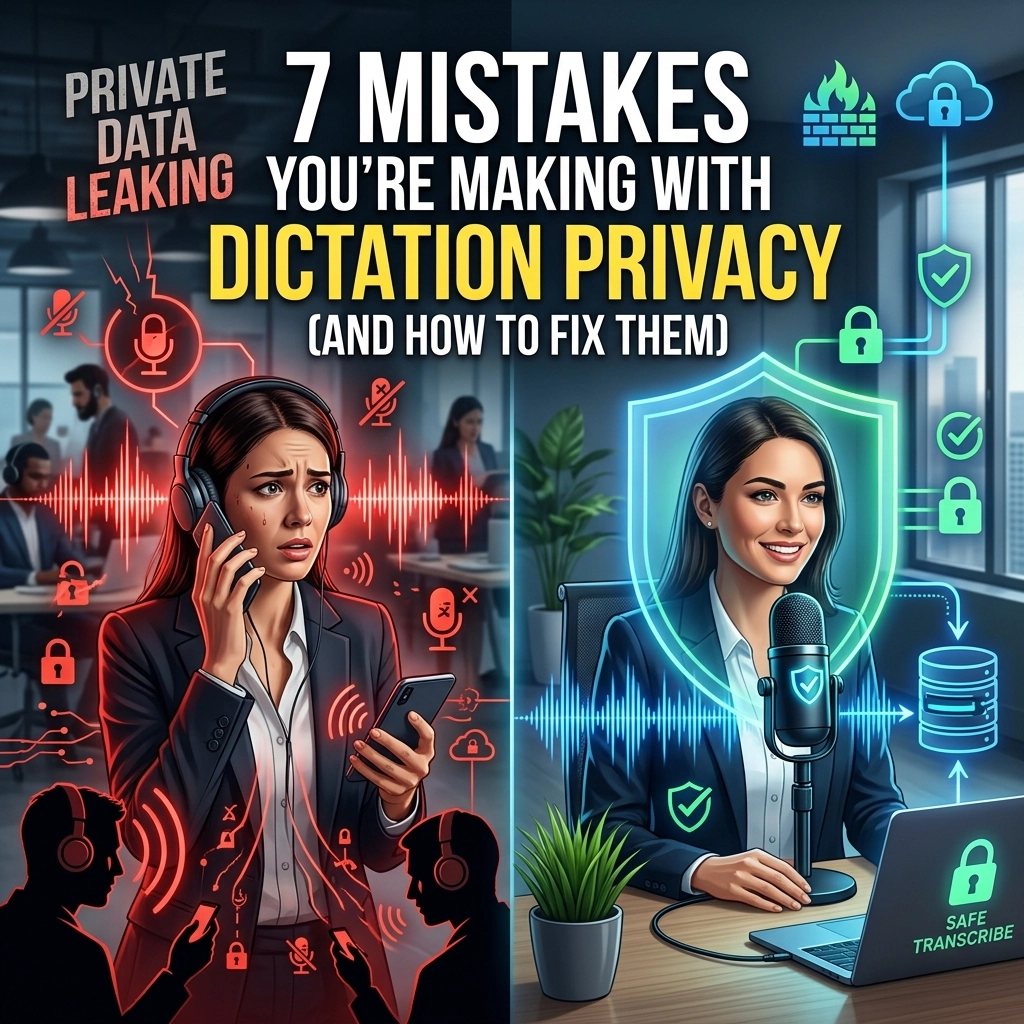
Privacy is a myth in the modern office. You think your dictation tools are private. You think your thoughts are your own. You are wrong. Every time you hit record on a standard cloud-based tool, you are handing over your intellectual property. You are mailing a postcard to a stranger. You are inviting a thousand sets of eyes into your boardroom.
Professionals handle sensitive data. Lawyers handle privilege. Doctors handle patient secrets. Executives handle trade secrets. Yet, most of these professionals use tools that treat privacy as an afterthought. They prioritize convenience over security. They prioritize the "cloud" over control.
It is time to stop. It is time to reclaim your data. It is time to move offline.
Here are the seven critical mistakes you are making with dictation privacy and exactly how to fix them.
1. You Trust the Cloud
The "Cloud" is just someone else’s computer. This is the biggest lie in tech. When you use a cloud-based dictation tool, your audio leaves your device. It travels across the internet. It lands on a server owned by a corporation.
You no longer own that audio. You are renting access to it. If their server is hacked, your data is gone. If their employees are curious, your data is read. If their business model changes, your data is sold.
The Fix: Go 100% Offline.
Stop sending your voice to servers. Use tools that process every syllable locally. If the data never leaves your laptop, it can never be intercepted. This isn't just a feature. it is a fundamental requirement for professional integrity. VoiceType ensures your data stays on your machine. Period.

2. You Ignore the "Human-in-the-Loop"
Read the fine print. Most major dictation providers include a clause about "improving service quality." This is code for human review.
Anonymized or not, your audio is being heard by contractors. These are people in cubicles halfway across the world. They hear your legal strategies. They hear your financial forecasts. They hear your patient's most intimate health struggles. They are "labeling" data to train the next model. You are paying them to let their staff eavesdrop on you.
The Fix: Eliminate the Middleman.
Demand tools that do not use human verification. If a tool requires an internet connection to function, assume a human could eventually hear your audio. True privacy means the only "intelligence" touching your files is the silicon in your processor.
3. You Fall for "Security Theater"
Encryption is the industry's favorite buzzword. They tell you your data is "encrypted at rest" and "encrypted in transit." This sounds safe. It isn't.
Encryption only matters if you hold the keys. In a cloud environment, the provider holds the keys. They have to. They need to unlock your audio to transcribe it on their servers. If they can unlock it, so can a rogue employee. So can a government agency with a subpoena. So can a sophisticated hacker.
The Fix: Local Processing Only.
Encryption is irrelevant when the data never leaves your sight. When you process audio locally, your device is the vault. No keys are shared. No doors are left unlocked. You are the only one with the combination.

4. You Enable "Product Improvement" Settings
Check your settings right now. Look for "Help us improve," "Analytics," or "Share Audio Data." These are dark patterns. They are designed to trick you into donating your proprietary information to the provider's R&D department.
Once you toggle these on, your voice becomes training data. Your unique insights are used to build products for your competitors. You are essentially working for the software company for free, and you are paying them for the privilege.
The Fix: Opt-Out is Not Enough. Use Opt-None.
Choose software that doesn't even have an "improvement" toggle. Your workflow should be a closed loop. A professional tool should be a silent utility that does its job without asking for feedback or data donations.
5. You Rely on Subscription-Based "Ownership"
Subscriptions are a trap for your data. When you pay monthly for a cloud service, your history is held hostage. If you stop paying, you lose access to your archives. More importantly, the provider has a continuous, live connection to your device.
This connection is a vulnerability. It is a persistent pipe that can leak metadata, location data, and usage patterns. A subscription model is a "lease" on your own productivity.
The Fix: Own Your Software.
Buy tools that work without a recurring tether to a mother ship. Software should be a tool you own, not a service you rent. When you own the software and it runs offline, you control the lifecycle of your information. You decide when it is deleted. You decide where it is stored.

6. You Mistake "Free" for "Safe"
If you aren't paying for the product, you are the product. We have known this for a decade, yet professionals still use free web-based dictation tools.
Free tools exist to harvest data. They capture your voice patterns, your vocabulary, and your most frequent topics. This data is the most valuable asset in the AI age. Giving it away for free is not just a security risk; it is a business failure. You are leaking your competitive advantage one "free" transcription at a time.
The Fix: Pay for Privacy.
Invest in professional-grade software. Real privacy costs money to build. It requires high-performance local AI models. It requires a business model that doesn't rely on data mining. Pay for your tools so you don't have to pay with your reputation. Explore the sitemap to see how professional tools are structured.
7. You Ignore the Metadata Trail
Privacy isn't just about the words you say. It is about when you say them, where you are when you say them, and how long you speak.
Cloud tools track all of this. They know you were working on a merger at 2:00 AM on a Sunday. They know you were at a specific hospital when you dictated that note. This metadata paints a picture of your life and your business. It is a breadcrumb trail for anyone who wants to track your movements or your work habits.
The Fix: Cut the Cord.
Total privacy requires an air gap. When you work offline, there is no metadata trail sent to a server. There is no IP address logged. There is no timestamp recorded in a remote database. You become invisible. You become secure.

The Only Real Solution: VoiceType
The mistakes listed above are not accidental. They are the business model of the "Big Tech" status quo. They want your data. They want your connection. They want your recurring payments.
Professionalism requires a different path. It requires a tool that respects the boundary between your work and the world.
VoiceType is that tool.
We built VoiceType for the skeptics. We built it for the professionals who cannot afford a leak. We built it for the people who value their time and their privacy equally.
- 100% Offline: No audio ever leaves your computer. No internet required.
- Local AI: We use the power of your own hardware to turn speech into text.
- Zero Data Harvesting: We don't want your data. We couldn't take it even if we wanted to.
- Direct Output: Dictate directly into any application. No copy-pasting. No middleman.
Stop compromising. Stop making excuses for tools that don't respect you. The fix is simple. Stop sending your voice to the cloud. Start using VoiceType.
Reclaim your privacy. Reclaim your productivity. Reclaim your peace of mind. The era of cloud-based eavesdropping is over for those who choose a better way.
Direct. Fast. Private. That is the VoiceType promise.
Fix your privacy today.
Leave a Reply