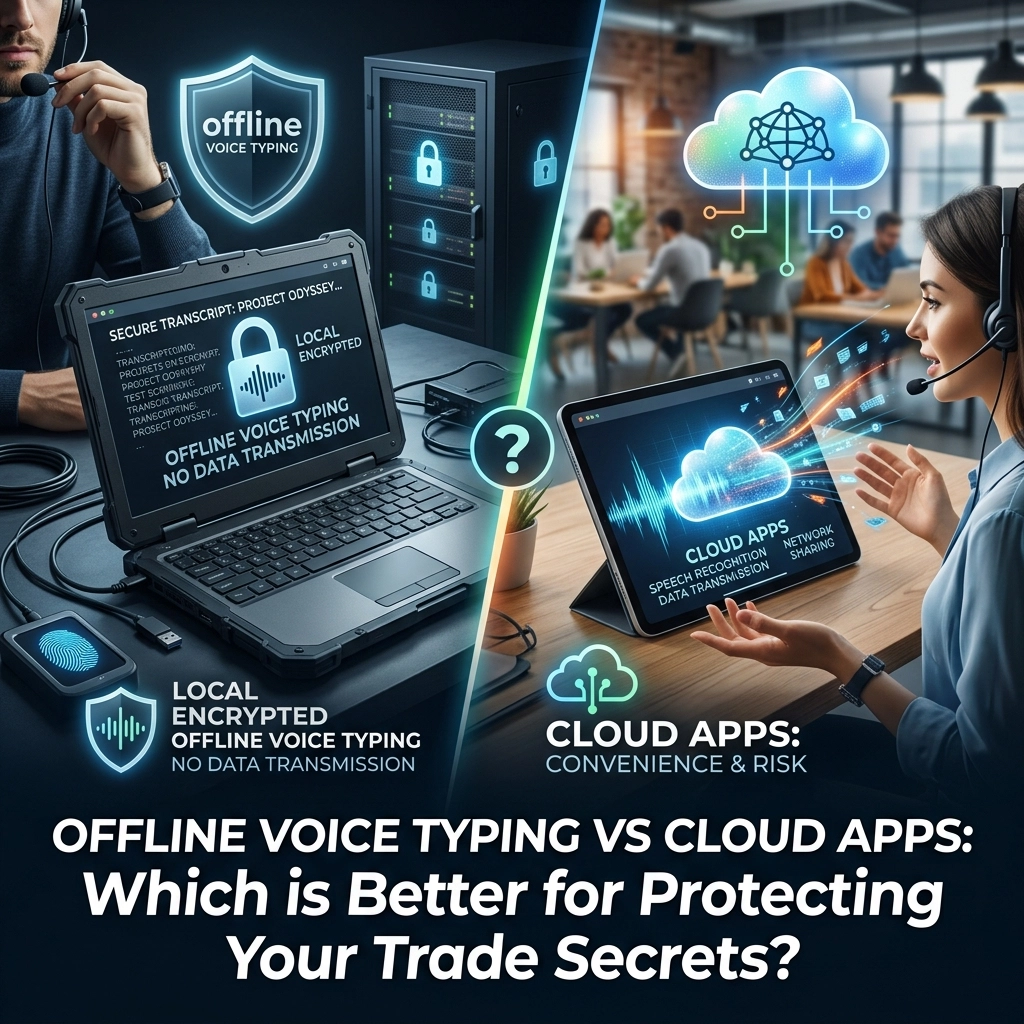
Stop talking to the cloud. It is listening. It is recording. It is owning your ideas.
Every time you hit the dictation button on a standard cloud-based app, you are making a choice. You are choosing convenience over ownership. You are choosing speed over security. For most people, that is a fair trade. For you, it is a liability.
If you are a lawyer, a hedge fund manager, or a surgeon, your words are your wealth. Your trade secrets: the strategies, the patient data, the M&A whispers: are the foundation of your business. In the modern world, your voice is data. And data is the most valuable commodity on earth.
Cloud-based voice typing apps are a sieve. They leak. They store. They analyze. They are built to harvest your information to "train models" or "improve services." In plain English: they use your proprietary thoughts to build their product.
Offline voice typing is the only solution. It keeps your data on your device. It never touches a server. It belongs to you.

The Cloud Trap: Your Voice is Not Your Own
Cloud apps operate on a simple principle: your device is a dummy terminal. When you speak, your audio is compressed and sent across the internet to a massive data center. There, a powerful server processes the audio and sends the text back to you.
It feels instant. It feels magic. It is actually a massive security risk.
When your audio leaves your device, you lose control. You are relying on the cloud provider’s encryption. You are trusting their employees. You are gambling on their server security.
Think about what happens to that audio once it reaches the server. Cloud providers often retain "snippets" of audio to improve their AI. They use human contractors to review transcriptions for accuracy. In 2019, major tech companies were caught using third-party contractors to listen to private voice recordings. These contractors were hearing medical records, criminal dealings, and intimate conversations.
If you are dictating a trade secret, you just shared that secret with a stranger in a cubicle halfway across the world.
The Legal Cliff: The Third-Party Doctrine
Privacy is not just a feeling. It is a legal status. In many jurisdictions, including the US, the "Third-Party Doctrine" dictates that you lose a "reasonable expectation of privacy" for information you voluntarily share with a third party.
When you use a cloud-based dictation app, you are sharing your audio with the app provider. Legally, this can weaken your claim that the information is a "trade secret." To qualify for trade secret protection, you must demonstrate "reasonable efforts" to keep the information confidential.
Using a public cloud to process a billion-dollar merger strategy is not a reasonable effort. It is negligence.
If your trade secret is leaked and you try to sue, the defense will ask a simple question: "Why did you send this information to a third-party server without a specific confidentiality agreement?" If you can’t answer that, your case is dead.
Offline dictation solves this. Because the data never leaves your hardware, the "Third-Party Doctrine" never applies. You maintain total control. You maintain total privacy. You maintain your legal standing.

Industry Deep Dive: The Legal Sector
Lawyers live and die by attorney-client privilege. It is the bedrock of the profession. Cloud dictation puts that privilege in jeopardy.
Imagine you are dictating a sensitive defense strategy for a high-profile criminal case. You use a standard cloud app on your smartphone. That audio is now on a server owned by a multi-billion dollar corporation. That corporation is subject to subpoenas. That corporation has terms of service that allow them to process your data.
You have just introduced a third party into a privileged conversation. You have created a digital trail that can be discovered.
Legal professionals require a "Zero-Trust" environment. You should not trust the cloud. You should not trust the internet connection. You should only trust the device in your hand. Offline voice typing allows you to dictate briefs, memos, and case notes with the absolute certainty that no one else is listening.
Protect your privilege. Keep your files local. Use VoiceType to ensure your work stays between you and your client.
Industry Deep Dive: The Finance Sector
In finance, information is the only edge that matters. A leaked M&A rumor can shift markets in seconds. A proprietary trading algorithm is worth billions.
Financial professionals are frequent targets of corporate espionage and sophisticated hacking attempts. Cloud servers are high-value targets. Your local device is not. By moving your dictation offline, you remove the biggest attack vector: the internet.
Think about your daily workflow:
- You dictate a memo about a pending acquisition.
- The cloud app processes it.
- The text is stored in the cloud.
- You sync it to your laptop.
In this "old way," your trade secret has lived on three different servers and crossed the internet twice.
In the "new way" with offline typing:
- You dictate the memo.
- Your device processes it.
- The text stays on your device.
Zero internet. Zero servers. Zero risk.

Industry Deep Dive: Healthcare
Healthcare is facing a new crisis: the rise of biometric data harvesting. Under frameworks like GDPR and HIPAA, your voice is no longer just "audio." It is "biometric personal information." It is as unique as a fingerprint.
When healthcare providers use cloud dictation for patient notes, they are transmitting biometric data. If that data is breached, the penalties are catastrophic. HIPAA fines can reach millions of dollars. The loss of patient trust is immeasurable.
Furthermore, cloud providers often disclaim liability for data disclosure in their fine print. They provide the service, but you carry the risk.
Offline voice typing is the only way to guarantee HIPAA compliance for voice data. If the data never leaves the hospital-issued tablet or the doctor’s workstation, it cannot be intercepted. It cannot be leaked from a central server. It remains a private interaction between a doctor and a patient.
The Performance Edge: Speed and Reliability
Privacy is the primary benefit, but it isn't the only one. Offline voice typing is faster.
Cloud apps are at the mercy of your internet connection. If you are in a basement office, a hospital wing with thick walls, or a plane, your dictation will lag. It will fail. You will see the dreaded "connecting…" spinner while your thoughts vanish.
Offline voice typing uses the power of your device’s processor. It is instant. There is no latency because there is no distance for the data to travel. You speak, and the words appear.
Stop renting your productivity from cloud providers. Reclaim your time. Reclaim your speed.

Why VoiceType is the Silent Powerhouse
We built VoiceType because we believe your thoughts should remain yours. We don't want your data. We don't want to "train our models" on your legal briefs or your financial strategies.
We provide a utility. A silent, powerful tool that lives on your device and works without an internet connection.
- No Servers: Your audio stays on your hardware.
- No Subscriptions to Privacy: You own the tool; you aren't the product.
- No Compromise: You get the accuracy of modern AI with the security of an air-gapped safe.
The status quo is risky. It is slow. It is outdated. The "Cloud-First" era has turned professionals into data sources for tech giants. It is time to move back to a "Privacy-First" workflow.
Take Back Control
You wouldn't leave your trade secrets printed on a table in a public park. Why are you sending them to a public cloud?
The choice is simple. You can continue to trust corporations that profit from your data, or you can trust yourself. You can keep hoping the next big data breach doesn't involve your voice, or you can ensure it never does.
Protect your business. Protect your clients. Protect your future.
Switch to offline voice typing today. Explore how VoiceType can secure your workflow.
For a full list of our features and how we handle data, view our sitemap.
The cloud is for weather. Your secrets belong on the ground.
Leave a Reply