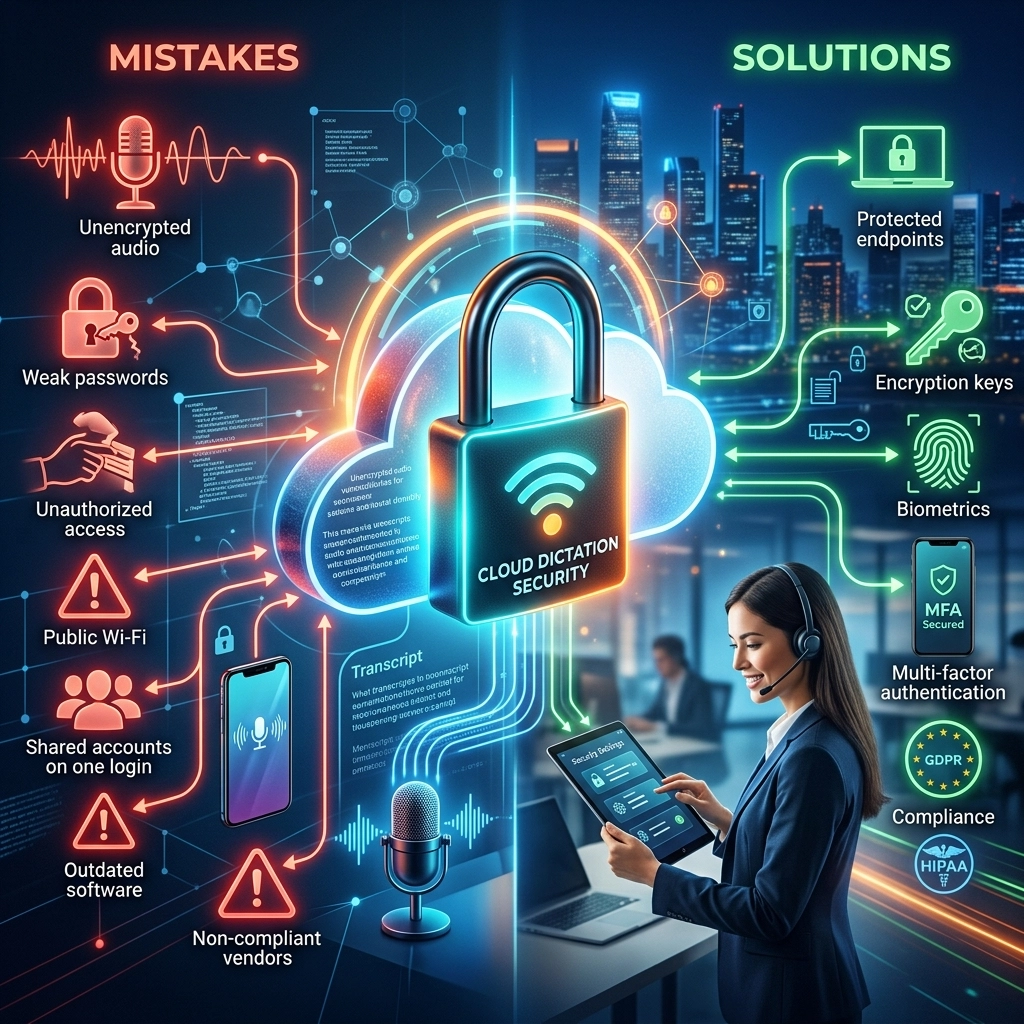
Your voice is your most private data. You use it to dictate emails, legal briefs, medical notes, and business strategies. You think you are being productive. You are actually leaking secrets.
Most dictation tools are "cloud-based." That is a polite way of saying your data lives on someone else’s computer. If you care about your privacy, you are making mistakes right now.
Stop compromising. Start securing. Here are the seven security mistakes you are making with cloud dictation and the definitive way to fix them.
1. You Think "Encryption" Means "Privacy"
Most cloud services boast about AES-256 encryption. They tell you your data is safe "in transit" and "at rest." This is a half-truth.
Encryption protects you from a hacker intercepting the file. It does not protect you from the company providing the service. If they hold the keys, they can see your data. If a government subpoenas them, they hand over your transcripts. If an employee goes rogue, your private thoughts are exposed.
The Fix: Stop Transmitting Data.
The only way to ensure 100% privacy is to keep the data on your machine. Do not send it to the cloud. Use a local AI solution like VoiceType that processes every syllable on your own hardware. No transmission means no interception. No keys held by third parties means no unauthorized access.
2. You Haven't Read the "Data Improvement" Clause
Read the fine print. Most "free" or subscription-based cloud dictation tools include a clause that allows them to use your data to "improve their machine learning models."
This means your private client data is being fed into a massive neural network. Your proprietary trade secrets are helping a trillion-dollar company train its next algorithm. You are paying them to take your data. You are the product, and your voice is the raw material.

The Fix: Own Your Model.
Switch to a tool that doesn't "learn" from you on a central server. Local AI models stay static or update via official patches without ever sucking up your personal input. You own the output. You own the process. You own the privacy.
3. You Are Vulnerable to Man-in-the-Middle Attacks
Every time your voice travels from your microphone to a cloud server, it takes a journey. It passes through your router, your ISP, and various data centers. Even with encryption, metadata is leaked. Sophisticated attackers can see when you are dictating, how long you are dictating, and where you are sending that data.
This is a massive footprint. It creates a surface area for attack that shouldn't exist.
The Fix: Shrink the Attack Surface to Zero.
When you dictate locally, the journey is two inches long. It goes from your microphone to your CPU. That’s it. There is no "middle" for a man-in-the-middle attack. You eliminate the network as a variable. You become a ghost to the internet.
4. You Trust Human Reviewers (By Accident)
"Quality Control" is the industry’s favorite euphemism. To make their AI better, many cloud companies employ thousands of low-wage contractors to listen to "randomly selected" audio snippets. They do this to check if the AI got the words right.
Your "private" dictation could be playing in a cubicle halfway across the world. There is no way to opt out that is truly ironclad once the data leaves your device.
The Fix: Human-Free Processing.
Use a system that never involves a third party. Local AI like VoiceType is a closed loop. There are no contractors. There is no quality control department listening to your brainstorms. It is just you and your computer. Total silence. Total security.
5. You Are Renting Your Security
Subscription models are a security risk. If your subscription lapses, do you lose access to your archives? If the company goes bankrupt, where does your data go? If their servers go down, can you still work?
Cloud dictation makes you a tenant. You are at the mercy of the landlord's security updates and business health. If they fail, your security fails.

The Fix: Buy the Tool, Keep the Security.
Invest in software that runs independently of a monthly check-in. Local AI is a utility you own. It works offline. It works forever. It doesn't matter if the company exists in ten years; the code is on your machine, and your data stays in your folder.
6. You Ignore the "Cloud Leak" Probability
It is not a matter of if a major cloud provider will have a data breach. It is a matter of when. Large databases are magnets for state-sponsored hackers and cybercriminals. A single vulnerability in a cloud provider’s API can expose millions of transcripts in seconds.
You are betting your career on the perfection of a third-party IT team.
The Fix: Decentralize Your Risk.
Hackers don't target individual laptops to find dictation files; they target massive central servers where the "gold" is. By keeping your data local, you become an uninteresting target. You are not part of a giant database. You are a single, locked door in a world of open warehouses.
7. You Are Sacrificing Speed for "Convenience"
Cloud dictation feels convenient until the Wi-Fi drops. Or until the latency slows your typing to a crawl. You think you are using the cloud for power, but modern CPUs and GPUs are more than capable of running world-class AI locally.
The "mistake" here is believing that the cloud is faster. It isn't. The round-trip to a server in Virginia or Singapore adds seconds to every sentence.

The Fix: Use Local Power.
VoiceType uses your computer’s own hardware to turn speech into text instantly. There is no lag. There is no "connecting…" spinner. It is raw, local performance. You get better security and better speed simultaneously.
Reclaim Your Privacy Today
The old way of dictating is broken. It is slow, it is risky, and it is invasive. You have been trained to think that the cloud is the only way to get high-quality AI. You were told a lie.
Local AI has arrived. It is faster. It is smarter. Most importantly, it is private.
Stop sending your voice into the void. Stop letting corporations "improve" themselves on your dime. Take control of your data.
How to fix everything at once:
- Uninstall cloud-dependent dictation apps.
- Clear your browser cache of any web-based recorders.
- Download a local AI solution.
- Turn off your Wi-Fi and try to dictate. If it doesn't work, you aren't secure.
With VoiceType, it always works. Because the power stays with you.
Check our sitemap for more guides on how to optimize your workflow without selling your soul to the cloud. It’s time to dictate with confidence. It’s time to go local.
Your words. Your computer. Your business. Keep it that way.
Leave a Reply